Sahyadria chalakkudiensis
概要
| 字段 | 值 |
|---|---|
| 类别 | 鱼 |
| 学名 | Sahyadria chalakkudiensis |
| 别名 | Puntius chalakkudiensis |
| 分类 | 鲤形目 Cypriniformes › 鲤科 Cyprinidae › Sahyadria |
| 水体 | 淡水 |
| 原产地 | 印度 |
| 成体体长 | 12.5 cm |
| 饲养难度 | 中等 |
| 最小水体 | 243 L |
| 最小缸长 | 120 cm |
| 群居方式 | 群游 |
| 外部数据 | seriouslyfish sahyadria-chalakkudiensis;fishbase 59835 |
| 食性 | 杂食 |
水质参数
| 参数 | 耐受范围 | 最适范围 | 单位 |
|---|---|---|---|
| 水温 | 15–25 | — | °C |
| pH | 6.5–7.5 | — | — |
| 总硬度 | 5–20 | — | dGH |
概述
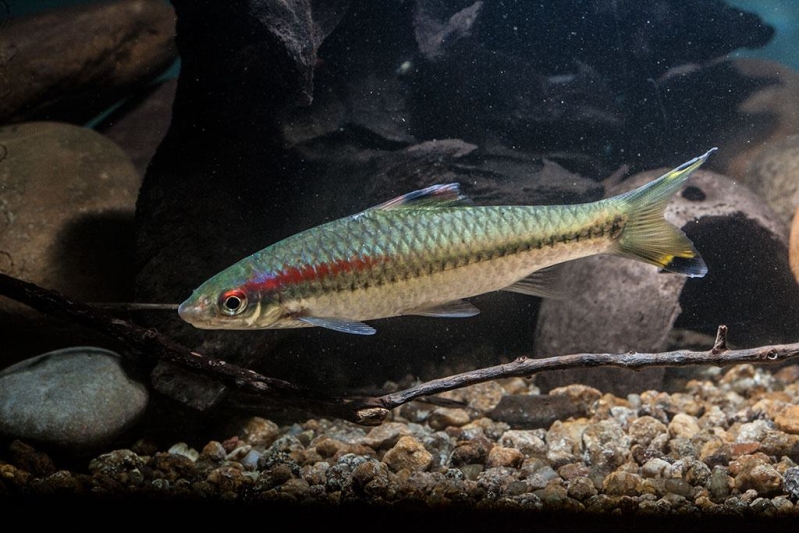
Sahyadria chalakkudiensis 外形接近一眉道人(Sahyadria denisonii),却更可能表现强硬,不适合普通混养缸。它会形成明显等级,至少五条同养,不能把两三条放在一起就当成满足群体需求。
分布与栖息地
已知来自印度南部喀拉拉邦的恰拉库迪、佩里亚尔、潘巴和阿昌科维尔河。最初以为只限恰拉库迪河,后来有其他流域记录。
通常在河流中段、岸边植被茂盛的岩石水潭聚集,底部包括砂、砾或基岩。
饲养环境
缸底至少约 120 × 45 cm,可用磨圆石块、砂、细砾与沉木模拟溪流。清洁水质比布置本身重要,不耐有机污染物积累。
保持高溶氧与中等水流,每周换水约 30%~50% 作为常规维护,不能只靠大过滤而忽略换水。
食性与喂食
野外吃虫、昆虫、甲壳类、植物和其他有机碎屑,食物组成较广。缸内可轮换红虫、水蚤、丰年虾等活或冷冻饵,配优质干粮,沉底食物更合适。
富含类胡萝卜素的食物据称可能加强红色,但保持均衡饮食比单纯追求发色更重要。
习性与混养
可能具有挑衅性,伙伴宜选择体形相近、强健且适应同样环境的鱼。它的群体会建立等级,若只有两三条,弱势鱼可能承受过度攻击,至少五条更合适。
雌雄区分
成年雌鱼通常略大、更厚实,颜色比雄鱼稍淡。
繁殖
缸内繁殖尚无记录,自然繁殖可能像近亲一样带季节性,不能把这种推测当作本种已确认的产卵时机。
补充说明
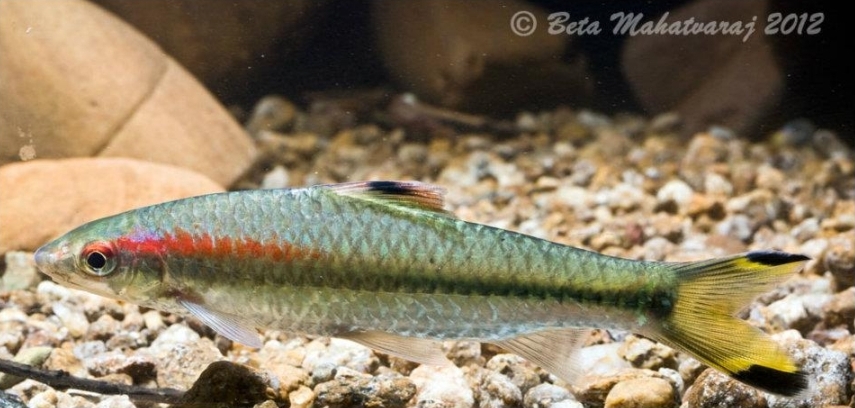
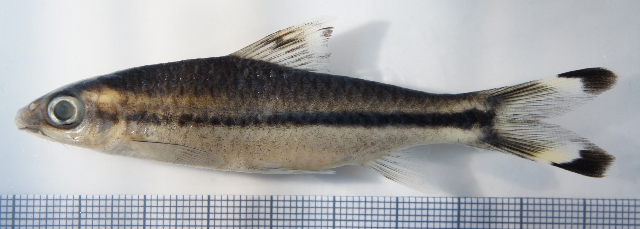
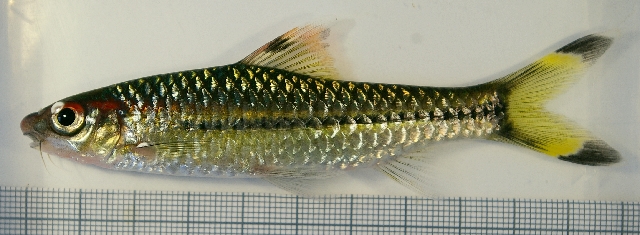
与一眉道人(Sahyadria denisonii)相比,本种嘴位更低,背鳍有黑斑,红色体侧线较暗,通常到背鳍起点下方或之前结束;近亲红线更鲜亮,并延伸得更后。
贸易早期还曾将其他属的鱼误用本种名称,购买时须查看嘴位、背鳍和红线组合,而不是仅看“一眉”式外观。
图片
图片来自 SeriouslyFish,版权归各摄影者所有。
English
Overview
Sahyadria chalakkudiensis resembles the familiar red-line torpedo barb, Sahyadria denisonii, but can be substantially more belligerent. It is unsuitable for a general community. A clear social hierarchy develops, making at least five specimens preferable to a token pair or trio.
Distribution & habitat
Records come from the Chalakudy, Periyar, Pamba, and Achankovil systems of Kerala, southern India. Its range is broader than the Chalakudy-only distribution first assumed.
Groups typically occupy rocky pools in middle river reaches, with dense bank vegetation and bottoms of sand, gravel, or bedrock.
Aquarium setup
Allow a footprint of at least about 120 × 45 cm. Rounded stones, sand, fine gravel, and wood can create a stream setting, but water quality matters more than the exact arrangement.
Organic pollution is poorly tolerated. Provide abundant oxygen, moderate circulation, and routine weekly changes of roughly 30–50%. Substantial filtration does not replace continuing water changes.
Diet & feeding
Wild food includes worms, insects, crustaceans, plants, and other organic material. In captivity, combine live or frozen bloodworms, Daphnia, and brine shrimp with quality dry preparations. Sinking offerings are preferable.
Carotenoid-rich food is said to enhance red pigmentation, but balanced feeding remains more useful than pursuing color alone.
Behaviour & compatibility
Potential belligerence favors robust, similarly sized companions with matching environmental needs. The group develops a pecking order. With only two or three fish, subordinate individuals may receive excessive harassment; maintain five or more.
Sexual dimorphism
Adult females tend to be slightly larger, heavier-bodied, and less colorful than males.
Breeding
Aquarium reproduction is unrecorded. Seasonal breeding like that of its relative is presumed, not a confirmed schedule for this species.
Notes
Compared with Sahyadria denisonii, it has a lower mouth position, a dark dorsal-fin mark, and a duller red body stripe ending at or before the dorsal origin. The relative's brighter stripe extends farther back.
Past trade confusion has even involved unrelated genera under this name. Examine mouth position, the dorsal fin, and stripe together rather than relying on a broadly similar red-line appearance.
来源
- https://www.seriouslyfish.com/species/sahyadria-chalakkudiensis(抓取于 2026-10-10)
sahyadria-chalakkudiensis · 文件: data/species/sahyadria-chalakkudiensis.md · 状态: 草稿