Rasbora cf. dandia
概要
| 字段 | 值 |
|---|---|
| 类别 | 鱼 |
| 学名 | Rasbora cf. dandia |
| 分类 | 鲤形目 Cypriniformes › 鲤科 Cyprinidae › Rasbora |
| 水体 | 淡水 |
| 成体体长 | 9.9 cm |
| 饲养难度 | 中等 |
| 最小水体 | 243 L |
| 最小缸长 | 120 cm |
| 群居方式 | 群游 |
| 性情 | 温和 |
| 特征 | 会跳缸: 是 |
| 外部数据 | seriouslyfish rasbora-cf-dandia |
| 原产地 | 斯里兰卡及印度南部卡纳塔克、喀拉拉和泰米尔纳德 |
| 游动层 | 上层 |
| 繁殖方式 | 散卵 |
水质参数
| 参数 | 耐受范围 | 最适范围 | 单位 |
|---|---|---|---|
| 水温 | 22–25 | — | °C |
| 总硬度 | 2–12 | — | dGH |
概述
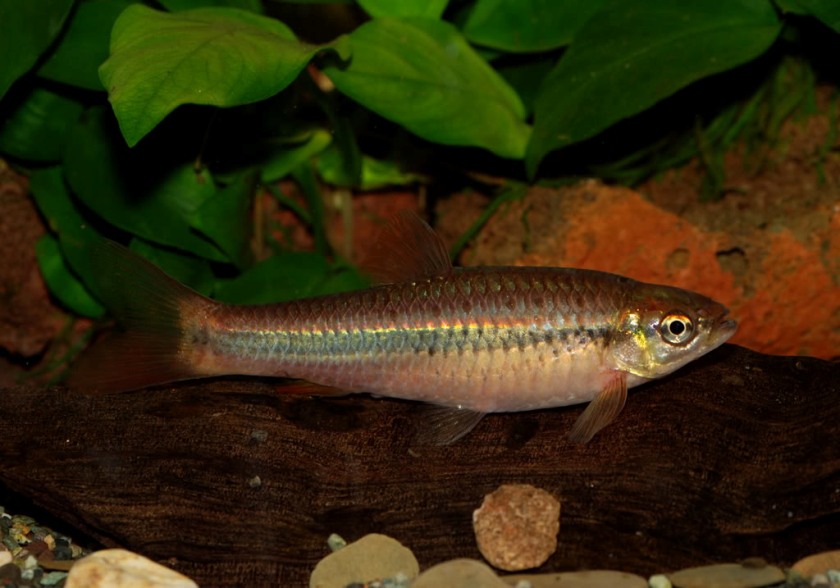
Rasbora cf. dandia 是身份仍带比较限定的波鱼,可能就是 Rasbora dandia 的一种形态。它在水面附近活动、善跳,成年需要较大空间;购买时不能因为商家标为另一种波鱼就忽略 cf. 与实际身份的区别。
分布与栖息地
广见于斯里兰卡和印度南部卡纳塔克、喀拉拉、泰米尔纳德。利用多种低地淡水环境,包括河流、溪流、稻田、池塘和人工水库。
饲养环境
长期缸底至少约 120 × 45 cm,重点是开阔游动区和洁净水质。可选择大型草缸,或用石砾、磨圆大石、沉木与耐受环境的附生水草模拟河道。
不耐有机废物累积,持续维护不可省略。缸盖要非常贴合,它既是水面活动鱼,又能从很小缝隙跳出。
食性与喂食
自然可能主要吃水生、陆生无脊椎动物,但这是与近似种比较后的推测。缸内通常易喂,可将红虫、水蚤、丰年虾等活或冷冻饵与优质薄片、颗粒轮换。
习性与混养
性情和平,适合空间足够的群落,但伙伴仍须按水质、成年体形与行为筛选。至少六条同养,可减少紧张并观察雄鱼之间的求偶竞争。
雌雄区分
成熟雌鱼腹部明显更圆,常略大于雄鱼。
繁殖
已有水族馆成功繁殖记录,为持续散卵型,不照护后代。状态良好时会反复产卵,成熟密植缸可能自然留下少数幼鱼。
实际繁殖中,较大、不黏的卵随机散落底部而不是附在水草上,因先前亲鱼似乎会吃卵,卵被吸到小容器单独孵育,约六十小时孵化。最初用草履虫,鱼苗在一天内就能转吃丰年虾无节幼体、微虫及适口干粮;有个体四周已超过 25 mm,但不能把这一生长速度当成每窝保证。
提高存活可考虑在底部上方架网,让卵落下而亲鱼够不到,产后移走成鱼。其他波鱼使用过塑料草垫收卵,但本种上述实际记录是底部散卵。
补充说明
常被误售为 Rasbora wilpita,后者的确认分布只涉及斯里兰卡少数溪流。保留 cf. 是为了区别尚未科学确认的身份,不应直接把商品标签当作定种依据。
图片
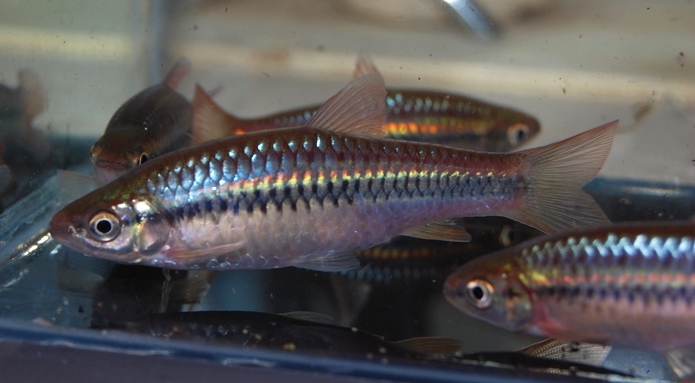
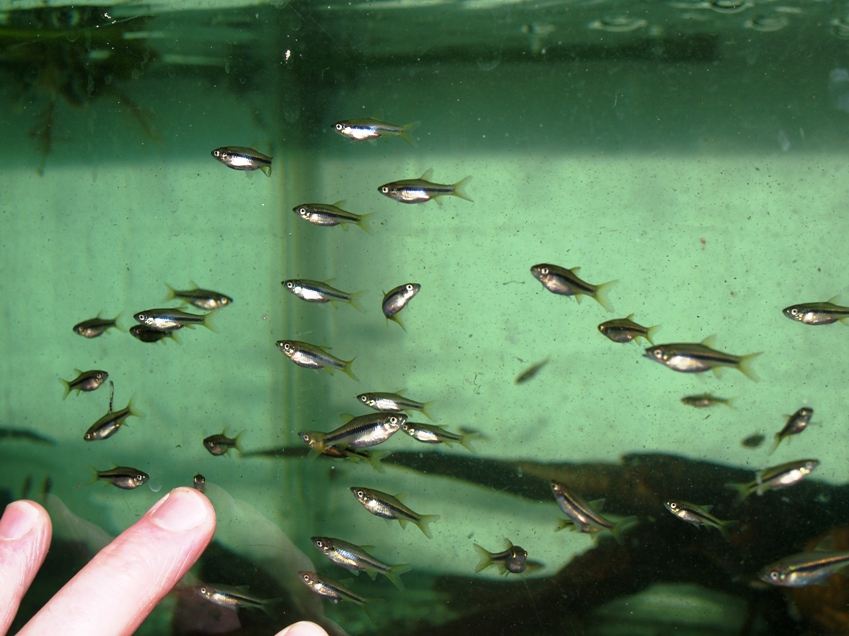
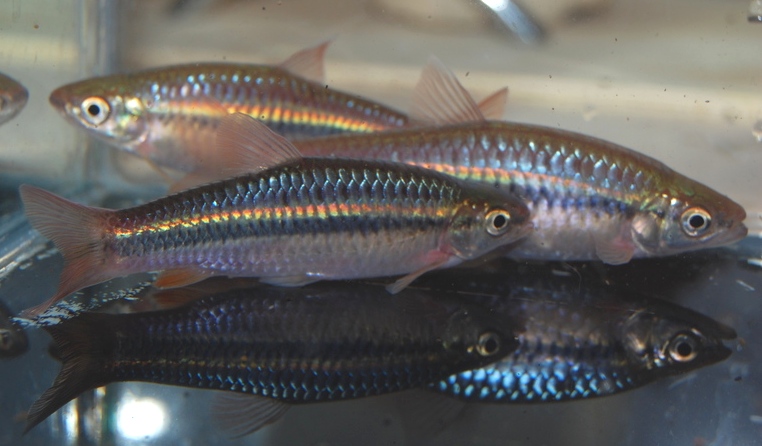
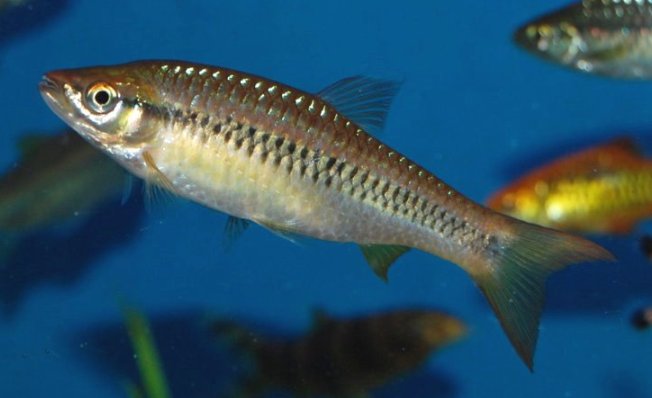
图片来自 SeriouslyFish,版权归各摄影者所有。
English
Overview
Rasbora cf. dandia retains a qualified identification and may be a form of Rasbora dandia itself. It is a surface-associated jumper needing substantial adult space. A different name on a sales label does not resolve that uncertainty.
Distribution & habitat
It is widespread in Sri Lanka and the southern Indian states of Karnataka, Kerala, and Tamil Nadu. Occupied lowland freshwater habitats include rivers, streams, rice fields, ponds, and artificial reservoirs.
Aquarium setup
For long-term care, allow a footprint of at least about 120 × 45 cm. Clean water and unobstructed swimming room take priority. A large planted tank or river-style arrangement with stones, gravel, rounded boulders, branches, and attached plants can work.
Organic waste accumulation is poorly tolerated. Maintain water quality consistently and seal the cover very closely: this surface-dwelling fish can jump through surprisingly small openings.
Diet & feeding
Aquatic and terrestrial invertebrates are considered likely natural prey, based partly on comparable species. Captive feeding is generally easy. Rotate live or frozen bloodworms, Daphnia, and brine shrimp with quality flakes or granules.
Behaviour & compatibility
It is peaceful in a sufficiently spacious community, but adult dimensions, behavior, and environmental requirements still govern companion selection. Keep at least six together to reduce nervousness and observe male courtship competition.
Sexual dimorphism
Mature females have distinctly rounder abdomens and are often slightly larger than males.
Breeding
Aquarium reproduction has succeeded. It repeatedly scatters eggs without care when in good condition, and a mature planted aquarium may occasionally retain a few young.
In an observed spawning, relatively large, nonadhesive eggs landed randomly on the bottom rather than attaching to plants. They were siphoned into separate accommodation because adults apparently ate earlier batches. Hatching took approximately sixty hours. Paramecium was the first food, followed within a day by brine shrimp nauplii, microworms, and suitably small dry food. Some young exceeded 25 mm after four weeks, an observation rather than a guaranteed growth schedule.
A raised mesh can protect eggs by allowing them to fall beyond adult reach, followed by removal of the parents. Plastic grass has also worked as an egg trap for other rasboras, whereas the direct observation here involved eggs scattered on the bottom.
Notes
It is often mislabeled as Rasbora wilpita, whose confirmed range involves only a few Sri Lankan streams. Retaining cf. distinguishes an unresolved identification from a scientifically confirmed name; a trade label should not override it.
来源
- https://www.seriouslyfish.com/species/rasbora-cf-dandia(抓取于 2026-10-10)
rasbora-cf-dandia · 文件: data/species/rasbora-cf-dandia.md · 状态: 草稿