Laubuka siamensis
概要
| 字段 | 值 |
|---|---|
| 类别 | 鱼 |
| 学名 | Laubuka siamensis |
| 别名 | Laubuca siamensis |
| 分类 | 鲤形目 Cypriniformes › 鲤科 Cyprinidae › Laubuka |
| 水体 | 淡水 |
| 原产地 | 柬埔寨、老挝、马来西亚、泰国、越南 |
| 成体体长 | 6 cm |
| 饲养难度 | 中等 |
| 最小水体 | 108 L |
| 最小缸长 | 120 cm |
| 群居方式 | 群游 |
| 特征 | 会跳缸: 是 |
| 外部数据 | seriouslyfish laubuka-siamensis;fishbase 67464 |
| 食性 | 肉食 |
| 性情 | 温和 |
| 游动层 | 上层 |
水质参数
| 参数 | 耐受范围 | 最适范围 | 单位 |
|---|---|---|---|
| 水温 | 20–28 | — | °C |
| pH | 6–7.5 | — | — |
| 总硬度 | 1–10 | — | dGH |
概述
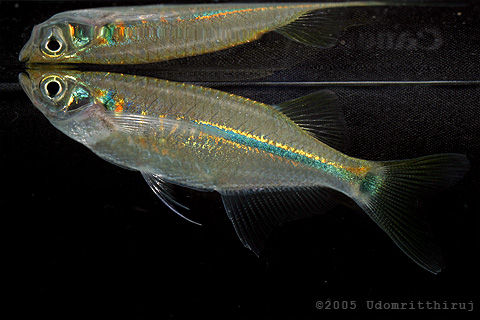
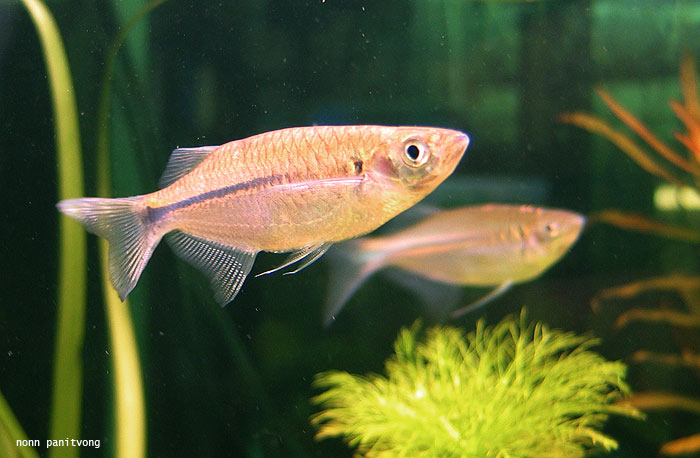
Laubuka siamensis 是在水面或紧贴水面成群游动的小型鲤科鱼,身体后半段有醒目的深色纵带,活鱼会泛蓝光,尾柄斑呈椭圆形。它容易跳出,饲养时要兼顾群体、游动空间与缸盖密封。
分布与栖息地
原生于湄公河、泰国湄南河和湄功河,以及向南延伸到马来半岛的若干小流域。
可见于小支流、淡水池、运河、稻田等安静水体,雨季也进入淹水森林。观察到的鱼群通常在水面或其下方活动,并非所有河流鱼都需要急流。
饲养环境
缸底至少约 120 × 30 cm,适合模拟缓流河溪,以岩石、砾石、磨圆大石与沉木搭配附生水草,保留成群游动空间。
维持清洁稳定水质,不容许有机废物积累。缸盖必须紧密,它的跳跃能力不能因鱼小而低估。
食性与喂食
自然在水面捕食水生及陆生无脊椎动物。可接受适口干粮,但应经常搭配活或冷冻水蚤、丰年虾、红虫等动物性食物。
习性与混养
没有明显攻击性,可与环境需求和体形性情合适的伙伴混养。至少 8~10 条为一群较好,能减少胆怯,并表现较自然的群游。
雌雄区分
成年雌鱼明显更高身,通常也略大于雄鱼。
补充说明
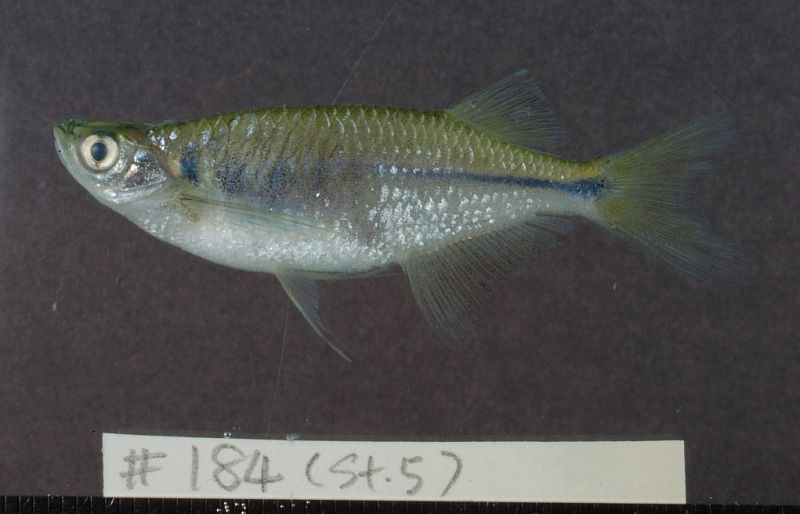
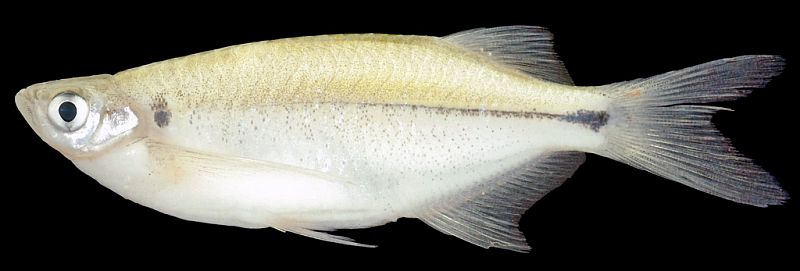
它过去常与 Laubuka laubuca 混用名称,贸易中也可能如此。辨识重点是本种后半身纵带连续而显眼,不被竖纹切断,终止于椭圆尾柄斑;前半身则有较淡竖纹,肩部斑纵向伸展而非圆形眼斑。
相比之下,L. laubuca 纵带较细、不显著且被不规则竖纹打断,尾柄斑更圆。核对花纹比仅凭商品标签可靠。
图片
图片来自 SeriouslyFish,版权归各摄影者所有。
English
Overview
Laubuka siamensis forms groups at or immediately beneath the surface. A conspicuous dark, iridescent blue stripe marks the rear half of the body and ends in an oval tail-base blotch. Its strong jumping ability makes a secure cover as important as company and swimming room.
Distribution & habitat
It is native to the Mekong, Thailand's Chao Phraya and Mae Klong systems, and smaller drainages extending south onto the Malay Peninsula.
Small tributaries, pools, canals, rice fields, and other quiet waters are occupied, with movement into flooded forest during the wet season. Groups consistently remain close to the surface. A river-basin origin does not mean that forceful currents are appropriate.
Aquarium setup
Consider a base of at least about 120 × 30 cm. A gently flowing river-style arrangement can combine stones, gravel, rounded boulders, branches, and attached plants while preserving room for the group.
Maintain clean, stable conditions and prevent organic waste accumulation. Close the cover securely; jumping capability should not be underestimated because the fish is small.
Diet & feeding
Natural prey consists of terrestrial and aquatic invertebrates taken at the surface. Suitable dry foods are accepted, but regularly supplement them with live or frozen Daphnia, brine shrimp, bloodworms, and comparable animal foods.
Behaviour & compatibility
It is nonaggressive with appropriately selected companions matching its conditions, size, and temperament. Eight to ten or more specimens form a preferable group, reducing nervousness and allowing more natural schooling behavior.
Sexual dimorphism
Adult females have noticeably deeper bodies and usually attain a slightly larger size.
Notes
It has often been confused with Laubuka laubuca, including in trade labels. In this species, the posterior stripe is conspicuous and uninterrupted by vertical markings, ending in an oval caudal-peduncle spot. Faint vertical marks occupy the front of the body, and the shoulder mark is elongated vertically rather than forming a round eyespot.
The stripe in L. laubuca is narrower, less obvious, and broken by irregular vertical markings, while its tail-base blotch is rounder. Check this pattern rather than relying solely on the supplied name.
来源
- https://www.seriouslyfish.com/species/laubuka-siamensis(抓取于 2026-10-10)
laubuka-siamensis · 文件: data/species/laubuka-siamensis.md · 状态: 草稿