施氏盘齿魮
概要
| 字段 | 值 |
|---|---|
| 类别 | 鱼 |
| 学名 | Discherodontus schroederi |
| 别名 | 施氏盤齒魮、Acrossocheilus schroederi |
| 分类 | 鲤形目 Cypriniformes › 鲤科 Cyprinidae › Discherodontus |
| 水体 | 淡水 |
| 原产地 | 泰国 |
| 成体体长 | 10 cm |
| 饲养难度 | 中等 |
| 最小水体 | 108 L |
| 最小缸长 | 120 cm |
| 群居方式 | 群游 |
| 性情 | 温和 |
| 外部数据 | seriouslyfish discherodontus-schroederi;fishbase 54673 |
| 游动层 | 底层 |
水质参数
| 参数 | 耐受范围 | 最适范围 | 单位 |
|---|---|---|---|
| 水温 | 23–26 | — | °C |
| pH | 6–7.5 | — | — |
| 总硬度 | 2–12 | — | dGH |
概述
施氏盘齿魮(Discherodontus schroederi)是偏下层活动的温和群游鱼,市场中不常见。它据称比同属其他鱼耐养,但仍需要成熟过滤、稳定水质和足够遮蔽,不能把相对耐养理解成能承受污染。
分布与栖息地
来自泰国美功河与湄南河流域,两流域种群在体高、鳍长等方面有差异。常栖清澈的森林溪流和小河,岩石急流与深潭交替;落叶、枝条和根系堆积的缓水区很重要。幼鱼曾成群出现在急流旁阴暗、接近静水、腐植层较深的侧潭。
饲养环境
适合较大且藏身处充足的溪流缸,可用砾石、不同大小的圆石和沉木构造遮阴区。耐养附生水草可种在硬景观上,照明也可促进可供啄食的附着藻类生长。维持高溶氧和适度水流,每周换水约三成至一半,防止有机废物积累。
它不耐明显水质波动,入缸宜缓慢适应数小时,不能进入生物过滤尚未成熟的环境。
食性与喂食
同属鱼通常以水生、陆生无脊椎动物为主要食物,缸中也常啄食石面生物膜。可用红虫、水蚤、丰年虾等活饵或冷冻饵搭配优质薄片、颗粒,形成多样菜单。
习性与混养
性情温和,大部分时间位于缸下层,适合与需要良好溶氧的非攻击性鱼同养。底部慈鲷可能造成空间冲突,除非缸很大,否则宜避免。建议至少六尾群养,数量充足时不易紧张,雄鱼展示也更自然。
雌雄区分
成熟雌鱼通常比雄鱼略大、体形明显更厚。
补充说明
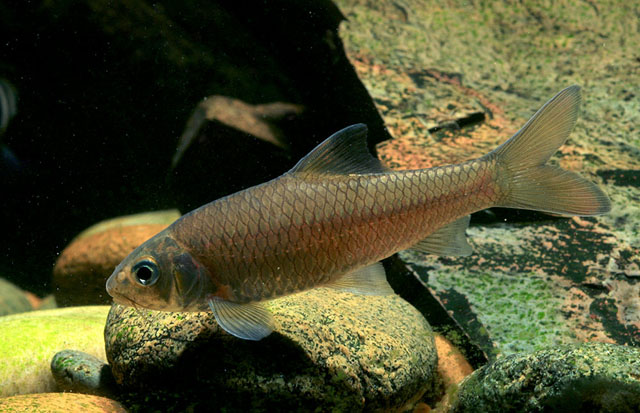
幼鱼容易与阿氏盘齿魮(Discherodontus ashmeadi)混淆,但本种成年后背鳍的大黑斑逐渐退成外缘细带,须也相对更长。来自不同水系的形态差异不宜轻率当作新品种。
图片
图片来自 SeriouslyFish,版权归各摄影者所有。
English
Overview
A peaceful lower-water shoaling fish, Discherodontus schroederi is rarely seen in the trade. It is reputed to be hardier than its relatives, but that comparison should not be mistaken for tolerance of unstable or polluted aquarium conditions.
Distribution & habitat
It occurs in Thailand's Mae Klong and Chao Phraya systems, whose populations differ in body depth and fin development. Clear forest streams and smaller rivers combine rocky fast sections with pools. Quiet areas collecting roots, branches and leaves provide important shelter. Juveniles have been found grouped in a shaded, nearly stagnant side pool beside a fast river reach.
Aquarium setup
Provide a large, sheltered river-style layout with gravel, rounded stones of varied size and wood forming shaded areas. Hardy attached plants are useful, and illuminated rocks can develop growth for browsing. Maintain good oxygenation and moderate flow, replacing about a third to half of the water weekly to limit waste buildup.
The biological system must be established before introduction. Acclimate gradually over several hours where possible and avoid abrupt water-chemistry changes.
Diet & feeding
The genus chiefly uses aquatic and terrestrial invertebrates, and aquarium fish browse films on rocks. Combine small live or frozen foods with quality flakes or granules for a varied menu.
Behaviour & compatibility
It spends most of its time low in the aquarium and suits nonaggressive companions requiring well-oxygenated water. Bottom-oriented cichlids are best excluded unless the tank is very large. Keep at least six conspecifics for confidence and a more representative social display.
Sexual dimorphism
Females are generally a little larger and noticeably thicker-bodied once mature.
Notes
Young fish can resemble Discherodontus ashmeadi. In this species the large dorsal blotch fades with growth into a narrow edge band, and the barbels are comparatively long. Differences between drainage populations should not automatically be treated as distinct ornamental strains.
来源
- https://www.seriouslyfish.com/species/discherodontus-schroederi(抓取于 2026-10-10)
discherodontus-schroederi · 文件: data/species/discherodontus-schroederi.md · 状态: 草稿