半线
概要
| 字段 | 值 |
|---|---|
| 类别 | 鱼 |
| 学名 | Devario interruptus |
| 别名 | 半線、Barilius interrupta、Danio interruptus、Danio interrupta |
| 分类 | 鲤形目 Cypriniformes › 鲤科 Cyprinidae › Devario |
| 水体 | 淡水 |
| 原产地 | 中国 |
| 成体体长 | 6 cm |
| 饲养难度 | 中等 |
| 最小水体 | 68 L |
| 最小缸长 | 75 cm |
| 群居方式 | 群游 |
| 特征 | 会跳缸: 是 |
| 外部数据 | seriouslyfish devario-interruptus;fishbase 27514 |
水质参数
| 参数 | 耐受范围 | 最适范围 | 单位 |
|---|---|---|---|
| 水温 | 16–21 | — | °C |
| pH | 6.5–7.5 | — | — |
| 总硬度 | 2–10 | — | dGH |
概述
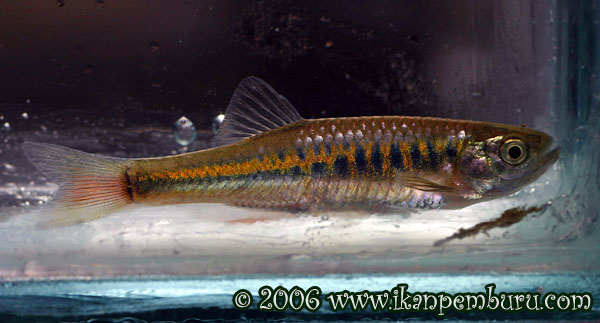
Devario interruptus 来自滇西山地小水系,体侧竖纹短而宽,后部横带由相连的黑斑构成。人工饲养经验有限,选择环境和同伴时应保留观察、调整的余地。
分布与栖息地
已知记录集中在云南德宏陇川户撒河谷及邻近的龙陵、瑞丽一带,属于靠近缅甸边界的伊洛瓦底江上游水系。多数产地是清澈、浅窄、中等至较快流速的溪流,沙砾和岩石底,无明显水草;部分岸边植被提供阴影。也曾在水较浑的人工灌溉渠中采到。
饲养环境
可尝试偏凉、维护良好的溪流缸,用沙砾、圆滑石块和沉木布置,耐养附生水草可作点缀。建议高溶氧、适度水流,每周换水约三成至一半,维持水体洁净,并严密加盖防跳。这些人工饲养方向主要参考近缘鱼,不能替代实际观察。
食性与喂食
野外很可能主要摄食昆虫及幼虫。缸中可尝试以优质干粮配合红虫、水蚤、丰年虾等小型活饵或冷冻饵,兼顾摄食和体况。
习性与混养
可能不太具有攻击性,但活跃游动和积极取食可能使胆小、迟缓的鱼紧张。可优先考虑体型相近、健壮且适应偏凉流水的同伴。建议八至十尾同养;足够群体可能有助于分散等级冲突,但仍需监测实际行为。
雌雄区分
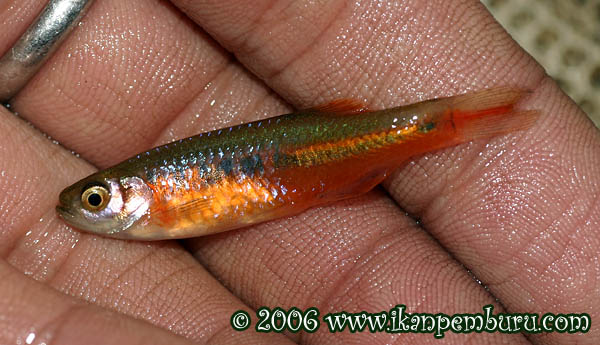
成熟雌鱼通常略大、更圆腹且较淡。处于繁殖状态的优势雄鱼,身体下半部会呈现明亮橙色。
繁殖
可按同属鱼的一般散卵方法尝试:使用独立昏暗缸、成熟水、轻柔供氧和保护卵的细叶水草或网格。亲鱼调养后配对进入,产卵后移走;若未观察到产卵,可在约两天后移出检查。鱼苗先供给微小开口饵,再过渡至微虫、丰年虾幼体和细粉饲料。繁殖过程仍应以个体观察为准。
补充说明
本种无须、侧线不完整,体侧短宽竖斑的深度相近。与相似鱼比较时,这些特征比只看橙色发色更可靠。
图片
图片来自 SeriouslyFish,版权归各摄影者所有。
English
Overview
Devario interruptus is an upland fish with short broad flank bars and a rear stripe formed from adjoining dark blotches. Captive experience is limited, so housing and companion choices should remain open to adjustment as the fish are observed.
Distribution & habitat
Known sites cluster around the Husa valley of Longchuan and nearby Longling and Ruili in southwestern Yunnan. They belong to the upper Irrawaddy drainage near Myanmar. Most records concern shallow, narrow, clear streams over sand and stones, with moderate or brisk flow and little aquatic vegetation. Bankside plants may shade the water. A turbid irrigation channel has also yielded specimens.
Aquarium setup
A relatively cool, well-maintained stream aquarium is a reasonable approach. Use sand, gravel, smooth stones and wood, adding hardy attached plants if desired. Good oxygenation, moderate circulation and weekly changes of roughly a third to half of the volume are suggested. Secure the cover against jumping. These husbandry proposals derive mainly from relatives and need practical observation.
Diet & feeding
Insects and larvae are the probable main wild foods. Try quality prepared food supplemented with small live or frozen invertebrates, checking feeding response and condition.
Behaviour & compatibility
Aggression is thought unlikely, but constant movement and energetic feeding may still intimidate quiet companions. Robust, similarly sized fishes suited to cool flowing water are more promising choices. Eight to ten conspecifics are suggested; a group may help contain ranking disputes, though actual behavior needs monitoring.
Sexual dimorphism
Females are expected to become larger, fuller-bellied and less colorful. Dominant reproductive males develop strong orange coloration across the lower body.
Breeding
A trial may follow general devario egg-scattering methods: a separate dim aquarium with established water, gentle aeration and fine plants or mesh protecting the eggs. Introduce conditioned pairs and remove them after spawning, or after about two days if spawning was not observed. Begin fry feeding with microscopic foods and gradually progress to larger items. Outcomes should be established from observation rather than assumed.
Notes
Absent barbels, an incomplete lateral line and similarly deep, broad flank bars help distinguish the species. These structural and pattern features are more useful than reproductive orange coloration alone.
来源
- https://www.seriouslyfish.com/species/devario-interruptus(抓取于 2026-10-10)
devario-interruptus · 文件: data/species/devario-interruptus.md · 状态: 草稿