金线
概要
| 字段 | 值 |
|---|---|
| 类别 | 鱼 |
| 学名 | Devario chrysotaeniatus |
| 别名 | 金線、Danio chrysotaeniatus |
| 分类 | 鲤形目 Cypriniformes › 鲤科 Cyprinidae › Devario |
| 水体 | 淡水 |
| 原产地 | 中国、老挝、泰国 |
| 成体体长 | 7.5 cm |
| 饲养难度 | 中等 |
| 最小水体 | 108 L |
| 最小缸长 | 120 cm |
| 群居方式 | 群游 |
| 特征 | 会跳缸: 是 |
| 外部数据 | seriouslyfish devario-chrysotaeniatus;fishbase 55989 |
水质参数
| 参数 | 耐受范围 | 最适范围 | 单位 |
|---|---|---|---|
| 水温 | 23–26 | — | °C |
| pH | 6–7 | — | — |
| 总硬度 | 1–8 | — | dGH |
概述
Devario chrysotaeniatus 是体侧横纹较浅、不太醒目的活跃群游鱼,在水族贸易中少见。它不以主动攻击著称,但旺盛的活动和抢食能力仍会影响胆小同伴。
分布与栖息地
来自澜沧江—湄公河上游水系,包括中国云南西双版纳、老挝北部及泰国北部。原生区域海拔较高,雨季明显;它可能主要利用有沙砾、石块和岸边遮蔽的山溪、小河,水流很可能随季节改变。
饲养环境
用足够长的缸提供游动空间,以沙、细砾、圆滑石块和沉木营造溪流布局,耐养水草可附着于硬景观。对有机污染积累不耐受,需维持洁净、高溶氧的水体和适度水流。每周换水约三成至一半,缸盖要贴合牢固以防跳出。
食性与喂食
野外很可能以昆虫及幼虫为主。人工饲养通常不挑食,优质干粮可作基础,再规律供应红虫、水蚤、丰年虾等小型活饵和冷冻饵。
习性与混养
更适合宽敞缸中体型相近、健壮、环境需求相容的鱼。慢游或过于胆小的同伴可能承受压力。宜至少八至十尾成群,让群体等级互动集中在同种之间,同时减少紧张;雄鱼与对手共同生活时常显色更好。
雌雄区分
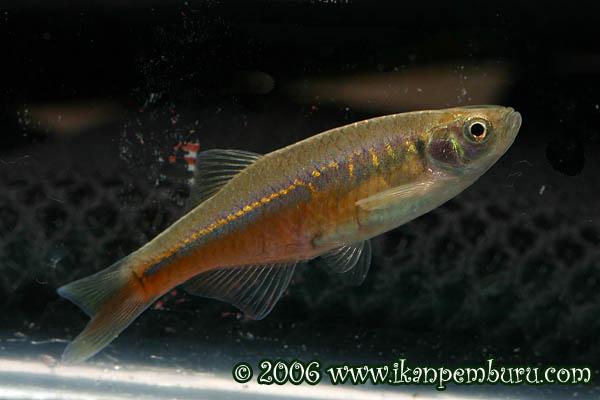
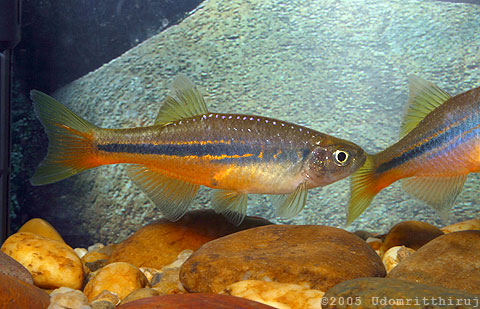
成熟雌鱼一般略大、腹部更圆且颜色较淡。繁殖雄鱼的后半身下部以及尾鳍中央鳍条可出现亮橙色。
繁殖
可参考同属鱼的散卵繁殖布置,另设成熟水、弱光和温和增氧的缸,用网格、细叶水草或产卵拖把保护卵。将养壮的亲鱼配对放入,产卵后移走;约两天仍未观察到产卵,也宜移出亲鱼再检查。鱼苗需先吃草履虫等细小饵,长大后接续微虫、丰年虾幼体和细粉饲料,发育速度受水温影响。
补充说明
可关注鳃盖后方的小黑斑、沿背部延伸的深色线和体侧短而细的浅横纹,并结合两对短须等特征辨识,不宜仅靠名称中的“金线”判断。
图片
图片来自 SeriouslyFish,版权归各摄影者所有。
English
Overview
A rarely encountered active devario, Devario chrysotaeniatus has comparatively subdued side striping. It is not notably aggressive, but energetic swimming and feeding still make timid companions a poor match.
Distribution & habitat
Its known range belongs to the upper Mekong system, covering Xishuangbanna in Yunnan, northern Laos and northern Thailand. The upland region has marked seasonal rainfall. Rocky hill streams and small rivers with marginal shelter are the probable habitats, with flow likely changing through the year.
Aquarium setup
Provide a long swimming area within a stream-style layout of sand, gravel, rounded rocks and wood. Hardy attached plants can be used. Keep organic pollution low, oxygen plentiful and circulation moderate. Weekly changes of approximately a third to half of the water are recommended, and the lid must close securely to contain jumping fish.
Diet & feeding
Insects and their larvae are considered the most likely wild foods. Aquarium feeding is generally straightforward. Supplement a quality prepared staple with frequent small live or frozen invertebrates.
Behaviour & compatibility
Choose robust, similarly sized companions with compatible needs for a spacious aquarium. Slow or shy fishes may be unsettled. At least eight to ten conspecifics help reduce nervousness and keep ranking interactions within the shoal; rival males commonly show stronger coloration.
Sexual dimorphism
Females are expected to be a little larger, paler and fuller in the abdomen. Breeding males develop vivid orange toward the lower rear of the body and along the middle tail rays.
Breeding
Methods used for related egg scatterers provide a starting point. Set up a separate dim aquarium with established water, gentle aeration and mesh, fine plants or mops to shelter eggs. Introduce conditioned pairs and remove adults after spawning; about two days is also a practical removal point if spawning has not been observed. Fry require microscopic first foods before progressing to larger live foods and fine powders. Development varies with temperature.
Notes
Look for a small mark behind the gill opening, a dark line along the back and faint short side stripes. Two short pairs of barbels offer another identifying feature; an evocative common name alone is insufficient.
来源
- https://www.seriouslyfish.com/species/devario-chrysotaeniatus(抓取于 2026-10-10)
devario-chrysotaeniatus · 文件: data/species/devario-chrysotaeniatus.md · 状态: 草稿