Devario assamensis
概要
| 字段 | 值 |
|---|---|
| 类别 | 鱼 |
| 学名 | Devario assamensis |
| 别名 | Danio assamensis |
| 分类 | 鲤形目 Cypriniformes › 鲤科 Cyprinidae › Devario |
| 水体 | 淡水 |
| 原产地 | 不丹、印度 |
| 成体体长 | 9 cm |
| 饲养难度 | 中等 |
| 最小水体 | 243 L |
| 最小缸长 | 120 cm |
| 群居方式 | 群游 |
| 特征 | 会跳缸: 是 |
| 外部数据 | seriouslyfish devario-assamensis;fishbase 55353 |
水质参数
| 参数 | 耐受范围 | 最适范围 | 单位 |
|---|---|---|---|
| 水温 | 15–22 | — | °C |
| pH | 6–8 | — | — |
| 总硬度 | 2–12 | — | dGH |
概述
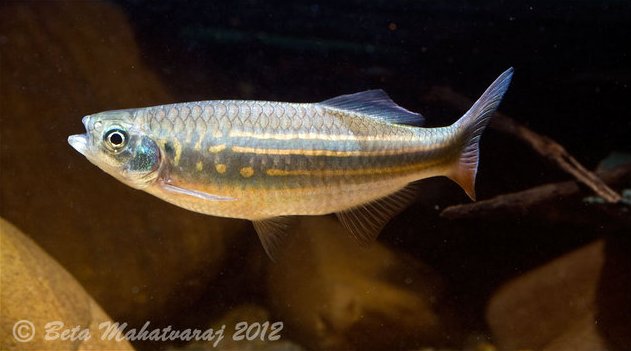
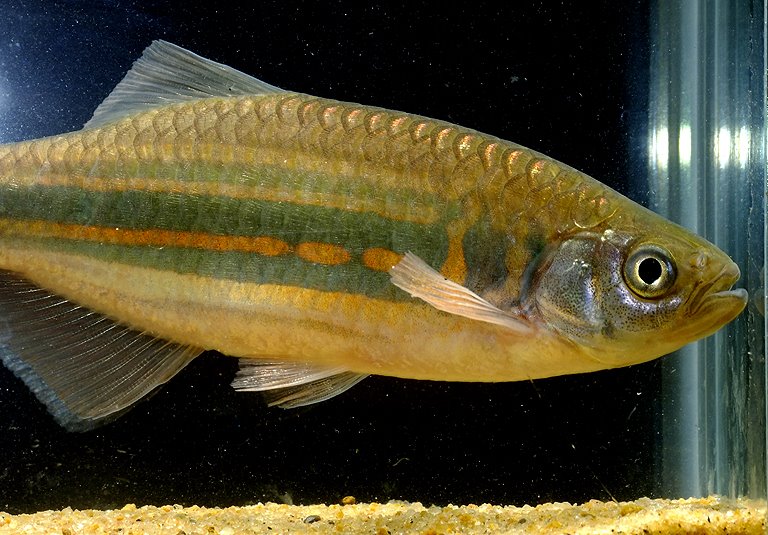
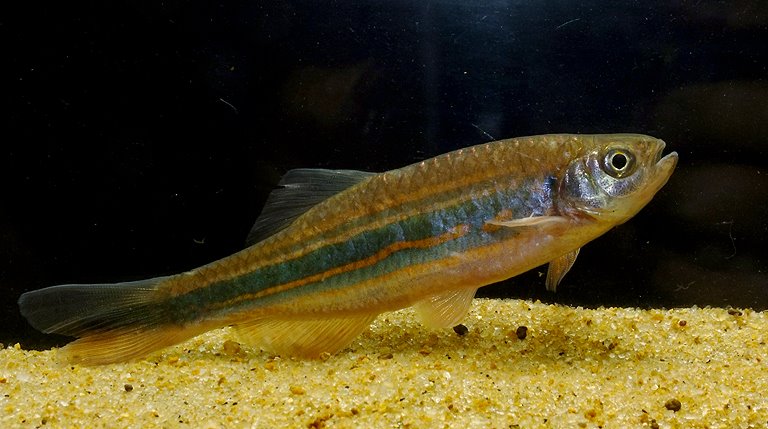
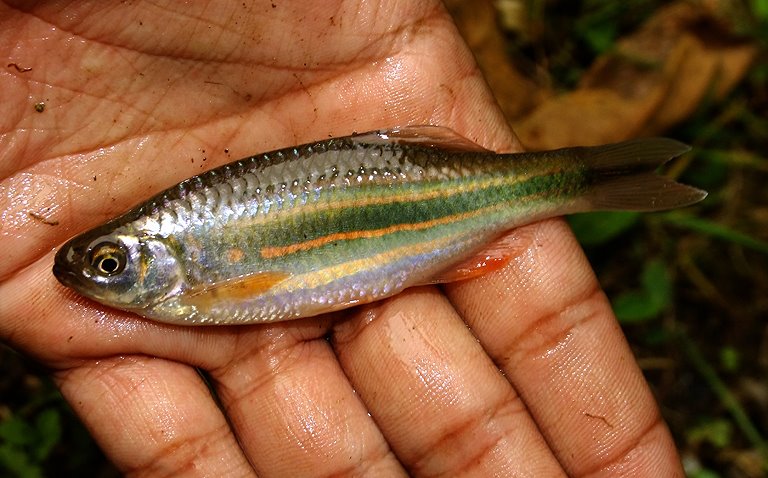
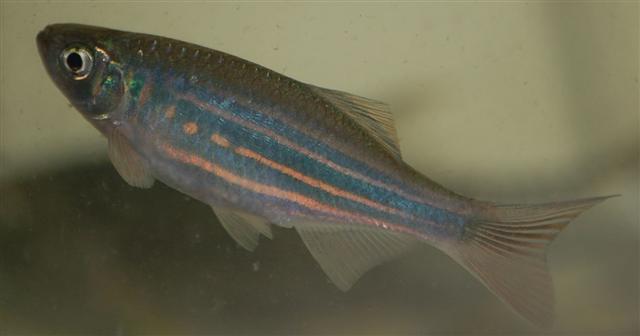
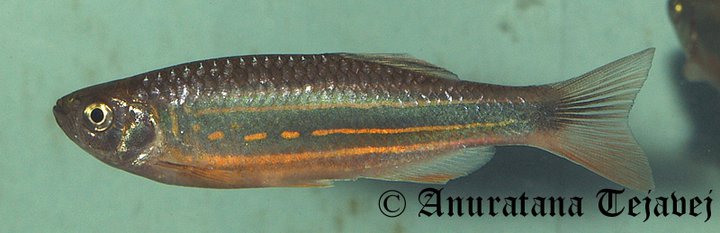
Devario assamensis 体高较深,是偏好凉水的活跃群游鱼。它不适合长期处于温暖热带缸,夏季降温与增氧比单纯增加造景更重要。贸易中曾以“Mirik red”“redline”“blood stripe”等名称出现。
分布与栖息地
模式产地位于印度阿萨姆邦 Tangla 附近小溪,另见于西孟加拉邦马哈南达河及布拉马普特拉河下游支流,部分支流源自不丹。阿萨姆邦 Kalmoni 河及西孟加拉邦 Mirik 周边也有记录,但后者更可能指附近溪流而非人工湖。
若这些记录均属同一种,它的分布可能从约 250 m 海拔的低地延伸至 Mirik 一带约 1767 m 的山地,在不丹也可能更高。清澈富氧、砾石岩底的山溪是可能栖境,季节水量和浑浊度预计会变化。
饲养环境
可用沙、细砾、圆滑石块和沉木布置溪流环境,耐受的附生水草可固定在造景上。水质要稳定洁净,维持较高溶氧和适中水流,不要求激流。
每周换水约 30%~50%,并使用严密缸盖。保持既定凉水范围,夏季可能还要增加曝气,不能把产地空气温度的极端值当作适合长期饲养的水温。
食性与喂食
天然很可能主要吃昆虫及幼体,缸中预计能接受多类饵料。可用优质干粮为基础,定期补充红虫、水蚤、丰年虾等小型活饵或冷冻饵。
习性与混养
通常并不主动攻击,但活跃游动和旺盛抢食会影响慢游或胆小鱼。应选同样适合凉水、体型接近且较健壮的同伴。
至少八至十条有助于减轻紧张,分散群体等级竞争,雄鱼也更容易展示体色。群游需要充分游动空间。
雌雄区分
成熟雌鱼预计体型略大、腹部更圆,体色较雄鱼朴素,应结合成熟状态判断。
繁殖
可借鉴本属散卵、无亲鱼照护的繁殖方式,但不能把通用流程当作已经逐项验证的本种方法。成熟草缸中有时可能自然出现少量幼鱼;若希望提高存活率,可另设繁殖缸,弱光,以隔卵网、塑料草垫、玻璃珠、细叶草或产卵拖把保护卵。
使用成熟水,弱酸至中性,温度靠近适温范围上端,以气动海绵过滤或气石提供轻柔循环与供氧。充分调理亲鱼后,选择一至两对腹部充实的成鱼入缸,准备充分时通常约一天内产卵,雌鱼腹部会变瘦;无论是否看到产卵,约两天后移走成鱼。
同属通用流程中的孵化常约 24~36 小时,数天后自由游动。开口先用草履虫等微小饵料,长大后逐渐改喂丰年虾无节幼体、微虫及粉状饵料。
补充说明
深体型和延伸至尾鳍分叉处的中央暗纹有识别参考价值,但来自阿萨姆的相似大型种之间仍有分类问题。贸易名称不能替代准确鉴定,不能仅据“红线”标签认定物种。
图片
图片来自 SeriouslyFish,版权归各摄影者所有。
English
Overview
Deep-bodied Devario assamensis is an energetic schooling fish that favors cool water. Prolonged tropical warmth is unsuitable, making summer cooling and oxygenation especially relevant. Mirik red, redline, and blood stripe have all been used as trade labels.
Distribution & habitat
The type locality lies near Tangla in Assam. Records also involve West Bengal's Mahananda and lower Brahmaputra tributaries, some rising in Bhutan, plus Assam's Kalmoni drainage and the vicinity of Mirik. Mirik collections probably came from surrounding streams rather than the artificial lake.
If these records represent the same species, elevation ranges from about 250 m to 1,767 m, potentially higher in Bhutan. Clear, oxygenated streams with gravel and rocks are the likely habitat, with seasonal changes in water volume and turbidity.
Aquarium setup
Sand, fine gravel, rounded stones, and roots can form a stream-style layout. Hardy attached plants are useful additions. Maintain clean stable water, high oxygen availability, and moderate rather than violent flow.
Change about 30–50% weekly and fit the lid securely. Keep within the established cool-water range, adding aeration in summer if required. Extreme air temperatures from the region are not long-term aquarium water targets.
Diet & feeding
Insects and their larvae are strongly suspected natural prey, while broad acceptance is expected in captivity. Quality dry food can be supplemented regularly with small live or frozen bloodworms, water fleas, and Artemia.
Behaviour & compatibility
It is not normally aggressive, but continual movement and rapid feeding can disturb slow or timid fishes. Choose robust companions of similar size that also suit cooler water.
At least eight to ten individuals help reduce nervousness and distribute hierarchy-related interactions. Males often display stronger color among rivals. Provide enough open swimming room for the group.
Sexual dimorphism
Mature females are expected to be somewhat larger, rounder in the abdomen, and less colorful. Maturity should be considered when interpreting these differences.
Breeding
The genus's general egg-scattering, nonparental method provides a possible approach rather than a fully verified protocol for this species. Occasional young may appear in a mature planted aquarium. For greater survival, a separate dim spawning aquarium can protect eggs with mesh, synthetic grass, glass marbles, fine plants, or mops.
Use mature slightly acidic to neutral water toward the upper end of the appropriate temperature range, with gentle air-driven circulation. Introduce one or two well-conditioned pairs when females are ripe. Ready fish commonly spawn within a day, after which females look slimmer. Remove adults after about two days even if spawning was not witnessed.
In the general method, hatching commonly takes 24–36 hours, followed by free swimming several days later. Start with Paramecium or comparable tiny foods, progressing to Artemia nauplii, microworms, and powdered preparations when large enough.
Notes
A deep body and central stripe reaching the tail fork are useful clues, but similar large forms from Assam still raise identification problems. Trade references to red lines cannot establish species identity by themselves.
来源
- https://www.seriouslyfish.com/species/devario-assamensis(抓取于 2026-10-10)
devario-assamensis · 文件: data/species/devario-assamensis.md · 状态: 草稿