透体小
概要
| 字段 | 值 |
|---|---|
| 类别 | 鱼 |
| 学名 | Danionella translucida |
| 别名 | 透體小 |
| 分类 | 鲤形目 Cypriniformes › 鲤科 Cyprinidae › Danionella |
| 水体 | 淡水 |
| 原产地 | 缅甸 |
| 成体体长 | 1.1 cm |
| 饲养难度 | 中等 |
| 最小水体 | 41 L |
| 最小缸长 | 45 cm |
| 群居方式 | 群游 |
| 外部数据 | seriouslyfish danionella-translucida;fishbase 27287 |
水质参数
| 参数 | 耐受范围 | 最适范围 | 单位 |
|---|---|---|---|
| 水温 | 18–24 | — | °C |
| pH | 6–8 | — | — |
| 总硬度 | 1–8 | — | dGH |
概述
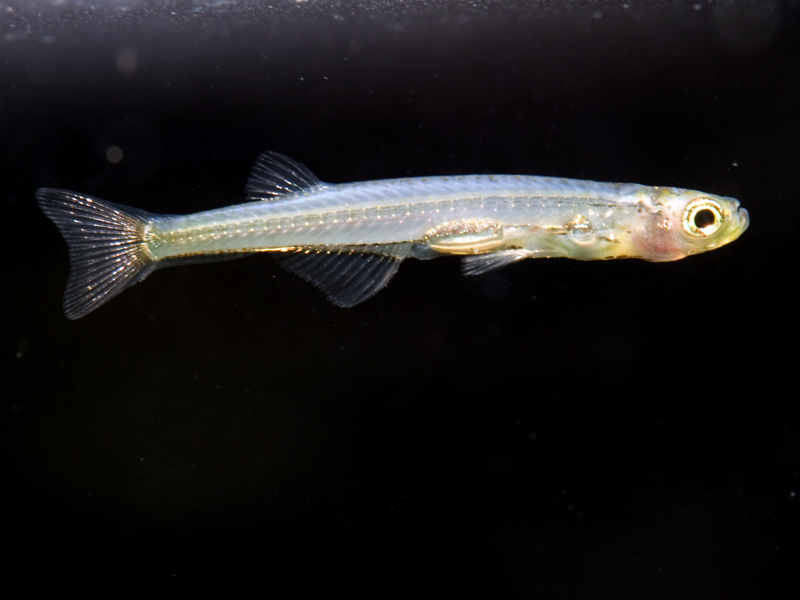
透体小(Danionella translucida)是身体几乎透明的微型鱼,成年后仍十分纤小。它的饲养重点是成熟而温和的环境、足够小的食物以及完整群体,单养一群比放入普通混养缸更合适。
分布与栖息地
见于缅甸南部勃固山脉南坡和东坡流出的少数溪流。栖地是低海拔、较宽的流水溪段,水通常浑浊,底质为沙或泥。采集个体曾出现在浮水植物根系间。
饲养环境
使用种有水草的成熟鱼缸,保持柔和水流,并让浮水植物覆盖部分水面。莫丝丛可提供微生物,让成鱼和鱼苗取食。过滤宜选择事先养成熟的气动海绵过滤,不要把新鱼直接投入未建立生物过滤的缸。
食性与喂食
外形娇小并不意味着完全无法喂养:压碎的干粮、极细颗粒、切碎的水蚯蚓、丰年虾无节幼体、微虫和筛过的小水蚤都可接受。关键在于入口尺寸足够小,并轮换不同食物。
习性与混养
自然群游,建议至少十二条。体型太小使混养选择非常有限,若尝试混养,应只选同样小型、要求相近的温和鱼;以繁殖为目标时更宜单养。
雌雄区分
雌鱼身体明显较高,怀卵时常能透过体壁看见卵。
繁殖
有一群被认为很可能属于本种的鱼,在独立、长有成熟莫丝的鱼缸中持续繁殖。观察到卵以独立的锥形团块附在底床,鱼苗先吃草履虫和绿水,再改喂丰年虾无节幼体、微虫。由于亲鱼种类未完全确认,这些经验只能作为谨慎尝试的参考;其第二代鱼苗还出现过脊柱畸形。
补充说明
它属于成熟个体仍保留某些幼体特征的微型鱼,不能把“透明、体型小”理解成尚未长大的普通鱼。
图片
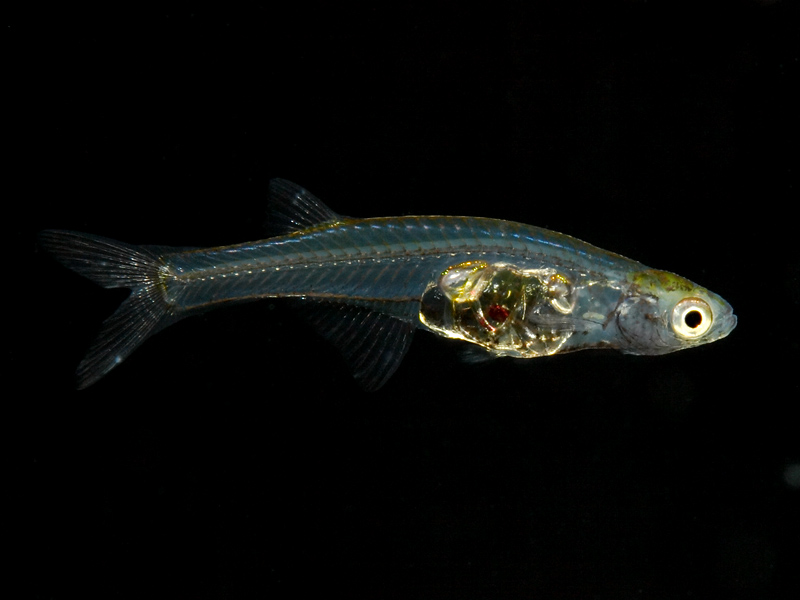
图片来自 SeriouslyFish,版权归各摄影者所有。
English
Overview
The almost transparent Danionella translucida remains minute even as an adult. An established environment, extremely small foods, and a substantial social group are the main practical considerations. A dedicated aquarium is generally preferable to a standard community.
Distribution & habitat
Records come from a few streams leaving the southern and eastern slopes of Myanmar's Bago Yoma. These are broad lowland channels with persistent flow, mostly turbid water, and sand or mud below. Floating-plant roots provided shelter at a collection site.
Aquarium setup
Plant the aquarium and keep water movement gentle. Partial floating cover and mature moss clumps are useful: the latter support microorganisms that adults and young can eat. An air-driven sponge filter should be biologically established before introduction.
Diet & feeding
Despite its delicate appearance, it accepts a useful range of foods when particles are small enough. Finely crushed dry food, chopped tubifex, nauplii, microworms, and suitably screened daphnia are options. Rotate foods rather than depending on one preparation.
Behaviour & compatibility
Provide at least a dozen fish. Their tiny dimensions sharply restrict safe community choices, and breeding is easier to prioritize in a species aquarium. If companions are attempted, choose equally small fish with matching environmental requirements.
Sexual dimorphism
Females have noticeably deeper bodies. In gravid individuals the eggs can often be seen through the body wall.
Breeding
A group believed probably to be this species reproduced repeatedly after transfer to an aquarium containing established moss. Eggs formed separate cone-shaped clusters on the substrate. Fry were raised initially on infusoria and green water, later taking nauplii and microworms.
Identification of the parents was uncertain, so this account should guide cautious experimentation rather than be treated as a verified species-specific method. Spinal abnormalities were also observed in the second generation.
Notes
Its miniature adult form retains developmental features associated with larvae in larger relatives. Transparency and tiny size therefore do not mean the fish is simply an immature version of a much larger species.
来源
- https://www.seriouslyfish.com/species/danionella-translucida(抓取于 2026-10-10)
danionella-translucida · 文件: data/species/danionella-translucida.md · 状态: 草稿