杂色剑尾鱼 · Variable Platy
概要
| 字段 | 值 |
|---|---|
| 类别 | 鱼 |
| 学名 | Xiphophorus variatus |
| 别名 | 雜色劍尾魚、Platypoecilus variatus |
| 分类 | 鳉形目 Cyprinodontiformes › 花鳉科 Poeciliidae › Xiphophorus |
| 水体 | 淡水 |
| 成体体长 | 5 cm |
| 饲养难度 | 入门 |
| 最小水体 | 54 L |
| 最小缸长 | 60 cm |
| 外部数据 | seriouslyfish xiphophorus-variatus;fishbase 3233 |
| 原产地 | 墨西哥大西洋坡面 |
| 食性 | 杂食 |
| 性情 | 温和 |
| 繁殖方式 | 卵胎生 |
水质参数
| 参数 | 耐受范围 | 最适范围 | 单位 |
|---|---|---|---|
| 水温 | 20–26 | — | °C |
| pH | 7–8.2 | — | — |
| 总硬度 | 14–30 | — | dGH |
概述
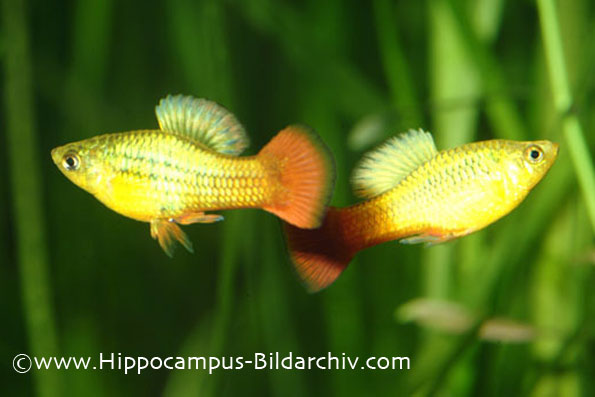
杂色剑尾鱼(Xiphophorus variatus)是常见卵胎生观赏鱼,已有许多人工品系。整体性情温和,但长期需要中等以上硬度的水;部分量产鱼因近交而体质较弱,选鱼时应留意健康与来源。
分布与栖息地
原产墨西哥大西洋坡面。哥斯达黎加、哥伦比亚、美国、新加坡及中国香港等地存在引入或逸生种群。贸易中主要为远东及东欧繁殖场生产个体,野生型较少。
常生活在浅而水草丰富的溪流、池塘、沼泽、运河和水沟,尤其与藻类及其他植物浮游生物丰富的环境有关。
饲养环境
缸长至少约 60 cm。布置要求不严,植物缸较能表现体色和活动。需要中等以上硬度,软酸水不适合作为长期环境。
食性与喂食
天然杂食,摄食底栖小动物与碎屑。活饵、冷冻饵和干粮通常都能接受,喂养不困难。
习性与混养
适合环境需求一致的温和混养缸。雌雄同养时,雄鱼追逐可能持续不断,宜让雌鱼多于雄鱼,并以植物提供退避空间。繁殖会不断产生新幼鱼,需要预先考虑容量。
雌雄区分
雄鱼较小,具有交接器。
繁殖
每雄配数条雌鱼有助分散追逐。妊娠约 4~7 周,一胎超过 100 条并不罕见。虽然本种成鱼一般不会吞食自己的后代,若需方便管理,仍可将孕鱼移入独立缸,产后移回主缸。
避免把小型繁殖盒或网盒作为长期育苗空间。幼鱼出生能吃丰年虾无节幼体和粉碎薄片,每天喂 2~3 次时生长很快。
补充说明
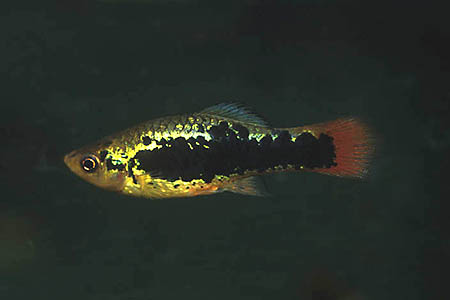
野生型比月光鱼(Xiphophorus maculatus)更修长,背鳍也略长,人工选育进一步发展出高鳍品系。部分商品品系与月光鱼或剑尾鱼(Xiphophorus hellerii)具有杂交背景,获得野生来源个体后应避免与家养品系混繁。
近交与过度量产可能使某些商业品系易病、早死,不能把本种总体强健的评价当作每条商品鱼都健康的保证。
图片
图片来自 SeriouslyFish,版权归各摄影者所有。
English
Overview
Numerous ornamental strains of Xiphophorus variatus are available. The species is generally peaceful, but needs moderately hard or harder water for long-term care. Some mass-produced lines are weakened by inbreeding, making stock quality relevant despite its reputation for toughness.
Distribution & habitat
Its native range is Mexico's Atlantic slope. Introduced or feral populations occur elsewhere, including Costa Rica, Colombia, the United States, Singapore, and Hong Kong. Farms in the Far East and eastern Europe produce most aquarium fish.
Shallow vegetated streams, ponds, swamps, canals, and ditches provide habitat, particularly where algae and phytoplankton are abundant.
Aquarium setup
Provide a tank at least about 60 cm long. Decoration is flexible, although planting displays the fish well and gives useful cover. Soft, acidic conditions are unsuitable for long-term maintenance.
Diet & feeding
An omnivore in nature, it consumes small bottom-dwelling animals and detritus. Live, frozen, and prepared foods are all readily accepted.
Behaviour & compatibility
A peaceful community with matching environmental requirements is suitable. Keep females more numerous than males, whose courtship can be persistent, and provide planted retreats. Mixed-sex groups continually add young, so plan for population growth.
Sexual dimorphism
Males are smaller and carry a gonopodium.
Breeding
Several females per male distribute attention. Pregnancy lasts approximately four to seven weeks, and broods exceeding 100 young are not unusual. Adults generally leave their own fry alone, but a separate maternity tank still offers convenient management; return the female after delivery.
Avoid cramped breeding boxes or net traps as rearing quarters. Newborns accept Artemia nauplii and powdered flakes. Two or three meals daily support fast growth.
Notes
Wild fish have a more elongated body and slightly longer dorsal fin than Xiphophorus maculatus. Selective breeding has amplified dorsal height in some strains. Hybrid ancestry involving that species or Xiphophorus hellerii occurs among ornamental fish, so keep wild-origin stock separate from domestic forms.
Inbreeding and excessive mass production can make some commercial lines disease-prone and short-lived. The species' overall hardiness does not guarantee the condition of an individual offered for sale.
来源
- https://www.seriouslyfish.com/species/xiphophorus-variatus(抓取于 2026-10-10)
xiphophorus-variatus · 文件: data/species/xiphophorus-variatus.md · 状态: 草稿