蛇皮曼龙 · Snakeskin Gourami
概要
| 字段 | 值 |
|---|---|
| 类别 | 鱼 |
| 学名 | Trichopodus pectoralis |
| 别名 | 糙鳞毛足鲈、糙鱗毛足鱸、蛇皮毛足鲈 |
| 分类 | 攀鲈目 Anabantiformes › 丝足鲈科 Osphronemidae › Trichopodus |
| 水体 | 淡水 |
| 成体体长 | 30 cm |
| 饲养难度 | 入门 |
| 最小水体 | 108 L |
| 最小缸长 | 120 cm |
| 性情 | 温和 |
| 外部数据 | seriouslyfish trichopodus-pectoralis;fishbase 499 |
| 原产地 | 越南、老挝、柬埔寨、泰国、缅甸 |
| 食性 | 杂食 |
| 繁殖方式 | 吐泡筑巢 |
水质参数
| 参数 | 耐受范围 | 最适范围 | 单位 |
|---|---|---|---|
| 水温 | 22–30 | — | °C |
| pH | 5.8–8.5 | — | — |
| 总硬度 | 2–30 | — | dGH |
概述
蛇皮曼龙(Trichopodus pectoralis)是体型较大的温和丝足鲈,适合空间充分的混养缸。它对同类的领地冲突通常比许多近缘种弱,但体型和繁殖护巢行为仍需纳入混养考虑。
分布与栖息地
原产越南、老挝、柬埔寨、泰国及缅甸的湄公河和湄南河相关区域。由于食用养殖与引入,亚洲多地及其他国家另有逸生种群。
常在水流缓慢或静止、植被茂密的水域表现较好。湄公河下游种群在雨季进入淹水森林或草地,退水后回到常年有水的区域。
饲养环境
布置水草、浮水植物和躲藏处,同时保留开放游动区。繁殖缸过滤温和,水面稳定,浮水植物为大型泡巢提供支撑。
食性与喂食
天然杂食,以植物、藻类和其他浮游植物为主要部分,也捕食昆虫幼体、蛞蝓、蜘蛛等水生或陆生无脊椎动物。不能因成鱼较大就只按肉食鱼投喂。
习性与混养
可选择温和且不会被其体型吓住的伙伴。雄鱼相对不强占领域,并不等于绝无冲突;较小的鱼仍可能被吞食。繁殖结束后雌鱼会被雄鱼驱赶,应及时分开。
雌雄区分
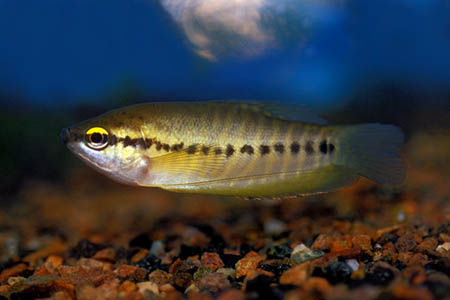
雄鱼背鳍和臀鳍末端较尖,腹鳍橙红;雌鱼体形更丰满。
繁殖
繁殖较容易,用丰富活饵调养,繁殖水深约 15~20 cm,并有较多浮水植物。雄鱼建立泡巢、展示求偶,双方用丝状腹鳍触碰,在巢下相拥排卵。卵上浮后由雄鱼收入巢中,多次产卵总数可达约五千粒。
产后移走雌鱼,防止被雄鱼伤害。卵约二十至三十小时孵化,再过四至五天鱼苗自由游动,此时移走雄鱼。第一周可喂微生物饵或适合极小鱼苗的液体饵,之后逐步转为丰年虾无节幼体、微虫和粉粮。鱼苗长得慢,最初约三个月对温度变化尤其敏感,换水时需避免温差。
补充说明
求偶及领地互动时可能发出类似噼啪的声音,是这种鱼有趣的行为之一。
图片
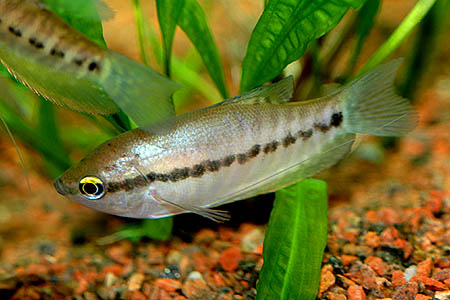
图片来自 SeriouslyFish,版权归各摄影者所有。
English
Overview
The large Trichopodus pectoralis, or snakeskin gourami, is generally peaceful and suitable for spacious communities. Its comparatively mild territorial behavior does not remove the importance of adult size or nest defense when planning companions.
Distribution & habitat
Its native range includes Mekong and Chao Phraya regions in Vietnam, Laos, Cambodia, Thailand, and Myanmar. Food-fish farming and introductions have established feral populations elsewhere.
It thrives in slow or still waters with dense vegetation. Lower Mekong populations enter flooded forest and grassland during the wet season, returning to permanent water as levels recede.
Aquarium setup
Combine plants, floating cover, and retreats with open swimming room. Breeding requires gentle filtration and a calm surface where floating plants can support a substantial bubble nest.
Diet & feeding
Wild fish are omnivorous, taking mostly plant material, algae, and other phytoplankton while also eating aquatic and terrestrial invertebrates such as insect larvae, slugs, and spiders. Adult size is not a reason to provide an exclusively meaty diet.
Behaviour & compatibility
Choose peaceful companions that will not be intimidated by its eventual size. Males are less territorial than many other gouramis, but smaller fish may still be swallowed. Nest defense changes the pair's relationship, and the female should be separated after spawning.
Sexual dimorphism
Males develop pointed dorsal and anal fins and orange-red pelvic fins. Females are fuller-bodied.
Breeding
Breeding is relatively easy after conditioning with live food. Use approximately 15–20 cm of water and abundant floating vegetation. The male constructs a bubble nest and displays; the pair may touch with their pelvic feelers before embracing beneath it. Floating eggs are gathered into the nest, with repeated spawning potentially producing about 5,000 eggs.
Remove the female afterward to prevent injury. Eggs hatch in roughly 20–30 hours. Fry swim freely another four or five days later, when the male should also be removed. Begin with infusoria-sized or suitable liquid fry foods, then progress after the first week to brine shrimp nauplii, microworms, and powdered foods. Growth is slow, and temperature changes during maintenance are particularly problematic for about the first three months.
Notes
Breeding and territorial exchanges may be accompanied by audible cracking sounds.
来源
- https://www.seriouslyfish.com/species/trichopodus-pectoralis(抓取于 2026-10-10)
trichopodus-pectoralis · 文件: data/species/trichopodus-pectoralis.md · 状态: 草稿