Syncrossus helodes · Banded Tiger Loach
概要
| 字段 | 值 |
|---|---|
| 类别 | 鱼 |
| 学名 | Syncrossus helodes |
| 分类 | 鲤形目 Cypriniformes › 沙鳅科 Botiidae › Syncrossus |
| 水体 | 淡水 |
| 原产地 | 柬埔寨、老挝、泰国、越南 |
| 成体体长 | 30 cm |
| 饲养难度 | 中等 |
| 最小水体 | 365 L |
| 最小缸长 | 180 cm |
| 群居方式 | 群游 |
| 特征 | 会跳缸: 是 |
| 外部数据 | seriouslyfish syncrossus-helodes;fishbase 26856 |
| 性情 | 半攻击性 |
水质参数
| 参数 | 耐受范围 | 最适范围 | 单位 |
|---|---|---|---|
| 水温 | 24–30 | — | °C |
| pH | 6–7.5 | — | — |
| 总硬度 | 2–12 | — | dGH |
概述
Syncrossus helodes 是可长到约 30 cm 的大型群居鳅,体侧有规律暗带,但性情和活动强度不适合普通小型混养缸。既要有宽敞环境,也要有足够同种,不能靠单养来避免群体冲突。
分布与栖息地
分布于老挝、柬埔寨、泰国及越南南部的湄公河流域,也见于泰国湄南河和 Mae Khlong 水系。不同地点的体色与鳍色会变化。
据报道,它从上游小溪到大河干流都能出现,雨季进入淹水区取食和繁殖。随季节改变,水深、水流、浑浊度和酸碱度均可上升,水温则可能下降,因此并非只对应一种固定河道环境。
饲养环境
长期饲养建议底面积至少约 180 × 45 cm。砂或细砾、平滑石块及沉木组成多处遮蔽,根枝和耐阴植物可提供阴影。它会挤入小缝,要移除锋利边缘并封住可能卡身的孔洞,缸盖也要严密。
使用成熟过滤,保持高溶氧和适当循环,不必制造猛烈湍流。对有机污染累积的耐受差,每周约换水 30–50%,不宜进未成熟新缸。藏身处和充足空间不能代替清洁水质。
食性与喂食
同属鱼以动物性食物为主,也会摄入植物,有时啃软叶。缸内可轮换优质干粮、红虫、水丝蚓、丰年虾等活饵或冻饵,再配黄瓜、瓜类、烫菠菜;多原料凝胶饲料也适用。切碎蚯蚓只需少量补充。
近亲吃水螺,但有其他食物时也会选择其他菜单,不能把它当作可靠的除螺措施。适应后的鱼抢食积极,需留意弱势个体是否有机会进食。
习性与混养
本种可能相当强势。至少五至六条,条件允许时十条以上更理想;独养可能退缩或攻击形似鱼,只养两三条时,优势鱼常反复攻击其他个体,甚至妨碍其进食。
避免明显更小、慢游或长鳍的鱼。体形合适、游动迅速的开阔水域鲤科鱼较可考虑;与强壮底部鳅合养的经验并不一致,仍可能过度攻击。其他底部伙伴也要避免领域争夺,不能把“皮实”当作相容保证。
同属鱼争位时可能暂时褪色,个体胆量差异较大,群体领头鱼的性情似乎也会影响全群。咔哒声与兴奋状态有关,但沟通功能和发声细节尚未完全厘清。
雌雄区分
成年雌鱼预计较粗壮,也可能长得更大,仍应保留个体差异和鉴别不确定性。
繁殖
野外有雨季进入淹水区产卵的描述,可能属于季节性洄游繁殖者。尚无可靠的缸内繁殖流程,不能据野外洄游背景推定家养条件下容易繁殖。
补充说明
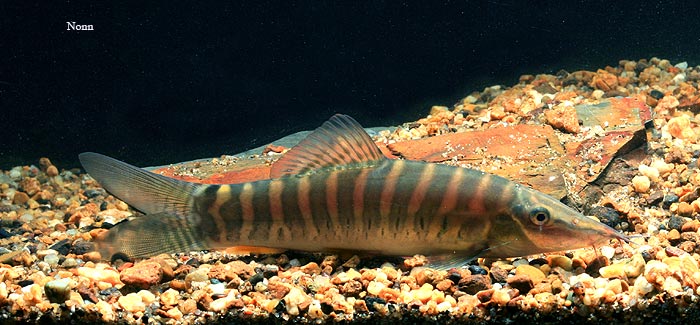
本种通常有 10–12 条暗带,下半身还有细小不规则暗纹;与 Syncrossus hymenophysa 相比,条带通常没有蓝色边缘,也缺少后者特征性的背鳍暗斑。不同产地鳍色有差异,但意义未明,不能仅靠鳍色划种。眼下棘受惊时会竖起,捞取时可挂网或刺伤手;持续消瘦也不应忽视。
图片
图片来自 SeriouslyFish,版权归各摄影者所有。
English
Overview
Syncrossus helodes can reach about 30 cm and combines a large adult size with vigorous, sometimes belligerent behavior. Its regular body bars should not distract from the space and social requirements. Solitary keeping is not a reliable solution to group conflict.
Distribution & habitat
The range includes the Mekong in Laos, Cambodia, Thailand, and southern Vietnam, plus Thailand's Chao Phraya and Mae Khlong systems. Body and fin colors vary between localities.
Reports span small headwaters and main river channels, with wet-season movement into flooded areas for feeding and spawning. Greater depth, stronger flow, increased turbidity, and rising pH may accompany falling temperature. The species therefore encounters changing habitats rather than one constant channel type.
Aquarium setup
Provide at least about 180 × 45 cm for long-term care. Sand or fine gravel, smooth stones, and wood should form numerous refuges, with roots and shade-tolerant plants adding shelter. Remove sharp edges and seal openings that could trap a fish squeezing inside. Fit a secure cover.
Use mature biological filtration with high oxygen levels and some circulation, without excessive turbulence. Prevent organic-waste buildup and change about 30–50% weekly. Do not introduce fish to an immature aquarium. Space and cover cannot compensate for poor water quality.
Diet & feeding
Related Syncrossus predominantly eat animal foods but also take vegetation and sometimes soft leaves. Rotate quality dry foods with live or frozen bloodworms, Tubifex, and brine shrimp, plus cucumber, melon, or blanched spinach. Mixed-ingredient gel foods are useful, while chopped earthworms should be limited additions.
Relatives eat aquatic snails but choose other foods too, so they are not dependable snail-control tools. Settled fish feed boldly; check that subordinate individuals can still obtain a share.
Behaviour & compatibility
This species can be forceful. Keep at least five or six, preferably ten or more where space allows. An isolated fish may withdraw or attack similar companions. In pairs or trios, the dominant fish commonly attacks others repeatedly and may prevent feeding.
Avoid much smaller, slow, or long-finned companions. Appropriately sized fast open-water cyprinids are better candidates. Reports of mixing it with robust bottom-dwelling loaches vary, including excessive aggression. Other companions should avoid territorial conflict; hardiness alone does not establish compatibility.
Temporary fading during rank contests is observed in the genus. Individual boldness varies, and the leading fish may influence the group. Audible clicks increase with excitement, but their communication role and production are incompletely understood.
Sexual dimorphism
Adult females are expected to be stockier and may grow larger. Individual variation and uncertainty limit this as an identification method.
Breeding
Wild fish reportedly enter flooded areas to spawn during the wet season and probably reproduce through seasonal migration. A dependable aquarium protocol is not established; wild migration does not imply easy captive breeding.
Notes
Usually 10–12 dark bars accompany small irregular marks on the lower body. Compared with Syncrossus hymenophysa, the bars generally lack blue edging and its characteristic dark dorsal-fin blotch is absent. Geographic fin-color differences have uncertain significance and do not alone define species. Eye spines can snag nets or injure hands, and persistent wasting deserves attention.
来源
- https://www.seriouslyfish.com/species/syncrossus-helodes(抓取于 2026-10-10)
syncrossus-helodes · 文件: data/species/syncrossus-helodes.md · 状态: 草稿