Sphaerichthys acrostoma · Giant Chocolate Gourami
概要
| 字段 | 值 |
|---|---|
| 类别 | 鱼 |
| 学名 | Sphaerichthys acrostoma |
| 分类 | 攀鲈目 Anabantiformes › 丝足鲈科 Osphronemidae › Sphaerichthys |
| 水体 | 淡水 |
| 原产地 | 印度尼西亚 |
| 成体体长 | 7 cm |
| 饲养难度 | 中等 |
| 最小水体 | 72 L |
| 最小缸长 | 80 cm |
| 群居方式 | 群游 |
| 水流偏好 | 低 |
| 外部数据 | seriouslyfish sphaerichthys-acrostoma;fishbase 25139 |
| 食性 | 肉食 |
| 繁殖方式 | 口孵 |
| 领地性 | 是 |
水质参数
| 参数 | 耐受范围 | 最适范围 | 单位 |
|---|---|---|---|
| 水温 | 21–25 | — | °C |
| pH | 3.5–6.5 | — | — |
| 总硬度 | 0–3 | — | dGH |
概述
Sphaerichthys acrostoma 是婆罗洲 Mentaya 水系的口孵迷鳃鱼,常被冠以大型或尖吻巧克力等商品标签。它动作较慢,群体需要安静环境和细小食物;繁殖由雄鱼含卵,不能套用其他巧克力鱼的雌性口孵模式。
分布与栖息地
已知来自印度尼西亚婆罗洲 Mentaya 河流域,包括 Sampit 附近。主要利用泥炭沼泽及黑水溪流,也可能出现在部分清水环境。典型栖地低光、极软且偏酸,底部多落枝和腐叶,森林破坏会改变这类水体。
饲养环境
至少约 80 × 30 cm 底面积。柔软砂底、沉木根枝可形成许多阴影与洞穴,陶罐、短管等人工藏身物也适用。干叶支持微生物群并增加遮蔽,仔鱼可利用其中的补充食物。
灯光偏暗,耐阴水草和浮水植物较合适。水流不要强,低密度饲养时每周约 10–15% 小换水可维持环境,避免突然大换水。换水和投喂都应照顾它行动较慢、怕受压的特点。
食性与喂食
本种主要捕食小型水生甲壳动物、蠕虫、昆虫幼虫及其他浮游动物。初入缸可能拒绝干粮,部分个体之后会接受。每天应供应小型活饵或冻饵,如丰年虾无节幼体、水蚤、微虫或格林达尔蠕虫。
习性与混养
大鱼或活跃争食者容易使它紧张和吃不到食物。伙伴应小型、平和且环境需求接近。至少六条有助于同种互动,但它不形成紧密群游;群体会建立等级,优势鱼可能在喂食或喜欢的位置驱逐其他鱼,应观察弱鱼是否正常进食。
雌雄区分
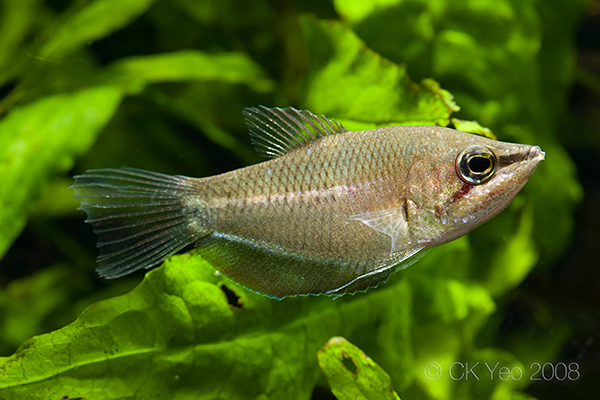
求偶或兴奋时,雄鱼有从尾基延至身体中段的侧纹。雌鱼没有这条纹,前下部身体及臀鳍基部有较暗鳞行,喉部和单鳍红色更多,头部更尖,下颌轮廓较直。雄鱼下颌略圆,口孵时皮肤可扩张。
繁殖
雄性口孵,可在群体或单对中繁殖,求偶通常由雌鱼、或群体中的优势雌鱼发起。亲鱼近乎直立地拥抱,在底质上产卵受精,雄鱼直接拾入口中;两亲在此期间守卫周围。
含卵雄鱼躲在安静处,很少或完全不进食,含养约 7–20 天后释放 10–40 条自由游动幼鱼。可在产卵数日后谨慎将雄鱼移至单独育苗缸,也可逐条转移释放的幼鱼,新缸需保持相同水温与化学条件;成熟密植缸也可能自然保住一些后代。
仔鱼可立即吃微虫和丰年虾无节幼体,育苗缸每天约换水 10% 以维持水质与生长。严密盖板保留温暖湿润空气,是幼鱼迷鳃正常发育的重要条件。
补充说明
本种雌雄体色组合与有明显浅色纵带的其他巧克力鱼不同。商品名并非可靠身份依据,尤其要同时核对侧纹、头形、红色分布及产地。
图片
图片来自 SeriouslyFish,版权归各摄影者所有。
English
Overview
Sphaerichthys acrostoma is a mouthbrooding labyrinth fish from Borneo's Mentaya system, sold under several giant- or sharp-nosed-chocolate labels. Slow movement calls for quiet company and small foods. Males carry the brood, unlike the female mouthbrooding of some other chocolate gouramis.
Distribution & habitat
It is known from the Mentaya drainage in Indonesian Borneo, including records near Sampit. Peat swamps and black-water streams predominate, although some clear-water occurrence is possible. Typical habitat is shaded, very soft, and acidic, with fallen branches and leaves. Forest alteration affects these environments.
Aquarium setup
Allow at least about 80 × 30 cm of floor space. Soft sand, roots, and branches create shaded caves; pots and pipes also provide useful refuges. Dried leaves add cover and microbial communities that supplement fry food.
Dim lighting, shade-tolerant plants, and floating cover are suitable. Keep water movement gentle. In lightly stocked aquariums, weekly changes of about 10–15% are appropriate, avoiding sudden large changes. Maintenance and feeding should account for the fish's sensitivity to competition and disturbance.
Diet & feeding
It mainly hunts small aquatic crustaceans, worms, insect larvae, and other zooplankton. New arrivals may reject prepared food, although some learn to accept it. Supply daily small live or frozen foods such as brine shrimp nauplii, Daphnia, microworms, or Grindal worms.
Behaviour & compatibility
Larger or vigorous fish can intimidate it and monopolize food. Choose small peaceful companions with matching requirements. At least six conspecifics support interaction, despite the absence of tight schooling. Groups develop hierarchies, and dominant fish may exclude rivals from food or favored places; monitor subordinate feeding.
Sexual dimorphism
Excited or courting males show a stripe from the tail base to midbody. Females lack it, instead showing darker scale rows on the lower front body and along the anal-fin base. Females also have more red on the throat and unpaired fins, a sharper head, and a straighter lower jaw. The male's rounder jaw has expandable skin for brooding.
Breeding
Males mouthbrood in pairs or groups. Courtship normally begins with a female, or the dominant female in a group. Nearly upright embraces precede eggs being deposited and fertilized on the substrate, then gathered directly by the male. Both adults defend the area during spawning.
A brooding male retreats and eats little or nothing. After about seven to twenty days he releases roughly ten to forty swimming young. He can be moved cautiously to separate accommodation a few days after spawning, or released fry transferred individually, using matching water chemistry and temperature. Mature planted aquariums may retain some offspring naturally.
Fry immediately accept microworms and brine shrimp nauplii. Daily water changes around 10% support rearing. A tight lid retains warm humid air needed for normal labyrinth development.
Notes
Sex-specific patterns distinguish this fish from more distinctly pale-barred chocolate gouramis. Check flank markings, head shape, red pigmentation, and provenance rather than relying on sales labels.
来源
- https://www.seriouslyfish.com/species/sphaerichthys-acrostoma(抓取于 2026-10-10)
sphaerichthys-acrostoma · 文件: data/species/sphaerichthys-acrostoma.md · 状态: 草稿