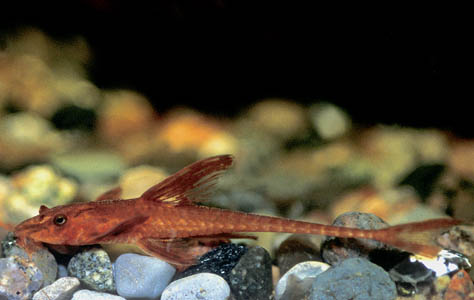
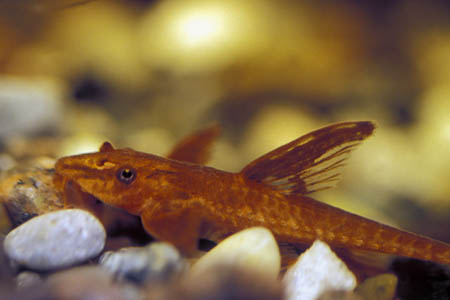
红蜥蜴 · Red Lizard Catfish
概要
| 字段 | 值 |
|---|---|
| 类别 | 鱼 |
| 学名 | Rineloricaria sp. |
| 别名 | L010a/L10a、Rineloricaria sp. |
| 分类 | 鲶形目 Siluriformes › 骨甲鲶科 Loricariidae › Rineloricaria |
| 水体 | 淡水 |
| 成体体长 | 11 cm |
| 饲养难度 | 入门 |
| 最小水体 | 68 L |
| 最小缸长 | 75 cm |
| 性情 | 温和 |
| 外部数据 | seriouslyfish rineloricaria-sp |
| 原产地 | 来源未确定,可能为人工培育类型;若为人工类型,亲本身份也未明 |
| 食性 | 杂食 |
| 领地性 | 是 |
| 繁殖方式 | 附着产卵 |
水质参数
| 参数 | 耐受范围 | 最适范围 | 单位 |
|---|---|---|---|
| 水温 | 24–29 | — | °C |
| pH | 6–7.5 | — | — |
| 总硬度 | 2–15 | — | dGH |
概述
红蜥蜴是身份来源尚未完全厘清的红色鞭尾鲶,贸易编号为 L010a。它非常温和,合适条件下容易产卵,真正的难点往往是让幼鱼持续获得适口食物并维持清洁水质。
分布与栖息地
尚不清楚它是独立野生类型、人工选育型还是杂交后代,所谓巴拉圭野生产地也只是未经证实的说法。市售个体看起来均为人工繁殖,不能把这些推测产地当成确定原生范围。
饲养环境
活动量较低,可小群饲养。砂底、干叶、根枝和圆石能形成柔和遮蔽,石木洞穴或短管可供繁殖,也适合种草缸。不要使用过强照明。挑选伙伴时还应注意它不适合长期偏高的温度。
食性与喂食
杂食,沉底干粮配焯软菠菜、西葫芦、羽衣甘蓝等植物性食物,以及红虫、水蚤等活饵和冷冻饵。确保食物真正留到它能吃到的位置,不被快鱼提前抢光。
习性与混养
可与很多温和鱼相处,小型灯鱼、温和短鲷、底栖鲶鱼和安静异型都可考虑。过于强势或活跃的鱼会使它躲藏退缩并抢不到食物。平时不明显守域,繁殖时例外,小群饲养较合适。
繁殖
可从六尾以上幼鱼养起获得配对,准备内径小于约 5 cm 的繁殖管,以营养好的绿叶菜及活饵、冷冻饵调理。雄鱼选洞清理,雌鱼进入产卵,受精后由雄鱼独自守卫、扇水,雌鱼不继续照料。必要时可移出其他鱼,或将整根繁殖管移到独立育苗缸,减少幼鱼被吃。
卵约四至五天孵化,再两至三天起游,此后可移走雄鱼。幼鱼能摄食软蔬菜、微虫及丰年虾无节幼体,关键是持续有食物且菜叶足够软;有藻的石面也可提供啃食来源。它们对水质敏感,宜每天少量换水。
迟迟不产时,可尝试较大量、稍凉的换水刺激,但这属于缸养诱导方法,不能据此反推它已经有确定的野生雨季生活史。
图片
图片来自 SeriouslyFish,版权归各摄影者所有。
English
Overview
The red whiptail traded as L010a has an unresolved origin and identity. Extremely peaceful, it breeds readily under suitable conditions. Rearing success depends especially on continuous access to appropriately soft food and clean water for the fry.
Distribution & habitat
Its status as a wild form, selectively bred variety, or hybrid remains unresolved. A proposed Paraguayan wild origin is unconfirmed. Available trade fish appear to be captive-bred, so speculative origins should not be presented as an established native range.
Aquarium setup
A relatively inactive fish, it can be maintained in a small group. Sand, leaves, branches, and rounded stones provide a sheltered layout, with rock or wood caves or short pipes for spawning. Planted aquaria also work. Avoid intense lighting and companions whose temperature needs push conditions excessively high.
Diet & feeding
An omnivore, it accepts sinking prepared food, softened vegetables such as spinach, zucchini, and kale, and live or frozen items such as bloodworms and water fleas. Ensure faster companions do not remove food before it can feed.
Behaviour & compatibility
Small characins, mild dwarf cichlids, catfish, and quiet plecos are possible companions. Vigorous or aggressive fishes can make it retreat and lose access to food. It is generally nonterritorial except when breeding and does well in a small group.
Breeding
Start with six or more juveniles to obtain a pair. Provide spawning tubes under roughly 5 cm in diameter and condition adults with nutritious greens and live or frozen foods. The male cleans a cave; a female enters to lay eggs, then leaves all guarding and fanning to him. Removing other fish, or transferring the whole tube to separate accommodation, can reduce fry predation.
Eggs hatch in about four to five days, followed by free swimming another two to three days later, when the male can be removed. Young take soft vegetables, microworms, and Artemia nauplii. Constant access to sufficiently soft food is crucial; algae-covered stones offer another feeding surface. Small daily water changes help protect sensitive fry.
A substantial change using slightly cooler water may encourage reluctant fish to spawn. This is a captive technique, not proof of an established wild rainy-season history.
来源
- https://www.seriouslyfish.com/species/rineloricaria-sp(抓取于 2026-10-10)
rineloricaria-sp · 文件: data/species/rineloricaria-sp.md · 状态: 草稿