大吻鰕虎鱼
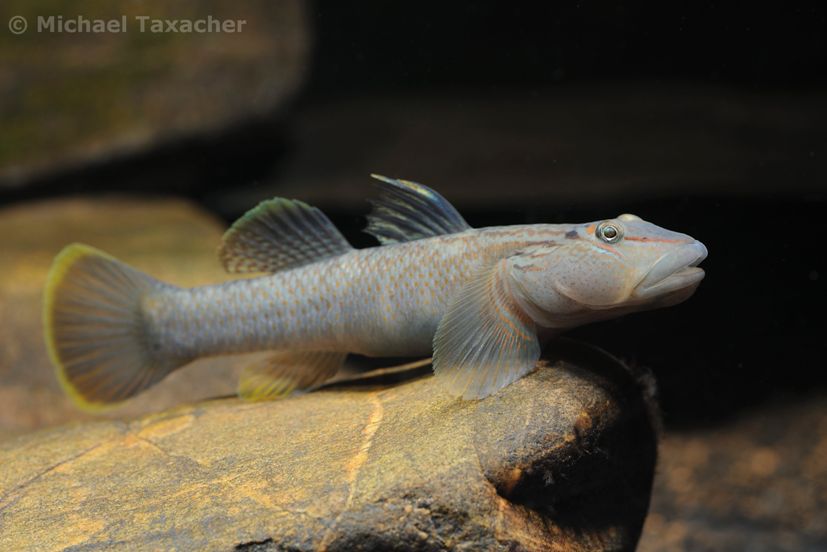
概要
| 字段 | 值 |
|---|---|
| 类别 | 鱼 |
| 学名 | Rhinogobius gigas |
| 别名 | 大吻鰕虎、大吻鰕虎魚 |
| 分类 | 虾虎鱼目 Gobiiformes › 虾虎鱼科 Gobiidae › Rhinogobius |
| 水体 | 淡水 |
| 原产地 | 台湾东部宜兰、花莲及台东的河流中下游 |
| 成体体长 | 8.5 cm |
| 饲养难度 | 中等 |
| 最小水体 | 72 L |
| 最小缸长 | 80 cm |
| 群居方式 | 群游 |
| 领地性 | 是 |
| 水流偏好 | 高 |
| 外部数据 | seriouslyfish rhinogobius-gigas;fishbase 27074 |
| 游动层 | 底层 |
| 繁殖方式 | 附着产卵 |
水质参数
| 参数 | 耐受范围 | 最适范围 | 单位 |
|---|---|---|---|
| 水温 | 18–28 | — | °C |
| pH | 6–8 | — | — |
| 总硬度 | 2–15 | — | dGH |
概述
大吻鰕虎鱼(Rhinogobius gigas)来自台湾东部,身体深色横带清楚,脸颊和第二背鳍、臀鳍上有多处斑点。它在贸易中并不常见,名字有时被用于近似种,饲养前应核实身份。
分布与栖息地
原生于宜兰、花莲和台东河流水系中下游。栖息环境包括小河、支流和溪流,底部由砂砾、岩石、大石及基岩构成,水深、水流和浑浊度随季节变化。强降雨及台风时环境变化尤其明显。
饲养环境
小群底面积约 80 × 30 cm 起步,用砂砾、圆石、枝木、陶管和小花盆构成多处阴影、洞缝与视线屏障,耐受水草可附生其上。保持充足溶氧和适当流动,无须猛烈激流。每周换水约三至五成,防止有机污物积累。
食性与喂食
吻鰕虎鱼属通常偏机会性肉食,缸内用适口红虫、蚊幼虫、丰年虾、水蚤、糠虾等小型活饵或冷冻饵。部分个体适应后接受干粮,但不宜把它作为经常性主食。
习性与混养
个体强健且偶有攻击行为,混养优先选适应相似环境的温和中上层鱼。小缸最好让它独占底层,大空间才考虑合适鳅类;淡水小虾可能被吃,不宜当成安全伙伴。避免其他守域底层鱼和同属近似种,后者有未厘清的杂交风险。
至少两雄配同数或更多雌鱼较合适,充分遮蔽可减少雄鱼之间的严重冲突,缺少同类可能变得不活跃。
雌雄区分
雄鱼较大、颜色更浓,背鳍和臀鳍延长。雌鱼尾基可有竖直弧形暗纹,抱卵时腹部透见蓝色卵团。
繁殖
在洞穴或石缝顶面产卵,由雄鱼守护。提供多个巢位,亲鱼进入后可能隐藏两至三天,不宜打扰;雌鱼离洞后再在水下轻抬巢体检查。
初次繁殖可能出现吃卵、受精不全或卵附着不牢,之后常会改善。可移走其他鱼,或将雄鱼和卵一起转到安全环境。窝卵量可很大,但没有固定粒数可直接套用;卵较大,通常九至十二天孵化。幼鱼先在水层中活动,随后落底,开口可吃丰年虾无节幼体、微虫等相近大小活饵。
补充说明
脸颊点纹、第二背鳍与臀鳍成排斑点,以及清晰体带应组合使用,单靠“大型”或某一条纹不足以可靠鉴定。
图片
图片来自 SeriouslyFish,版权归各摄影者所有。
English
Overview
Rhinogobius gigas is an eastern Taiwanese goby with distinct dark body bands, spotted cheeks, and rows of spots in the second dorsal and anal fins. It is uncommon in aquariums, and similar fishes are sometimes sold under its name.
Distribution & habitat
It inhabits middle and lower river sections in Yilan, Hualien, and Taitung. Small rivers, tributaries, and streams have bottoms of gravel, rocks, boulders, and bedrock. Depth, flow, and turbidity vary seasonally, especially during heavy rains and tropical storms.
Aquarium setup
Provide a small group a footprint around 80 × 30 cm or larger. Use sand, gravel, stones, wood, ceramic tubes, and pots to create shaded retreats and interrupted sight lines. Hardy attached plants can be included. Maintain high oxygen levels and some circulation without a constant torrent. Weekly changes of roughly 30–50 percent help prevent organic waste buildup.
Diet & feeding
The genus generally feeds opportunistically on small animal prey. Offer suitably sized live or frozen foods such as bloodworms, mosquito larvae, brine shrimp, water fleas, and mysids. Dry food may be accepted after acclimation but should not be a regular staple.
Behaviour & compatibility
These robust fish can be aggressive. Peaceful upper-water companions with similar requirements are better candidates. In small tanks, leave the bottom to the gobies; compatible loaches are more feasible in larger quarters. Small freshwater shrimp may be eaten. Avoid territorial bottom fishes and other species of the genus, whose hybridization potential is unresolved.
Keep at least two males with an equal or greater number of females. Sufficient cover usually limits serious male conflict, while inadequate company may lead to inactivity.
Sexual dimorphism
Males are larger and more colorful with longer dorsal and anal fins. Females may show a vertical curved dark mark at the tail base, and ripe females have a bluish egg mass visible through the abdomen.
Breeding
Eggs attach to the roof of a cave or crevice and receive male care. Offer several sites. Pairs may hide for two or three days; avoid disturbance and inspect gently underwater only after the female emerges.
Early attempts may involve egg eating, incomplete fertilization, or poor attachment. Remove other fish or move the male and clutch to safety. Broods can be large, but a fixed egg count is not established. The relatively large eggs usually hatch after nine to twelve days. Young occupy the water column initially before settling and can take brine shrimp nauplii, microworms, and comparable live foods immediately.
Notes
Use cheek spots, rows of fin markings, and clear body bands together. Large size or a single stripe is not sufficient identification.
来源
- https://www.seriouslyfish.com/species/rhinogobius-gigas(抓取于 2026-10-10)
rhinogobius-gigas · 文件: data/species/rhinogobius-gigas.md · 状态: 草稿