费氏拟丽鱼 · Goldbreast Zebra
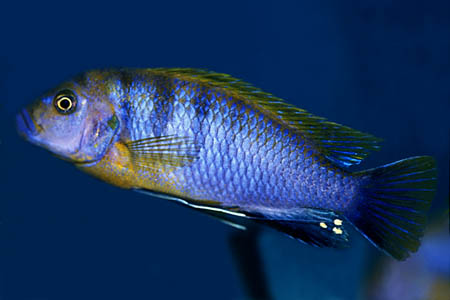
概要
| 字段 | 值 |
|---|---|
| 类别 | 鱼 |
| 学名 | Pseudotropheus fainzilberi |
| 别名 | 費氏擬麗魚 |
| 分类 | 慈鲷目 Cichliformes › 慈鲷科 Cichlidae › Pseudotropheus |
| 水体 | 淡水 |
| 成体体长 | 17.5 cm |
| 饲养难度 | 中等 |
| 最小水体 | 205 L |
| 最小缸长 | 120 cm |
| 领地性 | 是 |
| 外部数据 | seriouslyfish pseudotropheus-fainzilberi;fishbase 2364 |
| 原产地 | 马拉维湖 |
| 性情 | 攻击性 |
| 繁殖方式 | 口孵 |
水质参数
| 参数 | 耐受范围 | 最适范围 | 单位 |
|---|---|---|---|
| 水温 | 24–28 | — | °C |
| pH | 7.6–8.8 | — | — |
| 总硬度 | 10–25 | — | dGH |
概述
费氏拟丽鱼(Pseudotropheus fainzilberi)成鱼较大且攻击性很强,需要按强势岩栖慈鲷来安排空间。其刮食牙列较多,并延伸至口腔较深处。
分布与栖息地
马拉维湖特有,分布记为东北岸奇尔瓦岛至乌西西亚的一段,栖于湖岸和岛屿周围岩区。
饲养环境
约 120 × 45 × 38 厘米仅为最低参考,更大空间更合适。沙底配大量稳固岩洞和遮蔽,间留小片开阔区;保留岩面藻类供啄食。
食性与喂食
食谱以植物成分为主,可用含螺旋藻饲料、菠菜和海苔,再少量搭配活饵与冷冻食物。避免牛心等高蛋白肉类成为食谱。
习性与混养
不适合温和孔雀类或乌塔卡类;若混养可考虑体型较大、纹样不同的强健岩栖类。同种雄鱼间冲突可能致命,即使大缸也不能保证多雄安全。每雄配多雌并提供大量躲避处,未准备产卵的雌鱼也可能被杀。
雌雄区分
雄鱼通常更大且色彩更丰富,雌雄都有臀鳍卵点,但雄鱼的点更大、颜色更强。
繁殖
雌鱼口孵,最好一雄配四至六雌。繁殖参考水温 25~26.5 °C、酸碱度 8.2~8.5,提供平石与开阔底面。雄鱼清理场所并强烈求偶,雌鱼收卵后通过啄卵点时取得精子受精。含卵约三至四周并停食。雄鱼通常仍追逐含卵雌鱼,可谨慎隔离;移动受惊也可能导致吐卵或吞卵。鱼苗释放后可吃丰年虾无节幼体。
图片
图片来自 SeriouslyFish,版权归各摄影者所有。
English
Overview
A large and highly aggressive mbuna, Pseudotropheus fainzilberi demands substantial space and careful social management. Its specialized grazing dentition includes additional rows extending farther into the mouth.
Distribution & habitat
The recorded range runs from Chirwa Island toward Usisya along the lake’s northeastern coast. It uses rocky shoreline and island habitat in Lake Malawi.
Aquarium setup
Treat about 120 by 45 by 38 cm as only a minimum starting point. Provide sand and extensive stable rockwork with caves, sheltered routes, and small open areas. Allow algae to remain for browsing.
Diet & feeding
Make vegetable ingredients the basis of the diet, with spirulina foods, greens, and nori supplemented by live or frozen items. Avoid rich, meat-heavy feeding such as beef heart.
Behaviour & compatibility
Avoid mild Malawian species. Other large, robust mbuna with different markings may be considered. Rival males can be killed even in large tanks, and unreceptive females are also at risk. Several females per male and abundant shelter help distribute attention but do not eliminate danger.
Sexual dimorphism
Males are usually larger and more colorful. Both sexes have anal-fin egg spots, but those of males are larger and more intense.
Breeding
A breeding group of one male and four to six females is preferable. Provide flat stones and open substrate around 25–26.5 °C and pH 8.2–8.5. The female collects eggs and receives sperm during interaction with the male’s anal-fin spots. She incubates for roughly three to four weeks without feeding. Continued male pursuit often makes separation desirable, but moving her risks brood loss from stress. Released young can take brine shrimp nauplii.
来源
- https://www.seriouslyfish.com/species/pseudotropheus-fainzilberi(抓取于 2026-10-10)
pseudotropheus-fainzilberi · 文件: data/species/pseudotropheus-fainzilberi.md · 状态: 草稿