珀蒂鱼 · False Rummy-nose
概要
| 字段 | 值 |
|---|---|
| 类别 | 鱼 |
| 学名 | Petitella georgiae |
| 别名 | 珀蒂魚 |
| 分类 | 脂鲤目 Characiformes › 脂鲤科 Characidae › Petitella |
| 水体 | 淡水 |
| 成体体长 | 5 cm |
| 饲养难度 | 入门 |
| 群居方式 | 群游 |
| 性情 | 温和 |
| 外部数据 | seriouslyfish petitella-georgiae;fishbase 10695 |
| 原产地 | 秘鲁、巴西 |
| 繁殖方式 | 产卵 |
水质参数
| 参数 | 耐受范围 | 最适范围 | 单位 |
|---|---|---|---|
| 水温 | 22–26 | — | °C |
| pH | 5.5–7 | — | — |
| 总硬度 | 1–12 | — | dGH |
概述
珀蒂鱼(Petitella georgiae)是三种外观相近的红鼻类灯鱼之一,具有紧密群游的特点。它十分温和,但群体不能过小,且细小口部决定了饲料粒径需要格外留意。
分布与栖息地
原生于秘鲁、巴西的普鲁斯河,以及巴西的内格罗河和马德拉河。主要见于清水支流及小河,不能仅凭“红鼻”商品名就认为所有个体都来自同样的黑水环境。
饲养环境
应准备至少约 90 cm 长的缸,饲养 10 条以上。它偏好较暗的光照,暗色底床、密植水草、沉木及根状木材有助于展现体色;浮水植物可进一步柔化灯光。
也可选用沙底、枝木和落叶的自然式布置。定期检查和替换衰败叶片,避免大量腐烂。植物缸与木叶布置都是可选方案,不必把其中一种当成所有原生水域的复制。
食性与喂食
嘴很小,应选择细颗粒饲料,较大的薄片或干粮可先磨碎。食谱中还应有足够的小型活饵、冷冻饵,如水蚤及丰年虾,以维持体色和健康状态。
习性与混养
难与大型、强势或活动过猛的鱼争食,宜搭配温和的小型灯鱼、铅笔鱼、小型鲶鱼或合适的小型慈鲷。至少 10 条同养,数量更多通常更理想;过少的群体不利于状态和正常群游。
雌雄区分
成熟雌鱼体形比雄鱼明显圆润。
繁殖
繁殖有一定难度,宜设置单独的昏暗繁殖缸,提供细叶植物、产卵拖把或隔网保护卵。使用偏软、偏酸的水,约 pH 5.5~6.5、GH 1~5,配合轻柔海绵过滤;可借助反渗透水制备所需水质。
可约 6 雄、6 雌群繁,但提高产量通常以配对更适合。先分开育肥雌雄,傍晚挑选怀卵雌鱼和状态佳的雄鱼入缸,通常次日清晨产卵;数日未见卵可更换配对。亲鱼会吃卵,产后移出较稳妥;极密植缸中也可及时吸出发现的鱼苗。
卵约 24~36 小时孵化,再过 3~4 天自由游动。最初使用纤毛虫类微小饵料,之后转用微虫、丰年虾无节幼体。卵和早期鱼苗对光敏感,可尽量保持黑暗。
补充说明
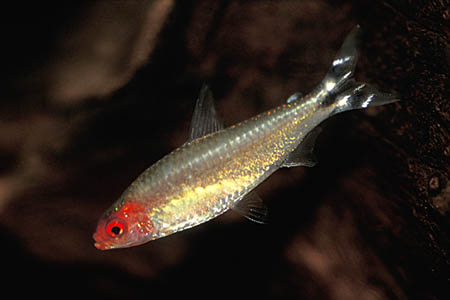
本种尾柄后下方缺少另两种近似鱼具有的黑斑,尾部中央黑带向身体前方延伸得较宽。头部红色不越过鳃盖,色调也常较浅;应组合这些特征判断,不能只看褪色程度。
不同产地样本的遗传差异提示它可能包含多个尚待厘清的谱系,但这仍不是已确定的拆分结论。
图片
图片来自 SeriouslyFish,版权归各摄影者所有。
English
Overview
Petitella georgiae, the false rummy-nose, is one of three very similar red-headed tetras. It forms close schools and is exceptionally peaceful. Adequate group size and food particles small enough for its tiny mouth are central to its care.
Distribution & habitat
The native range includes the Purus in Peru and Brazil, plus Brazil's Negro and Madeira rivers. It is mainly associated with clear-water tributaries and small rivers. A shared rummy-nose trade name does not imply identical blackwater origins for every species.
Aquarium setup
Provide a tank at least about 90 cm long for ten or more fish. Subdued lighting, dark substrate, dense planting, driftwood, and roots bring out its colors. Floating plants can diffuse the light further.
A natural-style arrangement of sand, branches, and leaf litter is another option. Inspect and replace deteriorating leaves before decay becomes excessive. These layouts are alternatives for aquarium care rather than exact replicas of every wild habitat.
Diet & feeding
Use fine-grade prepared foods, crushing larger flakes or pieces before feeding. Include a good proportion of small live and frozen foods, particularly Daphnia and Artemia, to support condition and color.
Behaviour & compatibility
Avoid large, dominant, or overly boisterous companions that can outcompete it. Peaceful small tetras, pencilfishes, small catfishes, and appropriate dwarf cichlids are possible partners. Keep at least ten fish and preferably more; a small group does not support normal schooling or good condition.
Sexual dimorphism
Mature females are conspicuously fuller-bodied than males.
Breeding
Breeding can be demanding. Prepare a separate, very dim aquarium with fine plants, spawning mops, or mesh to protect eggs. Soft, acidic water around pH 5.5–6.5 and 1–5 degrees GH, with gentle sponge filtration, is suitable. Reverse-osmosis water can help achieve the required conditions.
Groups of approximately six fish per sex can spawn, although pairs are generally more productive. Condition males and females separately, then move a gravid female and a well-conditioned male into the breeding aquarium in the evening. Spawning usually follows the next morning. Try a different pair if no eggs appear after several days.
Remove the adults after spawning because they eat eggs. In exceptionally dense planting, promptly siphoning out newly noticed fry is an alternative. Hatching takes about 24–36 hours and free swimming begins three or four days later. Offer infusoria-sized food first, then microworms and Artemia nauplii. Eggs and young fry are light-sensitive, so darkness is preferable during these stages.
Notes
Unlike the two similar species, it lacks a black blotch on the lower rear edge of the caudal peduncle. The central tail band continues forward as a relatively broad stripe. Red does not extend behind the gill covers and is often paler, but identification should combine these features rather than rely on color intensity alone.
Genetic differences between samples from different areas suggest potentially unresolved lineages. They do not yet amount to a confirmed taxonomic split.
来源
- https://www.seriouslyfish.com/species/petitella-georgiae(抓取于 2026-10-10)
petitella-georgiae · 文件: data/species/petitella-georgiae.md · 状态: 草稿