布氏非洲裙鱼 · Firehead Tetra
概要
| 字段 | 值 |
|---|---|
| 类别 | 鱼 |
| 学名 | Petitella bleheri |
| 别名 | 布氏非洲裙魚、Hemigrammus bleheri |
| 分类 | 脂鲤目 Characiformes › 脂鲤科 Characidae › Petitella |
| 水体 | 淡水 |
| 成体体长 | 5 cm |
| 饲养难度 | 入门 |
| 群居方式 | 群游 |
| 性情 | 温和 |
| 外部数据 | seriouslyfish petitella-bleheri;fishbase 12365 |
| 原产地 | 哥伦比亚、巴西 |
| 食性 | 杂食 |
| 繁殖方式 | 产卵 |
水质参数
| 参数 | 耐受范围 | 最适范围 | 单位 |
|---|---|---|---|
| 水温 | 23–26 | — | °C |
| pH | 5.5–7 | — | — |
| 总硬度 | 2–15 | — | dGH |
概述
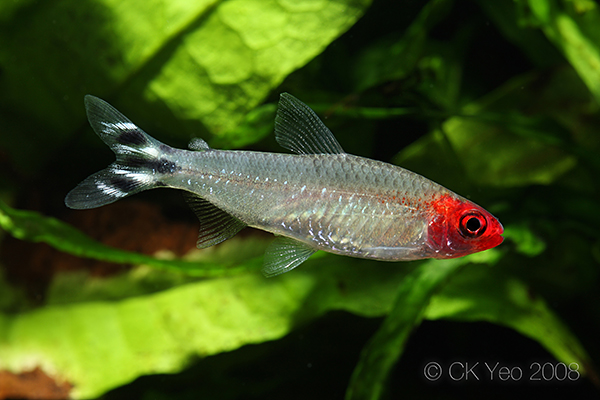
布氏非洲裙鱼(Petitella bleheri)是一种红头、黑白相间尾纹的南美小型脂鲤,贸易中常以“rummy-nose tetra”出售。它群游紧密、活动量大,适合数量充足的同种群体;状态不佳时头部红色会明显变淡。
分布与栖息地
分布于哥伦比亚和巴西的梅塔河、内格罗河水系,栖息在黑水河流及支流。分解的有机物使水色呈褐色,天然水体通常酸性较强。
饲养环境
缸长宜至少约 90 cm,以容纳 10 条或更多个体的游动。可用河沙、沉木、根状木材和干落叶构成昏暗环境,让木叶使水呈淡茶色;检查并定期更换落叶,避免腐败影响水质。维护良好的水草缸同样适合。
每周局部换水和稳定维护很重要。碱性水或其他不良条件都可能使颜色褪淡,发色变化应结合整体状态和水质判断。
食性与喂食
属于杂食性鱼,通常能接受多种食物,但嘴小,饵料必须细小适口。薄片、微颗粒与小型活饵、冷冻饵交替供应,更利于维持体况和颜色。
习性与混养
性情很温和,难与大鱼或过分活跃的鱼竞争。可选择温和的小型脂鲤、铅笔鱼、小型鲶鱼或适宜的小型慈鲷。至少养 10 条,更多同伴通常更好;数量过少会影响状态,也难表现紧密的群游行为。
雌雄区分
成熟雌鱼身体明显比雄鱼圆润。
繁殖
育苗宜用独立、昏暗的繁殖缸,放入细叶植物或产卵拖把,供有黏性的卵附着;也可用隔网隔开亲鱼和卵。可用约 6 雄、6 雌群繁,先以活饵及冷冻饵充分育肥。
另一方法是将雌雄分开育肥,再挑选腹部饱满的雌鱼和颜色鲜明的雄鱼配对,移入偏酸的繁殖水体后,通常次日清晨产卵。亲鱼会吞卵,见卵后应及时移出。卵约 24~36 小时孵化,随后 3~4 天鱼苗自由游动;先喂纤毛虫等微小饵料,再转用微虫、丰年虾无节幼体。卵和早期鱼苗怕强光,应持续保持昏暗。
补充说明
健康个体的红色越过鳃盖延伸至肩部,是与珀蒂鱼(Petitella georgiae)及红吻半线脂鲤(Petitella rhodostoma)区别的重要线索。但褪色时这一特征不可靠,还需结合尾柄下方黑斑、尾部中央黑带是否向前延伸判断。本种具有尾柄下斑,中央黑带不明显向身体前方延长,臀鳍透明。
贸易中也有人工选育的金色型。旧文献常使用学名 Hemigrammus bleheri,现有分类将它置于 Petitella。
图片
图片来自 SeriouslyFish,版权归各摄影者所有。
English
Overview
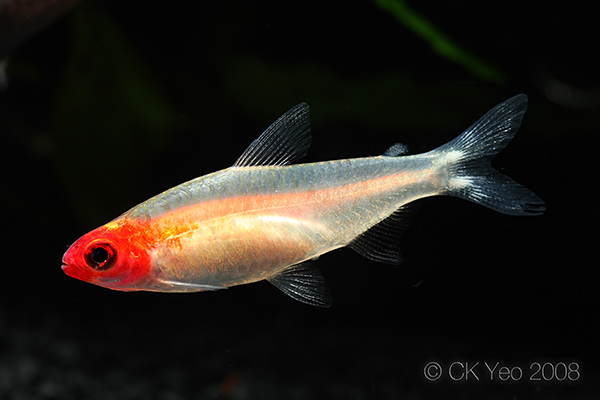
Petitella bleheri, the firehead tetra, is a South American tetra with a red head and contrasting black-and-white tail markings. It is frequently sold as a rummy-nose tetra. Active swimming and close schooling call for a substantial group, while loss of condition can greatly reduce the red coloration.
Distribution & habitat
The species occurs in the Meta and Negro systems of Colombia and Brazil. It inhabits blackwater rivers and tributaries, where decomposing organic matter stains the water brown and natural conditions are strongly acidic.
Aquarium setup
Allow a tank length of at least about 90 cm for ten or more fish. Sand, driftwood, twisted roots, and dried leaves can create a shaded setting with lightly tinted water. Inspect and replace leaves periodically before excessive decay affects water quality. A well-maintained planted aquarium is also suitable.
Weekly partial water changes and consistent maintenance are essential. Alkaline water and other unfavorable conditions can reduce color, so fading should be assessed alongside water quality and the fish's general condition.
Diet & feeding
This omnivore accepts a broad menu, but its small mouth requires fine foods. Alternate flakes or small granules with appropriately sized live and frozen foods to maintain condition and color.
Behaviour & compatibility
It is very peaceful and competes poorly with large or boisterous companions. Gentle small tetras, pencilfishes, small catfishes, and suitable dwarf cichlids are possible choices. Maintain at least ten individuals, preferably more. Insufficient numbers compromise both well-being and the close schooling for which it is valued.
Sexual dimorphism
Mature females are noticeably rounder than males.
Breeding
For dedicated fry production, prepare a dim breeding aquarium with fine plants or mops for the adhesive eggs. Mesh can also separate eggs from the adults. A group of roughly six fish of each sex can be conditioned with live and frozen foods.
Alternatively, condition the sexes separately and select a full-bodied female and a strongly colored male. Spawning often takes place the morning after transfer to acidic breeding water. Remove the adults promptly once eggs appear, since they will eat them.
Eggs generally hatch in 24–36 hours, followed by free swimming three or four days later. Start with infusoria-sized foods, then offer microworms and Artemia nauplii. Eggs and young fry are light-sensitive, so retain very subdued lighting.
Notes
In healthy fish, red extends behind the gill covers onto the shoulder. This helps distinguish it from Petitella georgiae and Petitella rhodostoma, but fading can obscure the character. Also examine the lower caudal-peduncle blotch and the forward reach of the central black tail band. This species has the lower blotch, little forward extension of that band, and a clear anal fin.
A selectively bred golden form is also traded. Older literature commonly uses the name Hemigrammus bleheri for the species now placed in Petitella.
来源
- https://www.seriouslyfish.com/species/petitella-bleheri(抓取于 2026-10-10)
petitella-bleheri · 文件: data/species/petitella-bleheri.md · 状态: 草稿