Oryzias songkhramensis
概要
| 字段 | 值 |
|---|---|
| 类别 | 鱼 |
| 学名 | Oryzias songkhramensis |
| 分类 | 颌针鱼目 Beloniformes › 怪颌鳉科 Adrianichthyidae › Oryzias |
| 水体 | 淡水 |
| 原产地 | 老挝、泰国 |
| 成体体长 | 2 cm |
| 饲养难度 | 入门 |
| 最小水体 | 16 L |
| 最小缸长 | 40 cm |
| 群居方式 | 群游 |
| 性情 | 温和 |
| 外部数据 | seriouslyfish oryzias-songkhramensis;fishbase 65577 |
| 繁殖方式 | 产卵 |
| 领地性 | 是 |
| 食性 | 肉食 |
水质参数
| 参数 | 耐受范围 | 最适范围 | 单位 |
|---|---|---|---|
| 水温 | 23–30 | — | °C |
| pH | 6–7.5 | — | — |
| 总硬度 | 2–15 | — | dGH |
概述
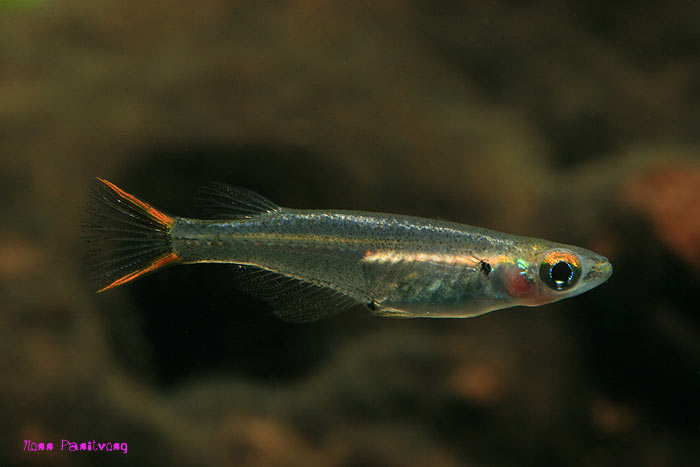
Oryzias songkhramensis 小型而通常温和,雄鱼尾鳍带黑色与黄橙色边带,胸鳍基部有黑点。
分布与栖息地
仅知来自泰国东北部颂堪河及老挝中部部分湄公河流域。生活在淡水静水的浅池、沟渠、稻田和清水沼泽,底部可有砂、泥与植物碎屑。
饲养环境
以深色底砂、密植水草、沉木枝根和浮水植物布置,同时留出游动区。空旷环境中显色可能较弱,密植区还为幼鱼提供躲藏空间。
食性与喂食
野外捕食小昆虫、蠕虫、甲壳类与其他浮游动物。缸内能吃适口干粮,仍应每天搭配水蚤、丰年虾和切碎红虫等小型活饵或冷冻饵。
习性与混养
至少八尾同养更容易放松。同伴应选体形相近的温和小鱼,适合的淡水米虾也可考虑。即使总体温和,求偶雄鱼仍会争夺临时空间。以繁殖为目标时宜同种单养,避免与其他青鳉杂交。
雌雄区分
雄鱼尾鳍黑黄或黑橙边带鲜明,臀鳍外缘凸起,背鳍和臀鳍前部鳍条延长;雌鱼尾纹较淡,臀鳍边缘略凹,腹鳍鳍条较长。雄鱼生殖乳突为短管,雌鱼分成两叶。
繁殖
亲鱼状态好时,雌鱼可隔几天甚至每天产卵。通常在清晨,雄鱼颜色变深并守住短暂的小领地。黏性卵成团排出并同时受精,先悬挂在雌鱼生殖孔附近,之后单枚或成小团黏到植物等介质上;细叶草或产卵拖把都可使用。
孵化一般需一至三周,受水温影响。成鱼多半不理会卵,却会吃游动鱼苗。可把卵或鱼苗移入装有亲鱼缸水的育苗容器,或用密植区让部分幼鱼躲避。鱼苗自由游动后能吃微虫、丰年虾无节幼体。大小相差明显的幼鱼应分开养,以免大吃小。
补充说明
相似近缘种(Oryzias mekongensis)也可能出现在贸易中,购买时不要仅凭小型青鳉的整体外形认种。
图片
图片来自 SeriouslyFish,版权归各摄影者所有。
English
Overview
Oryzias songkhramensis: A small, generally peaceful ricefish, it has a dark pectoral-base spot and males develop black and yellow-orange bands along the tail lobes.
Distribution & habitat
Known sites lie in northeastern Thailand’s Songkhram basin and parts of the middle Mekong drainage in Laos. Shallow pools, ditches, paddies, and clear freshwater swamps provide still water over sand, mud, and organic debris.
Aquarium setup
Combine dark substrate, thick planting, roots, wood, and floating cover with open swimming space.Sparse surroundings can reduce display color, whereas dense growth also shelters young fish.
Diet & feeding
Wild prey includes small insects, worms, crustaceans, and other zooplankton. Suitably sized dry food is accepted, supplemented daily with small live or frozen items such as Daphnia, Artemia, and chopped bloodworms.
Behaviour & compatibility
Eight or more individuals form a more confident group. Choose similarly small, peaceful companions; suitable freshwater shrimp are also possible. Courting males may defend brief territories despite an otherwise gentle disposition. Use a dedicated group for breeding and avoid other ricefish species because of hybridization risk.
Sexual dimorphism
Males have stronger tail bands, a convex anal-fin edge, and extended leading dorsal and anal rays. Females have fainter markings, a slightly concave anal margin, and longer pelvic rays. The male genital papilla is tubular; the female’s is bilobed.
Breeding
Well-conditioned females can produce eggs every few days or even daily. Spawning generally takes place early in the morning as males darken and defend small temporary spaces. Adhesive eggs are released and fertilized together. They remain attached beneath the female temporarily, then are transferred singly or in small clusters to plants or other media. Fine vegetation and spawning mops are suitable.
Incubation usually lasts one to three weeks, depending on temperature. Adults commonly ignore eggs but eat free-swimming fry. Transfer eggs or young to a nursery filled with parental-tank water, or provide dense cover for some to survive in place. Microworms and Artemia nauplii are accepted after free swimming begins. Separate markedly different sizes of juveniles to prevent the larger ones eating the smaller.
Notes
The similar Oryzias mekongensis has appeared in trade, so general ricefish appearance alone cannot establish identity.
来源
- https://www.seriouslyfish.com/species/oryzias-songkhramensis(抓取于 2026-10-10)
oryzias-songkhramensis · 文件: data/species/oryzias-songkhramensis.md · 状态: 草稿