西里伯斯青鮰 · Celebes Ricefish
概要
| 字段 | 值 |
|---|---|
| 类别 | 鱼 |
| 学名 | Oryzias celebensis |
| 别名 | Haplochilus celebensis |
| 分类 | 颌针鱼目 Beloniformes › 怪颌鳉科 Adrianichthyidae › Oryzias |
| 水体 | 淡水 |
| 原产地 | 印度尼西亚、东帝汶 |
| 成体体长 | 4.5 cm |
| 饲养难度 | 入门 |
| 最小水体 | 41 L |
| 最小缸长 | 45 cm |
| 群居方式 | 群游 |
| 性情 | 温和 |
| 外部数据 | seriouslyfish oryzias-celebensis;fishbase 12252 |
| 领地性 | 是 |
| 繁殖方式 | 产卵 |
水质参数
| 参数 | 耐受范围 | 最适范围 | 单位 |
|---|---|---|---|
| 水温 | 23–27 | — | °C |
| pH | 7–9 | — | — |
| 总硬度 | 5–25 | — | dGH |
概述
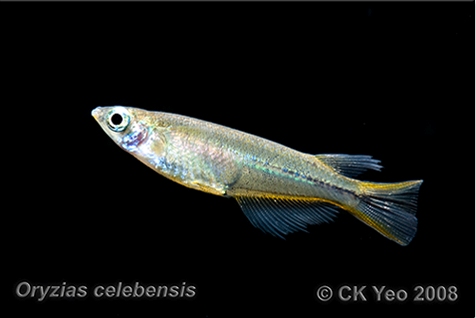
西里伯斯青鮰(Oryzias celebensis)是苏拉威西的小型稻田鱼,尾鳍近截形,尾缘带黄至橙色。它适合有开阔区的密植缸,群养更大胆,繁殖时可观察到雌鱼把卵暂时挂在腹部后再附到植物上。
分布与栖息地
主要见于印度尼西亚苏拉威西西南部河溪及坦佩湖,也有较中部切雷康河上游和帝汶岛莫塔塔劳河的记录。多生活在缓流或静水、水草丰富的位置,马罗斯地区河流常流经石灰岩,但并非所有栖地都如此。
饲养环境
小群底面积至少参考 45 × 30 厘米。深色底床、局部密植、根枝沉木与水面植物提供遮蔽,仍留开阔游动区,可帮助显色,也给鱼苗藏身机会。不宜长期养在酸性水中。
食性与喂食
天然可能捕食小昆虫、蠕虫、甲壳类及其他浮游动物。人工可接受适口薄片和颗粒,同时每天提供水蚤、丰年虾或切碎红虫等小型活冷冻饵。
习性与混养
建议八尾以上。小体形使它不适合很多普通混养组合,伙伴应细小、温和且条件相近,适宜淡水虾和螺也可考虑。求偶雄鱼会争夺临时小领地;繁殖以单养种为宜,避免与其他青鳉同缸造成杂交。
雌雄区分
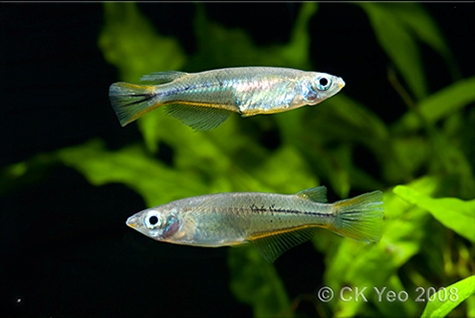
成年雄鱼颜色更鲜艳、背鳍臀鳍更长、身体更细,臀鳍外缘向外凸;雌鱼较丰满,臀鳍外缘略凹。雄性生殖突短管状,雌性为双叶状。
繁殖
状态好时雌鱼可每隔几天、甚至每天产卵,通常在清晨进行。雄鱼颜色加深并求偶,黏卵成团排出并同时受精,先挂在雌鱼生殖孔外,再逐粒或成小簇附到细叶植物、莫丝或人工产卵拖把上。
孵化通常约一至三周,受温度影响。成鱼往往不理卵,却会吃自由游动的鱼苗;密植缸可能留下少量,也可把卵或苗移入用亲鱼缸水的独立育苗容器。开口可用微虫、丰年虾无节幼体,大小差异明显的幼鱼要分开,避免互食。
图片
图片来自 SeriouslyFish,版权归各摄影者所有。
English
Overview
A small Sulawesi ricefish, Oryzias celebensis has a squared-off tail with yellow to orange markings. Groups in a planted aquarium with open areas display confidently. During breeding, females briefly carry an external egg cluster before attaching eggs to vegetation.
Distribution & habitat
Records center on southwestern Sulawesi, including the Maros drainage and Lake Tempe, with additional localities in the upper Cerekang and on Timor. Slow or standing water with abundant plants is typical. Limestone influences many Maros-area streams, but not every occupied habitat.
Aquarium setup
Use at least a 45 by 30 cm footprint for a group. Dark substrate, dense plant patches, wood, and surface cover encourage color while leaving open swimming areas. Vegetation also improves fry survival. Prolonged acidic conditions are unlikely to suit it.
Diet & feeding
Natural feeding probably focuses on small invertebrates and zooplankton. Offer suitably sized flakes or granules alongside daily small live or frozen foods such as Daphnia, Artemia, or chopped bloodworms.
Behaviour & compatibility
Eight or more form a confident group. Its size limits community options to small peaceful species sharing the conditions; suitable freshwater shrimp and snails are also possible. Courting males defend temporary spaces. A species-only breeding setup avoids both competition and hybridization with other ricefish.
Sexual dimorphism
Males are brighter, slimmer, and have longer dorsal and anal fins, with a convex anal edge. Females are fuller with a slightly concave edge. The genital papilla is tubular in males and bilobed in females.
Breeding
Well-conditioned females can spawn every few days or even daily, usually in the morning. Males intensify in color and court. Adhesive eggs are released and fertilized together, hang briefly from the female, and are then attached singly or in small clusters to fine plants, moss, or spawning mops.
Incubation usually spans one to three weeks depending on temperature. Adults often leave eggs alone but eat free-swimming fry. Dense plants may preserve some young; alternatively transfer eggs or fry to parental water in a separate rearing container. Microworms and Artemia nauplii are suitable first foods. Separate markedly different-sized young to reduce cannibalism.
来源
- https://www.seriouslyfish.com/species/oryzias-celebensis(抓取于 2026-10-10)
oryzias-celebensis · 文件: data/species/oryzias-celebensis.md · 状态: 草稿