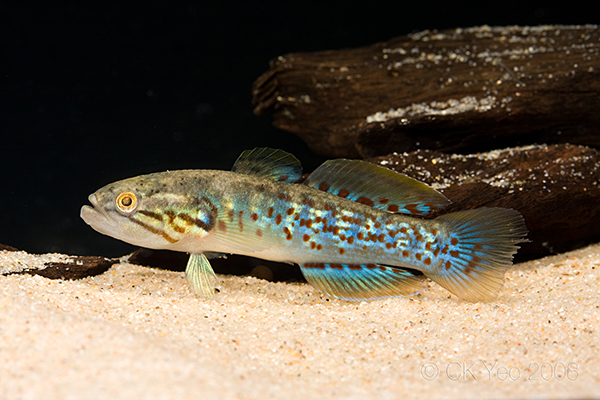
彩塘鳢 · Northern Purple Spotted Gudgeon
概要
| 字段 | 值 |
|---|---|
| 类别 | 鱼 |
| 学名 | Mogurnda mogurnda |
| 别名 | 彩塘鱧 |
| 分类 | 虾虎鱼目 Gobiiformes › 塘鳢科 Eleotridae › Mogurnda |
| 水体 | 淡水 |
| 成体体长 | 17 cm |
| 饲养难度 | 中等 |
| 最小水体 | 108 L |
| 最小缸长 | 120 cm |
| 外部数据 | seriouslyfish mogurnda-mogurnda;fishbase 22759 |
| 原产地 | 澳大利亚、巴布亚新几内亚 |
| 领地性 | 是 |
| 繁殖方式 | 附着产卵 |
水质参数
| 参数 | 耐受范围 | 最适范围 | 单位 |
|---|---|---|---|
| 水温 | 24–26 | — | °C |
| pH | 6–8 | — | — |
| 总硬度 | 10–20 | — | dGH |
概述
彩塘鳢(Mogurnda mogurnda)适应力较强,也容易在缸中繁殖,但有领地意识和咬鳍习惯。它不适合与娇弱或长鳍鱼相处,遮蔽丰富且水流柔和的环境较合适。
分布与栖息地
原产澳大利亚和巴布亚新几内亚,可生活于森林溪流、沼泽、池塘,甚至沙漠钻井水体等多种环境,具有耐受低氧条件的能力。
饲养环境
缸长至少约 120 cm、容积约 108 L。沙底配合石块、沉木和水草,提供充足藏身处;无需例行加盐。柔和灯光能让鱼更常活动,水流应保持平缓。
不同来源个体对水化学的适应有所差别,接近中性的中硬水通常是较稳妥方向,仍应以适用范围和来源条件为依据。
食性与喂食
不挑食,多数常见鱼食均可接受,搭配活饵和冷冻饵有助体色与繁殖状态。
习性与混养
领地意识明显,可能较强势并啃咬鳍。避免娇弱和长鳍同伴,可考虑较快游、体型合适的鲤科鱼、脂鲤、较大彩虹鱼或强健底层鲶鱼。
雌雄区分
平时不易分辨。繁殖雄鱼生殖突明显尖细,成年雄鱼通常比雌鱼小。
繁殖
同种专缸中从一群幼鱼形成配对较方便,以多样食物调理。雄鱼增色、展鳍引诱雌鱼,在平面上产卵,玻璃也可使用。产卵量随年龄变化,约 20~200 粒,卵以细黏丝固定。
产后雄鱼赶走雌鱼,独自扇水和护卵。若原缸育苗,应移走其他鱼。约 5~7 天孵化,雄鱼照护结束,此时将成鱼与鱼苗分开,避免幼鱼被吃。
卵黄耗尽后最初几天需草履虫等微小食物,再转丰年虾无节幼体。幼鱼长速可能差异很大,要观察互食风险。
补充说明
与较少见的大眼彩塘鳢(Mogurnda adspersa)很相似,购买时应核对身份。繁殖容易和水质耐受较广,并不代表能忽略领地性与同伴鳍型。
图片
图片来自 SeriouslyFish,版权归各摄影者所有。
English
Overview
Adaptable and readily bred, Mogurnda mogurnda still presents territoriality and fin-nipping concerns. Delicate or long-finned companions are poor choices. Abundant cover and gentle circulation suit it well.
Distribution & habitat
Native to Australia and Papua New Guinea, it uses forest streams, swamps, ponds, and even desert boreholes. Tolerance of low oxygen allows occupation of varied habitats.
Aquarium setup
Provide at least about 120 cm of tank length and 108 L. Sand with stones, wood, and plants creates plentiful retreats. Salt supplementation is unnecessary. Subdued lighting encourages activity, while water movement should remain modest.
Water preferences vary with origin. Moderately hard, near-neutral conditions are a useful general direction within the established range, taking the source population into account.
Diet & feeding
Most aquarium foods are accepted. Add live and frozen items to a varied menu to support coloration and breeding condition.
Behaviour & compatibility
It defends space, can be boisterous, and may damage fins. Avoid fragile or long-finned fishes. Appropriately sized fast cyprinids, characins, larger rainbowfishes, or robust bottom catfishes are possible alternatives.
Sexual dimorphism
Sexing outside breeding condition is difficult. Breeding males have a distinctly pointed genital papilla, and adult males are usually smaller than females.
Breeding
A juvenile group forming pairs in a dedicated aquarium is useful. Condition fish with varied food. Males intensify in color and spread fins to attract females to a flat surface, including glass. Approximately 20–200 eggs, depending on age, attach by fine threads.
The male drives the female away and tends the clutch alone. Remove other fish if the aquarium will serve as a nursery. Hatching occurs after roughly five to seven days, ending male care; separate adults from fry to prevent losses.
After yolk absorption, young need microscopic food for several days before Artemia nauplii. Uneven growth can lead to sibling predation, requiring close observation.
Notes
It is easily confused with the less frequently traded Mogurnda adspersa. Confirm identity at purchase. Ease of breeding and broad tolerance do not negate territorial behavior or the need to consider companions' fin shapes.
来源
- https://www.seriouslyfish.com/species/mogurnda-mogurnda(抓取于 2026-10-10)
mogurnda-mogurnda · 文件: data/species/mogurnda-mogurnda.md · 状态: 草稿