Melanotaenia splendida splendida · Eastern Rainbowfish
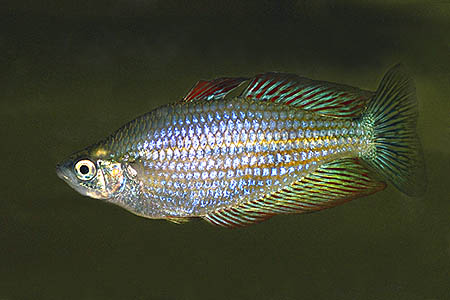
概要
| 字段 | 值 |
|---|---|
| 类别 | 鱼 |
| 学名 | Melanotaenia splendida splendida |
| 分类 | 银汉鱼目 Atheriniformes › 黑带银汉鱼科 Melanotaeniidae › Melanotaenia |
| 水体 | 淡水 |
| 成体体长 | 15 cm |
| 饲养难度 | 入门 |
| 最小水体 | 108 L |
| 最小缸长 | 120 cm |
| 群居方式 | 群游 |
| 性情 | 温和 |
| 外部数据 | seriouslyfish melanotaenia-splendida-splendida |
| 原产地 | 澳大利亚 |
| 繁殖方式 | 散卵 |
水质参数
| 参数 | 耐受范围 | 最适范围 | 单位 |
|---|---|---|---|
| 水温 | 20–30 | — | °C |
| pH | 5–8 | — | — |
| 总硬度 | 5–20 | — | dGH |
概述
Melanotaenia splendida splendida 是澳大利亚活跃的彩虹鱼,不同产地的颜色和斑纹差异明显,贸易名后有时会附带地名。幼鱼多较暗淡,成体完整发色可能需要一年以上。
分布与栖息地
在澳大利亚利用沼泽、潟湖、溪流和河流等多样水域,通常靠水草、沉木等遮蔽。栖地的水温、水位和泥沙状况常随季节变化。
饲养环境
以水草密植区配宽阔游泳空间,缓至中等水流即可。水体接近中性较合适;布景既要让鱼感到安全,也要满足它们快速游动的需要。
食性与喂食
适应多种干粮、冷冻饵和活饵,通常不挑食。规律加入活饵有助雄鱼表现较好的颜色。
习性与混养
至少六至八尾成群会更安定,条件允许可增加数量,并配更大空间。雄鱼在同种群体中更常展示。它很温和,但体形和快速活动会打扰小型或迟缓鱼。
可与体形相称的彩虹鱼、脂鲤、斑马鱼、鲃类、淡水虾虎及合适鼠鱼搭配;同一复合群的不同地理类型及亚种应分开,避免杂交。
雌雄区分
成熟雄鱼比雌鱼更大、更亮,随年龄增加身体明显变高,背鳍与臀鳍也更长。雌鱼繁殖前腹部会饱满。
繁殖
散卵繁殖相对容易,鱼苗养成更费心。繁殖缸可不铺底砂,放细叶水草或产卵拖把,用小型气动过滤维持轻缓水流与溶氧,水稍硬、偏碱。亲鱼先成群调养,再选饱满雌鱼和颜色良好雄鱼配对,轻微升温可能诱发。
产卵可持续数周,每天一批,卵用细丝附着。成鱼通常不吃卵,不过定期把卵移到装有亲鱼缸水的育苗缸更易照料。卵约 7–12 天孵化,初期喂纤毛虫等微小食物,约一周后加丰年虾无节幼体等游动活饵;仔鱼贴近水面,沉底饵无法有效供应。
补充说明
不同产地类型在外形上会有重叠,购入时尽量保留完整地名和来源,分开繁殖比仅凭体色配对更可靠。
图片
图片来自 SeriouslyFish,版权归各摄影者所有。
English
Overview
This Australian rainbowfish varies conspicuously in color and pattern by locality, so Melanotaenia splendida splendida is often sold with a place name attached. Juveniles usually look subdued, and full adult coloration may take more than a year to develop.
Distribution & habitat
Australian habitats include swamps, lagoons, streams, and rivers. Fish commonly stay near aquatic vegetation or submerged wood. Seasonal changes affect temperature, water level, and sediment conditions.
Aquarium setup
Balance dense plants with open swimming space and use slow to moderate flow. Approximately neutral water is appropriate. Decor should offer security without restricting these active fish to narrow gaps.
Diet & feeding
Feeding is straightforward with a variety of suitable dry, frozen, and live foods. Regular live meals help bring out the fish’s coloration.
Behaviour & compatibility
Groups of six to eight or more reduce nervousness and promote male displays, provided the aquarium expands with the group. Although peaceful, its size and brisk movement can disturb tiny or slow neighbors.
Comparable rainbowfishes, characins, danios, barbs, freshwater gobies, and suitable cory catfish are candidates. Separate geographic forms and subspecies within this complex to avoid hybridization.
Sexual dimorphism
Males become larger, brighter, and much deeper-bodied than females, developing longer dorsal and anal fins. Females fill out in the abdomen as spawning approaches.
Breeding
It scatters eggs readily, though the fry require more attention. A bare-bottom breeding tank can hold fine plants or spawning mops, gentle air-powered filtration, and slightly hard alkaline water. Condition adults in a group, then select a full female and a well-colored male. A modest temperature rise may trigger activity.
Daily spawning batches can continue for weeks, with eggs attaching by fine threads. Adults generally do not eat them, but regular transfer to a nursery filled with parental-tank water makes care easier. Eggs hatch after around 7–12 days. Feed infusoria initially, moving to swimming prey such as Artemia nauplii after roughly a week. Fry remain at the surface, so sinking foods are unsuitable.
Notes
Local forms can overlap in appearance. Retain their locality labels and provenance, and breed them separately rather than pairing fish solely by color.
来源
ID:melanotaenia-splendida-splendida · 文件: data/species/melanotaenia-splendida-splendida.md · 状态: 草稿