伊里安虹银汉鱼 · Irian Jaya Rainbowfish
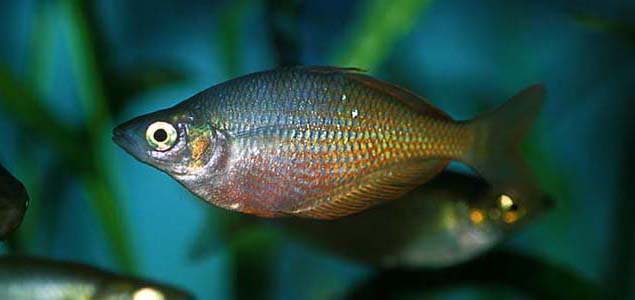
概要
| 字段 | 值 |
|---|---|
| 类别 | 鱼 |
| 学名 | Melanotaenia irianjaya |
| 别名 | 伊瑞安虹银汉鱼、伊里安虹銀漢魚 |
| 分类 | 银汉鱼目 Atheriniformes › 黑带银汉鱼科 Melanotaeniidae › Melanotaenia |
| 水体 | 淡水 |
| 成体体长 | 12 cm |
| 饲养难度 | 中等 |
| 最小水体 | 81 L |
| 最小缸长 | 90 cm |
| 群居方式 | 群游 |
| 性情 | 温和 |
| 外部数据 | seriouslyfish melanotaenia-irianjaya;fishbase 25628 |
| 原产地 | 印度尼西亚伊里安查亚宾图尼湾周边 |
| 食性 | 杂食 |
| 繁殖方式 | 散卵 |
水质参数
| 参数 | 耐受范围 | 最适范围 | 单位 |
|---|---|---|---|
| 水温 | 23–26 | — | °C |
| pH | 6.5–8 | — | — |
| 总硬度 | 10–15 | — | dGH |
概述
伊里安虹银汉鱼(Melanotaenia irianjaya)是贸易中较少见的温和彩虹鱼。它的背鳍、臀鳍中部鳍条较长,可作为辨识特征;饲养时应重视同种群体和合适水质。
分布与栖息地
记录限于印度尼西亚伊里安查亚宾图尼湾一带。生活在雨林溪流中,缓流和急流环境均有出现。与许多同属不同,它的天然栖地水草不多,主要利用没入水中的木头和树枝藏身。
饲养环境
底面积至少约 90 × 30 cm。可用细砂或细砾配合沉木、树枝,也能适应密植水草的布置。它对布景形式和水流强弱没有特别苛刻的要求,水质则宜偏硬,在原有范围内以高于中性的一侧较合适。
食性与喂食
属于不挑食的杂食鱼,可接受多数干饲料、活饵和冷冻饵。定期喂适口活饵有助于保持鲜明体色。
习性与混养
可与体形相仿的温和鱼同养,前提是水质需求一致。容易受惊,建议至少六至八条同种成群,空间足够时可增加数量;雄鱼在群体中更容易展示体色。
雌雄区分
成年雄鱼通常更大、更鲜艳,体高也随着成熟而增加。
繁殖
属于散卵型,产卵相对容易,鱼苗养成更有难度。先以活饵和冷冻饵群体调养,再选体况好的一对,提供细叶水草或产卵拖把及温和气动过滤。水质宜略硬、偏碱,底砂并非必需。
亲鱼可数周持续每天产少量卵,卵用细丝附着。虽然通常不积极吃卵,将卵定期移到水质相同的独立育苗缸仍更便于照料。孵化约需七至十二天;初期喂微型饵,一周左右逐步转为丰年虾无节幼体等游动小饵。鱼苗接近水面活动,沉底饵不适合作为初期食物。
补充说明
背鳍和臀鳍的中央鳍条比周边长,是较有用的外形线索,不应只凭颜色判断个体身份。
图片
图片来自 SeriouslyFish,版权归各摄影者所有。
English
Overview
Melanotaenia irianjaya is a peaceful rainbowfish that appears relatively infrequently in the hobby. Longer central rays in its dorsal and anal fins provide a useful identification feature. Group size and water chemistry matter more than a particular style of decoration.
Distribution & habitat
Known records are confined to the Bintuni Bay region of Indonesian New Guinea. It inhabits rainforest streams ranging from slow to fast flowing. Aquatic vegetation is often sparse, with submerged wood and branches providing shelter instead.
Aquarium setup
Provide a footprint around 90 × 30 cm or more. Sand or fine gravel with wood can reflect the natural setting, while a heavily planted aquarium is also suitable. Neither decor choice nor current strength is especially restrictive. Relatively hard water on the alkaline side of neutral is preferred within its established range.
Diet & feeding
This omnivore readily takes most dry, frozen, and live foods. Regular suitable live offerings help bring out good color.
Behaviour & compatibility
Choose placid fish of comparable size whose water needs match. At least six to eight conspecifics are recommended, with larger groups where accommodation permits. Keeping it socially secure reduces nervousness and encourages males to show their colors.
Sexual dimorphism
Adult males are larger and more colorful, developing a deeper body with maturity.
Breeding
It scatters eggs fairly readily, although raising the offspring requires closer attention. Condition adults together on live and frozen foods, then choose a well-conditioned pair. Fine plants or spawning mops provide attachment sites in a gently filtered breeding aquarium. Slightly hard, alkaline water is appropriate, and substrate is optional.
Eggs are laid in small daily batches over several weeks and attach by fine threads. Adults usually do not seek them out, but moving eggs regularly into matching water makes fry management easier. Hatching takes around seven to twelve days. Begin with microscopic foods and progress toward swimming prey such as brine-shrimp nauplii after about a week. Young fry stay near the surface, making sinking foods inappropriate initially.
Notes
The elongated middle rays of the dorsal and anal fins are more informative than color alone when examining this species.
来源
- https://www.seriouslyfish.com/species/melanotaenia-irianjaya(抓取于 2026-10-10)
melanotaenia-irianjaya · 文件: data/species/melanotaenia-irianjaya.md · 状态: 草稿