类甲鲶 · Marbled Whiptail
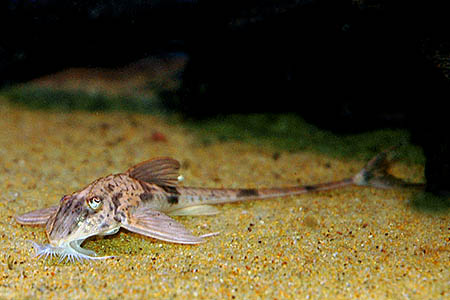
概要
| 字段 | 值 |
|---|---|
| 类别 | 鱼 |
| 学名 | Loricaria simillima |
| 别名 | 類甲鯰 |
| 分类 | 鲶形目 Siluriformes › 骨甲鲶科 Loricariidae › Loricaria |
| 水体 | 淡水 |
| 成体体长 | 18 cm |
| 饲养难度 | 中等 |
| 外部数据 | seriouslyfish loricaria-simillima;fishbase 50637 |
| 原产地 | 委内瑞拉、厄瓜多尔、秘鲁、巴西、巴拉圭、阿根廷 |
水质参数
| 参数 | 耐受范围 | 最适范围 | 单位 |
|---|---|---|---|
| 水温 | 24–27 | — | °C |
| pH | 5.6–7.8 | — | — |
| 总硬度 | 1–20 | — | dGH |
概述
以类甲鲶(Loricaria simillima)之名流通的鱼,真正身份仍有很大不确定性,可能涉及多个种或亚种。饲养中可见雄鱼用下唇携带卵团的有趣行为,但这些贸易鱼记录不能无条件等同于已确认的模式种。
分布与栖息地
该名称下记录遍及委内瑞拉、厄瓜多尔、秘鲁、巴西、巴拉圭和阿根廷,其中一些分布可能实际属于别种。贸易鱼来自黑水和白水等不同溪河环境,色深浅与产地也有差异。
饲养环境
一对贸易鱼可参考约 75 × 30 × 30 厘米,群体需更大空间。柔软沙底、沉木、平滑石块及管道提供多处阴影和躲藏,水草也可增加遮蔽。
食性与喂食
食谱偏重水生无脊椎动物,供给红虫、水蚤、碎蚯蚓等活冷冻饵,再配下沉干粮与少量黄瓜或西葫芦。
习性与混养
行动安静,容易被活跃伙伴抢食。宜配小型温和鱼、温和慈鲷或不强占领地的鲶鱼,同种通常能较友善地群养。
雌雄区分
成熟雄鱼口部组织明显增大。
繁殖
贸易鱼已有缸内繁殖,可从小群自然配对,以多样饵料和每周约 40%~50% 换水调理。夜间产卵后雄鱼用下唇携卵,宜隔开其他鱼以降低幼鱼被捕食机会。携卵约十至十五天,雄鱼通过口部动作通水;部分会提前吐卵或吃卵,另一些能完整护持。孵出幼鱼再二至三天耗尽卵黄后,可喂初孵丰年虾、微虫与碎干粮。它们易饥饿且怕水质变化,需要持续供食与严格维护。
图片
图片来自 SeriouslyFish,版权归各摄影者所有。
English
Overview
Fishes traded as Loricaria simillima have uncertain identities and may include several taxa. Male care of an egg cluster held against the lower lip makes them interesting breeding subjects, but aquarium observations under this name cannot automatically be assigned to the true species.
Distribution & habitat
Records under the name extend from Venezuela and Ecuador through Peru, Brazil, Paraguay, and Argentina; some may prove to involve other species. Reported habitats include blackwater and whitewater streams and rivers, with darker and lighter trade forms associated with different environments.
Aquarium setup
A pair of the traded form can use roughly 75 by 30 by 30 cm, while a group needs more room. Soft sand, wood, smooth rocks, and pipes create shaded retreats. Plants can provide additional cover without normally being damaged.
Diet & feeding
Provide plentiful small live or frozen invertebrates, including bloodworms, water fleas, or chopped earthworms. Sinking prepared foods and occasional vegetables add variety.
Behaviour & compatibility
Quiet behavior makes food competition a concern. Choose small peaceful fishes or compatible catfishes, avoiding very territorial loricariids. The traded forms are usually amicable with one another and can be maintained in groups.
Sexual dimorphism
Males develop enlarged mouthparts as they mature.
Breeding
Aquarium spawning has occurred in the traded form. A small group helps obtain a pair; condition it with varied food and weekly changes around 40–50%. Following nighttime spawning, the male carries eggs at his lower lip. Separate other fishes to reduce fry predation. He ventilates the clutch for about ten to fifteen days, though some males eat or release eggs early. After successful hatching, yolk absorption takes another two to three days. Nauplii, microworms, and crushed prepared foods can then be offered. Fry need constant food access and careful maintenance because starvation and water-chemistry changes are serious problems.
来源
- https://www.seriouslyfish.com/species/loricaria-simillima(抓取于 2026-10-10)
loricaria-simillima · 文件: data/species/loricaria-simillima.md · 状态: 草稿