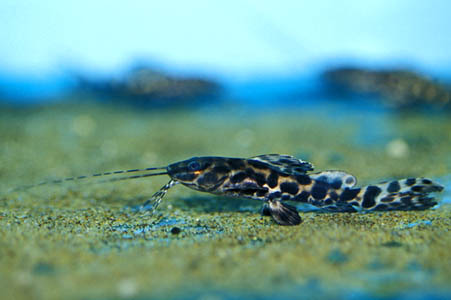
Leiarius longibarbis · Marbled Pim
概要
| 字段 | 值 |
|---|---|
| 类别 | 鱼 |
| 学名 | Leiarius longibarbis |
| 分类 | 鲶形目 Siluriformes › 长须鲶科 Pimelodidae › Leiarius |
| 水体 | 淡水 |
| 成体体长 | 80 cm |
| 饲养难度 | 中等 |
| 最小水体 | 3240 L |
| 最小缸长 | 300 cm |
| 性情 | 温和 |
| 外部数据 | seriouslyfish leiarius-longibarbis;fishbase 63110 |
| 原产地 | 哥伦比亚、委内瑞拉、圭亚那、巴西、秘鲁、玻利维亚 |
| 食性 | 肉食 |
| 领地性 | 是 |
| 特征 | 夜行性: 是;吃小鱼: 是 |
水质参数
| 参数 | 耐受范围 | 最适范围 | 单位 |
|---|---|---|---|
| 水温 | 21–26 | — | °C |
| pH | 5.8–7.4 | — | — |
| 总硬度 | 5–20 | — | dGH |
概述
Leiarius longibarbis 是体形庞大的长须鲶鱼,成鱼饲养需要接近公共水族馆的空间。它会很快长大,小缸不能限制其正常体形;只有在长期设施已准备妥当时才适合考虑饲养。
分布与栖息地
分布于哥伦比亚、委内瑞拉的奥里诺科河,圭亚那的埃塞奎博河,以及巴西、秘鲁、玻利维亚的亚马孙河流域。生活在大型河流与湖泊,白天藏在淹水树根等掩体中,夜间出来觅食。
饲养环境
成鱼所需缸体约为 300 × 90 × 120 cm。照明柔和即可,布景可以简化,仍要保留充足游动区和完全伸展长须的宽度。沉木、岩块等应牢固或重到不会被推移。幼鱼更需要树根、石堆和合适粗细的管道躲藏。
普通砾石可能被吞入或卡住鳃部;砂底会被翻动,大而光滑的卵石或裸底更便于安排。强大的生物过滤不可缺,底滤有助于将设备放到缸外,避免大型个体撞坏玻璃加热棒、温度计等物件。
食性与喂食
天然食鱼,但通常能接受非活体动物性食物。虾、贝、蚯蚓和白肉鱼可交替提供,避免长期只认一种饵料。幼鱼可隔日喂,随生长降低频率,成鱼至多每周一餐,避免过量导致肥胖。
不建议用牛心、鸡肉等陆生动物肉,也无须常规投喂活饵鱼,后者可能带来病原。
习性与混养
会吞食小鱼,对大小相近的其他鱼则相对温和,但混养所需空间极大。合适的大型棘鲶可作伙伴;水深足够时才考虑大型脂鲤、鲤科鱼、南美龙鱼或大型慈鲷。它对同种及其他大型油鲶科鱼有领地性,多数情况下只应养一尾这一类型的鱼。
雌雄区分
仅凭外形几乎无法可靠辨别。成年雌鱼可能较粗壮,但这不是确定的鉴别标准。
繁殖
尚无人工繁殖记录。
补充说明
资料中常见旧名 Leiarius marmoratus,不要因此误以为是另一种可小缸饲养的鱼。近似种(Perrunichthys perruno)外形也很接近,背鳍鳍条数量可辅助辨别:本种为 10–11 条,后者为 8 条。长期饲养还应预留很长的照顾年限,大型鲶鱼的寿命可超过二十年。
图片
图片来自 SeriouslyFish,版权归各摄影者所有。
English
Overview
Leiarius longibarbis is a massive, long-whiskered catfish requiring accommodation closer to a public exhibit than an ordinary home aquarium. Growth can be rapid, and a small tank will not safely keep it small. Permanent facilities should exist before a juvenile is acquired.
Distribution & habitat
It occurs in the Orinoco of Colombia and Venezuela, Guyana's Essequibo, and Amazonian waters in Brazil, Peru, and Bolivia. Large rivers and lakes provide submerged roots and other daytime retreats. Feeding takes place after dark.
Aquarium setup
An adult needs approximately 300 × 90 × 120 cm of space. Keep lighting subdued and leave generous swimming room, including enough width for the long barbels to spread. Heavy or secured wood and smooth rocks are optional; juveniles benefit from root tangles, rock refuges, and suitably sized tubes.
Ordinary gravel can be swallowed or caught in the gills. Sand will be displaced, while large smooth pebbles or a bare floor are alternatives. Substantial biological filtration is essential. A sump helps place equipment outside the main aquarium, where a large fish could otherwise break glass heaters or thermometers.
Diet & feeding
A natural fish predator, it usually adjusts to nonliving foods. Rotate shrimp, shellfish, earthworms, and white fish rather than encouraging dependence on one item. Feed juveniles on alternate days and reduce frequency as they grow; adults require at most one weekly meal. Excess feeding can lead to obesity.
Avoid mammalian and poultry meat. Routine feeder fish are unnecessary and can introduce infectious disease.
Behaviour & compatibility
Small companions will be eaten, although similarly sized fishes are usually treated peacefully. Mixed housing requires exceptional space. Large doradid catfish are suitable candidates, with large characins, cyprinids, South American arowanas, or cichlids possible where depth also permits. Territorial behavior toward conspecifics and other large pimelodids means that only one fish of this type should normally be included.
Sexual dimorphism
External sexing is highly unreliable. Adult females may have a heavier build, but this should not be treated as a definitive test.
Breeding
Aquarium reproduction has not been reported.
Notes
Older literature commonly uses Leiarius marmoratus. A separate look-alike, Perrunichthys perruno, has eight dorsal-fin rays compared with ten or eleven in this species. Planning must allow for a lengthy commitment: large catfish of this kind can live beyond two decades.
来源
- https://www.seriouslyfish.com/species/leiarius-longibarbis(抓取于 2026-10-10)
leiarius-longibarbis · 文件: data/species/leiarius-longibarbis.md · 状态: 草稿