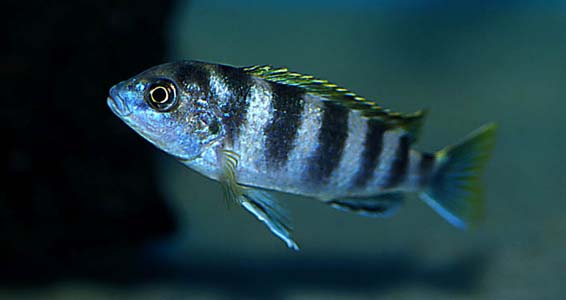
Labidochromis sp. "perlmutt" · Pearly Labidochromis
概要
| 字段 | 值 |
|---|---|
| 类别 | 鱼 |
| 学名 | Labidochromis sp. "perlmutt" |
| 分类 | 慈鲷目 Cichliformes › 慈鲷科 Cichlidae › Labidochromis |
| 水体 | 淡水 |
| 成体体长 | 10 cm |
| 饲养难度 | 中等 |
| 最小水体 | 154 L |
| 最小缸长 | 90 cm |
| 领地性 | 是 |
| 外部数据 | seriouslyfish labidochromis-sp-perlmutt |
| 原产地 | 马拉维湖 |
| 食性 | 肉食 |
| 繁殖方式 | 口孵 |
水质参数
| 参数 | 耐受范围 | 最适范围 | 单位 |
|---|---|---|---|
| 水温 | 24–28 | — | °C |
| pH | 7.5–8.5 | — | — |
| 总硬度 | 10–25 | — | dGH |
概述
Labidochromis sp. 'perlmutt' 是马拉维湖岩栖慈鲷,成年鱼有珍珠白色光泽。它主要生活在较深的岩区,天然食物偏向水生甲壳动物。它有领域性,但通常没有许多其他岩栖慈鲷那么强势。
分布与栖息地
已知来自马拉维湖的 Higga Reef 与姆班巴湾,包括湾内岛屿附近。常见于约 30 m 或更深的岩石带,弱光使藻类不如浅水岩区繁茂。
饲养环境
小群至少需要约 90 × 45 cm 底面积,铺砂并用稳固石堆形成多个洞穴、缝隙。灯光可以较暗;若与其他岩栖慈鲷同养,也能使用较明亮照明。良好过滤及规律维护很重要,本种不耐水质恶化。
食性与喂食
天然以水生甲壳动物为主,可接受丰年虾、水蚤和红虫等动物性食物。也能适应以藻类配方为主、间歇补充动物饵的菜单。不论采取哪种组合,都应包含植物成分,例如含螺旋藻的优质干粮。
习性与混养
具有一定攻击性,可与大小相当的岩栖慈鲷混养,也有与较温和的孔雀类慈鲷同养的经验。雄鱼会争夺同种领域,多雄需要更大空间和足够遮挡。每雄配置数尾雌鱼可分散追逐压力。较密集的岩栖鱼混养虽可分散攻击,也要求充足过滤与持续观察,不能仅靠加鱼解决欺压。
雌雄区分
雄鱼较大、体色通常更浓。幼鱼两性都有体侧纵带,雄鱼成熟后多趋近整片珍珠白,雌鱼仍在不同程度上保留条带。
繁殖
雌性口孵,可用一雄至少三雌组成繁殖群,单种缸更利于保住幼鱼。约 120 cm 长的繁殖缸应同时留平石和开阔砂地;繁殖可维持 pH 8.0–8.5、25–26.5 °C。
雄鱼清理地点并展示求偶,雌鱼分批产卵后立即含入口中。雌鱼追啄雄鱼臀鳍卵斑时完成口内受精,一窝常约 10–15 粒。雌鱼约 3–4 周不进食地含卵育仔,之后释放能自由游动的幼鱼,可立即喂丰年虾无节幼体及碾碎干粮。
含卵雌鱼受压可能提前吐卵或吞卵;分离过久又可能失去群体地位。除非持续被欺压,尽量避免过早搬动。人工掏仔需要经验,不应作为初学者默认操作。
补充说明
Perlmutt 是德语“珍珠母”的意思,yellow bar 也是商品标签。姆班巴湾岛屿种群与非洲王子(Labidochromis caeruleus)很相似,两者可杂交,为保存种源应分开饲养。
图片
图片来自 SeriouslyFish,版权归各摄影者所有。
English
Overview
Labidochromis sp. 'perlmutt' is a Lake Malawi rock-dwelling cichlid with a pearly adult sheen. It occupies relatively deep rocky habitat and naturally feeds mainly on aquatic crustaceans. Territorial behavior remains significant, although it is less forceful than many other mbuna.
Distribution & habitat
Records come from Higga Reef and Mbamba Bay, including the area around Mbamba Bay Island. It is common among rocks at about 30 m or deeper, where reduced light limits dense algal growth.
Aquarium setup
A small group needs a footprint of at least around 90 × 45 cm. Use sand and secure rock piles providing numerous caves and crevices. Subdued lighting is suitable, although brighter lighting used for other mbuna is tolerated. Strong filtration and consistent maintenance are essential because poor water quality is poorly tolerated.
Diet & feeding
Aquatic crustaceans dominate its natural diet. Suitable aquarium foods include brine shrimp, Daphnia, and bloodworms. It also adapts to an algae-based mbuna menu with occasional animal foods. Include plant matter under either approach, for example a quality spirulina preparation.
Behaviour & compatibility
Moderately combative behavior allows carefully chosen companions of similar size, including other mbuna and some calmer cichlids. Males defend space against rivals, so keeping multiple males requires a larger aquarium. Several females per male distribute courtship pressure. Higher stocking in a mbuna community may spread aggression, but requires ample filtration and observation rather than simply adding fish to solve harassment.
Sexual dimorphism
Males become larger and usually more strongly colored. Both sexes have flank bars as juveniles. Mature males tend toward nearly uniform pearly white, while females retain some barring.
Breeding
Females mouthbrood. A species aquarium with one male and at least three females improves fry survival. A breeding enclosure around 120 cm long can provide both flat rocks and open sand. Conditions of pH 8.0–8.5 and 25–26.5 °C are suitable for breeding.
The male cleans a site and courts passing females. Eggs are laid in batches and immediately gathered by the female; attention to the male's anal-fin egg spots facilitates fertilization in her mouth. Typical broods contain about ten to fifteen.
She holds the brood without feeding for roughly three to four weeks. Released fry can take brine shrimp nauplii and crushed dry foods. Stress may cause premature release or loss of the brood, while prolonged isolation can cost the female her social position. Avoid moving her early unless harassment is persistent. Artificial removal of fry requires experience.
Notes
Perlmutt means mother-of-pearl in German; yellow bar is another trade label. The Mbamba Bay Island population resembles Labidochromis caeruleus, with which it hybridizes readily. Keep them separately to preserve stock identity.
来源
- https://www.seriouslyfish.com/species/labidochromis-sp-perlmutt(抓取于 2026-10-10)
labidochromis-sp-perlmutt · 文件: data/species/labidochromis-sp-perlmutt.md · 状态: 草稿