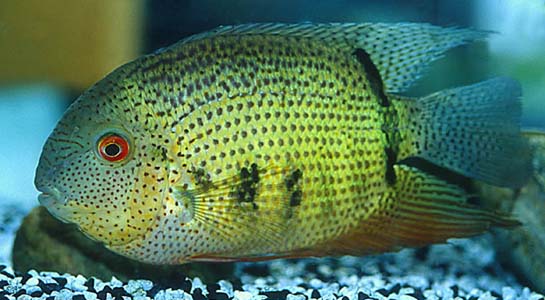
Heros notatus · Spotted Severum
概要
| 字段 | 值 |
|---|---|
| 类别 | 鱼 |
| 学名 | Heros notatus |
| 分类 | 慈鲷目 Cichliformes › 慈鲷科 Cichlidae › Heros |
| 水体 | 淡水 |
| 成体体长 | 30 cm |
| 饲养难度 | 中等 |
| 最小水体 | 173 L |
| 最小缸长 | 120 cm |
| 特征 | 吃小鱼: 是;翻底砂: 是 |
| 外部数据 | seriouslyfish heros-notatus;fishbase 57739 |
| 原产地 | 巴西尼格罗河流域 |
| 食性 | 杂食 |
水质参数
| 参数 | 耐受范围 | 最适范围 | 单位 |
|---|---|---|---|
| 水温 | 22.2–28.9 | — | °C |
| pH | 6–7 | — | — |
| 总硬度 | 0–10 | — | dGH |
概述
Heros notatus 是尼格罗河流域的大型慈鲷,适合有足够游泳空间的南美鱼缸。它通常不算特别好斗,但同种雄鱼可能争执,体型明显较小的伙伴则有被吞食的风险。
分布与栖息地
原生于巴西尼格罗河流域的黑水河流与支流,经常出现在岸边沉水根系、枝条周围。腐解有机物释放的单宁使水呈茶褐色,自然环境偏酸。
饲养环境
至少以 120 cm 长的缸作为空间起点,并保留开阔游泳区。可在周围种植水草,搭配沉木、枝条和平滑石块。它喜欢挖掘,底床选砂更合适。灯光可按水草需求安排,不必刻意追求强光或全暗。
食性与喂食
本种杂食,优质慈鲷颗粒可作基础,再轮换红虫、丰年虾等;较大个体可吃切小的虾肉或白肉鱼。植物成分同样需要,可用藻片或烫软的绿叶蔬菜补充,不宜只喂肉食。
习性与混养
可考虑与体型相当、较结实的大型脂鲤或鲤科鱼混养,也能进入空间宽裕的慈鲷组合。雄鱼间可能发生摩擦,不能把“不特别凶猛”理解为完全没有冲突。明显小得多的鱼应避免。
雌雄区分
雄鱼通常更大,鳃盖红色花纹更清楚,背鳍与臀鳍的延长部分也较长。
繁殖
水族繁殖记录有限。参照近亲的模式,配对后可能选择平石或挖坑产卵,双方护卵,孵化后把幼鱼移到坑内再继续照顾;约 2–3 天孵化、之后 3–4 天开始自由游动的时间线属于近亲参考,不能当成本种稳定结论。
育幼缸宜安静、少受干扰,受惊的亲鱼可能吞食后代。仔鱼可从刚孵化的丰年虾和粉末仔鱼粮开始喂养,随后随口径增加食物大小。
图片
图片来自 SeriouslyFish,版权归各摄影者所有。
English
Overview
Heros notatus is a large cichlid from the Negro basin that needs generous swimming space. It is not exceptionally aggressive, but males can dispute with one another and much smaller companions are at serious risk of being eaten.
Distribution & habitat
Native to Brazil's Negro basin, it inhabits black-water rivers and tributaries, often around submerged roots and branches near the bank. Decomposing organic material stains the water brown with tannins, and natural conditions are acidic.
Aquarium setup
Treat a 120 cm aquarium as a starting point for space planning and retain an open swimming area. Plant the surrounding areas and use wood, branches, and smooth stones for structure. Sand suits its digging behavior. Lighting can follow plant requirements rather than a special need for either intense light or darkness.
Diet & feeding
An omnivore, it accepts a quality cichlid pellet as a staple, supplemented with foods such as bloodworms and brine shrimp. Larger fish can take small pieces of shrimp or white fish. Include plant foods, for example algae wafers or blanched greens, instead of relying entirely on animal foods.
Behaviour & compatibility
Robust, similarly sized characins or barbs are possible companions, as are suitable cichlids in a spacious community. Male disputes remain possible even though the species is not especially combative. Avoid markedly smaller fish.
Sexual dimorphism
Males tend to grow larger, show clearer red markings on the gill covers, and develop longer dorsal and anal fin extensions.
Breeding
Aquarium breeding accounts are limited. A pattern suggested by related fish involves eggs on a flat stone or in an excavated site, shared guarding, and transfer of hatched larvae to a pit. A two-to-three-day incubation followed by another three to four days before free swimming is a comparative timetable, not an established result for this species.
A quiet breeding aquarium with minimal disturbance is appropriate, since frightened parents may consume their offspring. Newly hatched brine shrimp and powdered fry foods provide starting foods, followed by larger items as the young grow.
来源
- https://www.seriouslyfish.com/species/heros-notatus(抓取于 2026-10-10)
heros-notatus · 文件: data/species/heros-notatus.md · 状态: 草稿