蓝斑丽体鱼 · Texas Cichlid
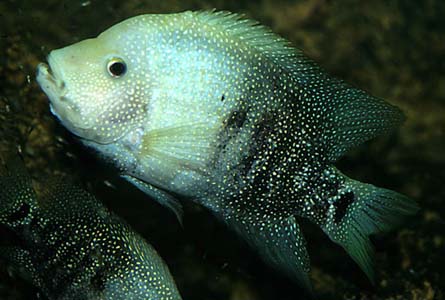
概要
| 字段 | 值 |
|---|---|
| 类别 | 鱼 |
| 学名 | Herichthys cyanoguttatus |
| 别名 | 得克萨斯丽鱼、藍斑麗體魚、得克薩斯麗魚 |
| 分类 | 慈鲷目 Cichliformes › 慈鲷科 Cichlidae › Herichthys |
| 水体 | 淡水 |
| 成体体长 | 30 cm |
| 饲养难度 | 中等 |
| 领地性 | 是 |
| 外部数据 | seriouslyfish herichthys-cyanoguttatus;fishbase 3614 |
| 原产地 | 美国、墨西哥 |
| 性情 | 攻击性 |
| 特征 | 翻底砂: 是 |
| 繁殖方式 | 附着产卵 |
水质参数
| 参数 | 耐受范围 | 最适范围 | 单位 |
|---|---|---|---|
| pH | 6–7.5 | — | — |
| 总硬度 | 5–12 | — | dGH |
概述
蓝斑丽体鱼(Herichthys cyanoguttatus)领地性强,尤其雄鱼和空间不足时更难相处。它经常翻掘底砂,饲养应先解决个体分隔、过滤和成鱼空间,而非追求精细水草景观。
分布与栖息地
原产美国南部与墨西哥的格兰德河水系,另有包括佛罗里达在内的引入种群。偏爱池塘和河流较缓区,常靠近沉石、枝条或茂密植被。
饲养环境
单尾最低考虑约 120 × 45 × 45 厘米,成对或混养需明显更大。细沙或细砾应有一定厚度,约 5~8 厘米,配平滑岩石、沉木或大陶罐提供遮蔽和产卵面。不适合扎根水草和底滤板系统;保持清洁富氧的水,外滤配每周约 25%~50% 换水。
食性与喂食
野外主要吃水生无脊椎动物,胃中也发现植物与碎屑,但是否直接摄食尚不清楚。缸内通常不挑食,优质干粮配合活饵或冷冻饵料,再补去皮豌豆、烫菠菜或含藻粮等植物成分。
习性与混养
好斗且有强领地意识,小于约 1.8 米长的环境更易出现问题,雄鱼尤甚。不能把两尾成年雌雄直接当作稳定配对,繁殖时不应留其他鱼。
雌雄区分
成年雄鱼一般更大,背鳍与臀鳍尖端延长,有些成熟雄鱼会起额瘤。
繁殖
先从幼鱼群自然形成配对较稳妥,发现配对后及时移出其他个体。繁殖缸约需 1.5~1.8 米长,备分隔板;隔板相处数周也不能保证合缸安全。亲鱼清理平石等基面后分批产卵受精,初次可能吞卵。卵约 2~3 天孵化,幼体被转入沙坑,再 4~5 天平游;此时可喂丰年虾无节幼体,每天 2~3 次,长大后加细碎干粮。双亲共同护幼。
补充说明
相似种有时以同名出售。本种体侧通常为较小、排列成横行的斑点,近似鱼可能斑点更大而分散,但地域变化仍可能使辨认困难。
图片
图片来自 SeriouslyFish,版权归各摄影者所有。
English
Overview
Strong territorial behavior makes Herichthys cyanoguttatus a demanding stocking choice, particularly for males in restricted quarters. Frequent digging favors a practical aquarium focused on space, robust filtration and the ability to separate fish.
Distribution & habitat
Native to the Rio Grande drainage of the southern United States and Mexico, it also has introduced populations beyond that range. Slower river sections and ponds with submerged cover are favored.
Aquarium setup
A single fish needs at least about 120 by 45 by 45 cm; pairs and companions demand substantially more. Provide roughly five to eight centimeters of sand or fine gravel with smooth rocks, wood or large pots. Rooted plants and undergravel filtration are poor matches for digging. Maintain clean, oxygenated water with effective filtration and regular partial changes.
Diet & feeding
Aquatic invertebrates dominate wild feeding. Plant material and detritus also occur in stomachs, although their route of ingestion is uncertain. In captivity, combine quality prepared food with live or frozen supplements and a vegetable component.
Behaviour & compatibility
Aggression is pronounced, especially in shorter enclosures and in males. Do not assume that two adults of opposite sex are compatible. Other tankmates should be removed from a breeding pair’s aquarium.
Sexual dimorphism
Males are generally larger, with pointed fin extensions and sometimes a developing forehead hump.
Breeding
Natural pairing from juveniles is preferable to forcing adult introductions. Remove remaining fish once a pair forms and keep a divider available in the roughly 1.5–1.8 m breeding aquarium. Eggs are laid on a cleaned surface in successive batches. Inexperienced pairs may eat early clutches. Hatching takes about two to three days, followed by another four to five days in a nursery pit before swimming. Both parents guard the young, which can then take brine-shrimp nauplii and later fine prepared foods.
Notes
Look-alikes may be mislabeled. Small spots arranged in clear lateral rows are characteristic, although geographic variation can complicate identification.
来源
- https://www.seriouslyfish.com/species/herichthys-cyanoguttatus(抓取于 2026-10-10)
herichthys-cyanoguttatus · 文件: data/species/herichthys-cyanoguttatus.md · 状态: 草稿