Hemiodontichthys acipenserinus · Pinocchio Whiptail Catfish
概要
| 字段 | 值 |
|---|---|
| 类别 | 鱼 |
| 学名 | Hemiodontichthys acipenserinus |
| 分类 | 鲶形目 Siluriformes › 骨甲鲶科 Loricariidae › Hemiodontichthys |
| 水体 | 淡水 |
| 成体体长 | 13.5 cm |
| 饲养难度 | 中等 |
| 最小水体 | 68 L |
| 最小缸长 | 75 cm |
| 外部数据 | seriouslyfish hemiodontichthys-acipenserinus;fishbase 50681 |
| 原产地 | 圭亚那、法属圭亚那、秘鲁、玻利维亚、巴西 |
| 食性 | 杂食 |
| 游动层 | 底层 |
| 特征 | 翻底砂: 是 |
| 繁殖方式 | 产卵 |
水质参数
| 参数 | 耐受范围 | 最适范围 | 单位 |
|---|---|---|---|
| 水温 | 24–28 | — | °C |
| pH | 6–7 | — | — |
| 总硬度 | 2–12 | — | dGH |
概述
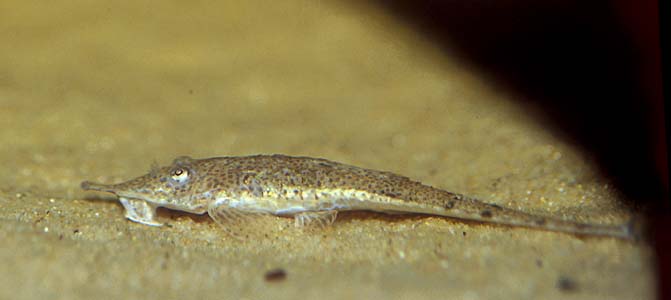
Hemiodontichthys acipenserinus 俯视近菱形,细长吻端膨大,习惯半埋在砂中伪装。新进口时可能因缺氧而虚弱,适应初期风险较高;稳定适应后,在合适条件下并不特别难养。
分布与栖息地
分布涉及圭亚那、法属圭亚那、秘鲁、玻利维亚和巴西。只见于砂底表面或砂中,是否普遍来自流水环境仍带推测。
饲养环境
小群可用约 75 × 30 cm 的缸底面积。柔软细砂不可少,让鱼能部分埋身;另一重点是充分溶氧,最好有一定水流。落叶、枝条及少量圆石可增加遮蔽。
对差水质敏感,应规律换水并保持稳定。它活动不多不代表能忍受缺氧,进口后的实际体况和进食需密切观察。
食性与喂食
杂食但野外主要吃水生无脊椎动物。提供红虫、水蚤、碎蚯蚓等活饵或冷冻饵,搭配沉底粮,偶尔给黄瓜或西葫芦。不能让快速抢食的伙伴把食物吃光。
习性与混养
胆小退缩,很容易在抢食中落后。可选温和小型伙伴,繁殖时以专缸或少量陪游鱼较合适。同种相处较友善,可以小群饲养。
雌雄区分
成熟雄鱼口部明显增大,繁殖状态时更突出,雌雄牙齿结构也有差异。
繁殖
已有人工繁殖,但并不常见。可从小群取得配对机会,提供多样食物,每周换约 40%~50% 水调理;雄鱼口部进一步增大是接近繁殖的线索。
夜间产卵的细节尚不清楚,产后雄鱼把卵团携在下唇外部,并用口部动作通水约 10~15 天。可小心隔离雄鱼或移走其他鱼,减少吃苗风险;有的雄鱼会提前丢卵或吃卵,亲性并不一致。
幼鱼孵化后约再过 2~3 天吸收卵黄,开始吃丰年虾无节幼体或微虫。它们对水质变化敏感,也很容易饥饿,需要持续适口食物与细致维护。
补充说明
特别的吻端和俯视体形很有辨识度,头部及胸鳍也缺少明显齿突。下唇携卵不同于把卵含在口腔中的口孵,观察记录应区分。
图片
图片来自 SeriouslyFish,版权归各摄影者所有。
English
Overview
Hemiodontichthys acipenserinus has a diamond-like outline from above and an enlarged snout tip. It partly buries itself in sand for camouflage. Imports may arrive weakened by oxygen deprivation, but established fish are manageable when their needs are met.
Distribution & habitat
Records span Guyana, French Guiana, Peru, Bolivia, and Brazil. It occurs exclusively over or within sand. Flowing-water association is presumed rather than fully established.
Aquarium setup
A small group can use a footprint around 75 × 30 cm. Soft sand is essential for partial burial, together with strong oxygenation and preferably some water movement. Leaves, branches, and a few rounded stones provide additional cover.
Maintain regular water changes and stable quality. Low activity does not indicate tolerance of oxygen shortage, particularly during post-import acclimation.
Diet & feeding
It is omnivorous but feeds mainly on aquatic invertebrates in nature. Offer bloodworms, water fleas, chopped earthworms, and comparable live or frozen foods, supplemented by sinking preparations and occasional cucumber or zucchini. Ensure faster companions do not monopolize meals.
Behaviour & compatibility
Shy and retiring fish are easily outcompeted. Choose small, gentle companions; breeding attempts are best dedicated, perhaps with a small dither group. Conspecifics are generally amicable and can live together.
Sexual dimorphism
Male mouthparts enlarge markedly at maturity and further during reproductive condition. Dentition also differs between sexes.
Breeding
Captive spawning has occurred but is uncommon. A small group improves the chance of obtaining a pair. Condition fish with varied foods and weekly water changes of about 40–50%. Enlarging male mouthparts indicate readiness.
Spawning takes place at night, with details unresolved. The male carries the egg mass externally on his lower lip for approximately 10–15 days, ventilating it through mouth movements. Isolate him carefully or remove companions to protect eventual fry. Some males discard or eat eggs prematurely, so parental performance varies.
Young use yolk for another two or three days after hatching, then take brine shrimp nauplii or microworms. They are highly sensitive to changing water conditions and starvation, requiring continuing suitable food and careful maintenance.
Notes
The expanded snout and distinctive outline aid recognition. External lower-lip carriage should be distinguished from incubation inside the mouth.
来源
ID:hemiodontichthys-acipenserinus · 文件: data/species/hemiodontichthys-acipenserinus.md · 状态: 草稿