Gymnocorymbus bondi · Silver Tetra
概要
| 字段 | 值 |
|---|---|
| 类别 | 鱼 |
| 学名 | Gymnocorymbus bondi |
| 分类 | 脂鲤目 Characiformes › 脂鲤科 Characidae › Gymnocorymbus |
| 水体 | 淡水 |
| 成体体长 | 5 cm |
| 饲养难度 | 入门 |
| 最小水体 | 68 L |
| 最小缸长 | 60 cm |
| 群居方式 | 群游 |
| 外部数据 | seriouslyfish gymnocorymbus-bondi;fishbase 58026 |
| 原产地 | 哥伦比亚和委内瑞拉奥里诺科河流域 |
| 食性 | 杂食 |
| 性情 | 温和 |
| 繁殖方式 | 产卵 |
水质参数
| 参数 | 耐受范围 | 最适范围 | 单位 |
|---|---|---|---|
| 水温 | 22–27 | — | °C |
| pH | 5.5–7.5 | — | — |
| 总硬度 | 5–20 | — | dGH |
概述
Gymnocorymbus bondi 是较容易照料的群居灯鱼,幼鱼活跃、鳍带淡红,成年后颜色逐渐朴素。性情通常温和,却有咬鳍倾向,不能因此与所有长鳍鱼自由混养。
分布与栖息地
原生于哥伦比亚及委内瑞拉的奥里诺科河流域,多见小支流与溪流。
饲养环境
偏胆怯,密植水草、深色底床和浮水植物遮蔽能使它更安定。群体数量要足够,不能只靠更多装饰弥补单养或过小群体造成的退缩。
食性与喂食
杂食且容易接受饲料,干粮、活饵和冷冻饵都可搭配。菜单中加入螺旋藻薄片或焯过的菠菜等植物性食物,否则更可能去啃软叶水草。
习性与混养
至少六至八尾更合适,太少时容易胆怯退缩。可搭配体型相近的温和灯鱼、小型底栖鲶鱼和适当中型温和慈鲷,避开孔雀鱼、斗鱼或神仙鱼等长鳍伙伴。幼鱼活跃不等于好斗,但抢动和咬鳍仍需留意。
雌雄区分
成年雄鱼通常略小、体形更修长,雌鱼较饱满。
繁殖
较易繁殖,保苗可用独立昏暗缸,细叶植物或产卵拖把供黏性卵附着,也可用隔卵网保护卵不被亲鱼吃。以活饵、冷冻饵充分调理,可群体繁殖,也可把雌雄分开调理后选饱满雌鱼与展色雄鱼成对。
亲鱼状态合适时可能次晨产卵,看到卵便及时移出成鱼。约十八至三十六小时孵化,再过数日起游。初期喂草履虫等微小饵料,长大后转微虫及丰年虾无节幼体。卵和早期幼鱼怕强光,繁殖缸应维持昏暗。
图片
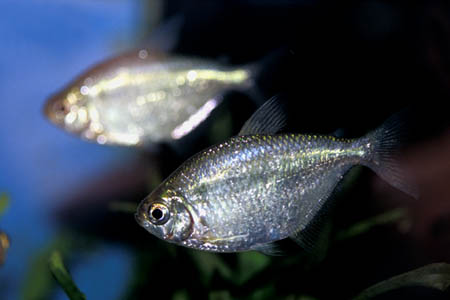
图片来自 SeriouslyFish,版权归各摄影者所有。
English
Overview
A hardy social tetra, Gymnocorymbus bondi has active juveniles with reddish fins that become plainer as they mature. Its generally peaceful nature comes with a reputation for fin nipping, so long-finned companions are unsuitable.
Distribution & habitat
It occurs in small tributaries and streams of the Orinoco basin in Colombia and Venezuela.
Aquarium setup
Dense planting, dark substrate, and floating cover help this shy fish settle. Adequate group size remains important; additional décor alone cannot compensate for isolation or a very small group.
Diet & feeding
An adaptable omnivore, it accepts prepared, live, and frozen foods. Include vegetable foods such as spirulina flakes or blanched spinach; otherwise soft-leaved aquarium plants are more likely to be nibbled.
Behaviour & compatibility
Keep at least six to eight; smaller groups may become withdrawn. Similar-sized peaceful tetras, small catfish, and suitable mild cichlids are possible companions. Avoid long-finned guppies, bettas, and angelfish. Juvenile activity is not aggression, but nipping still matters.
Sexual dimorphism
Mature males tend to be slightly smaller and slimmer than females.
Breeding
Breeding is relatively easy in a separate dim aquarium. Fine-leaved plants or spawning mops receive adhesive eggs; mesh can also protect them from adults. Condition fish with live and frozen foods. Either a group or a well-conditioned pair can be used, with sexes conditioned separately when selecting a pair.
Ready fish may spawn the following morning. Remove adults as soon as eggs appear. Hatching takes roughly 18–36 hours, followed by free swimming several days later. Start with infusoria-sized food, then introduce microworms and Artemia nauplii. Eggs and young fry are light-sensitive, so keep the setup dim.
来源
- https://www.seriouslyfish.com/species/gymnocorymbus-bondi(抓取于 2026-10-10)
gymnocorymbus-bondi · 文件: data/species/gymnocorymbus-bondi.md · 状态: 草稿