Dario kajal
概要
| 字段 | 值 |
|---|---|
| 类别 | 鱼 |
| 学名 | Dario kajal |
| 分类 | 攀鲈目 Anabantiformes › 变色鱼科 Badidae › Dario |
| 水体 | 淡水 |
| 原产地 | 孟加拉国、印度 |
| 成体体长 | 2 cm |
| 饲养难度 | 中等 |
| 最小水体 | 41 L |
| 最小缸长 | 45 cm |
| 群居方式 | 成对 |
| 外部数据 | seriouslyfish dario-kajal;fishbase 67186 |
| 领地性 | 是 |
水质参数
| 参数 | 耐受范围 | 最适范围 | 单位 |
|---|---|---|---|
| 水温 | 16–24 | — | °C |
| pH | 6.5–7.5 | — | — |
| 总硬度 | 5–10 | — | dGH |
概述
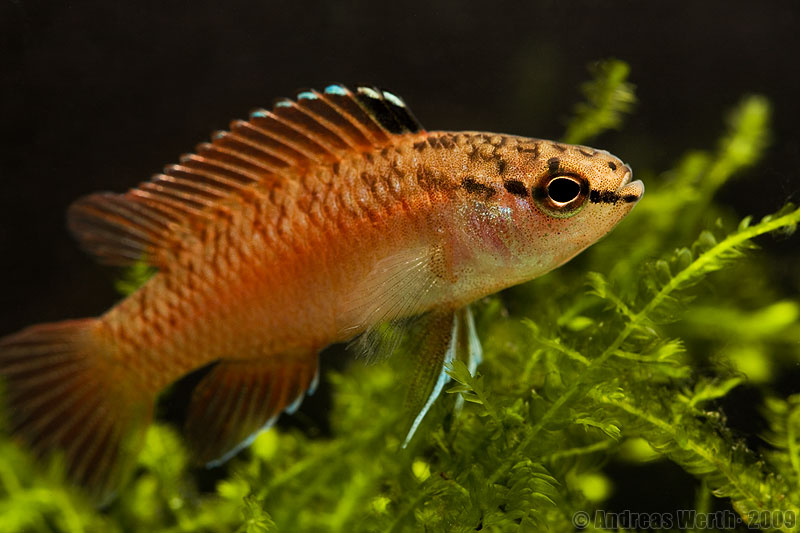
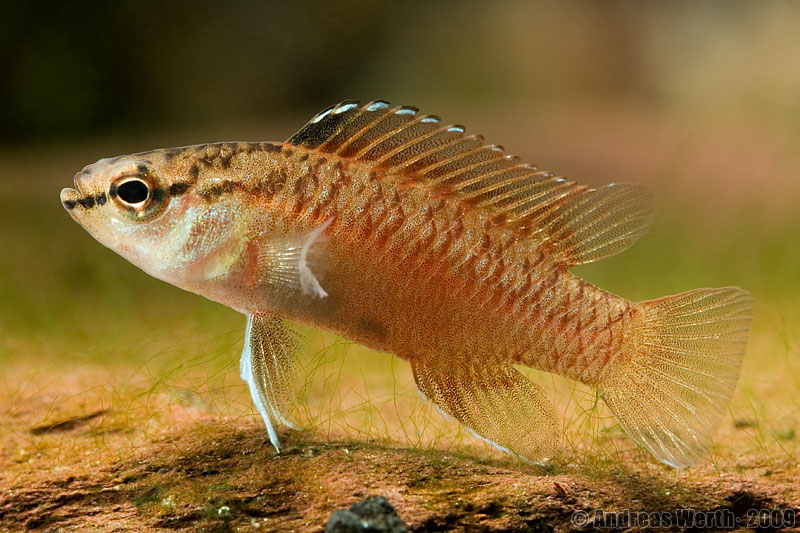
Dario kajal 是小型变色鲈,雄鱼体侧樱桃红、背侧泛绿,上半身条纹成对排列,眼前与眼后的深纹近乎连成直线。它动作慢、较隐蔽,雄鱼之间却有强烈领域争夺,适合遮蔽充分的专养环境。
分布与栖息地
记录涉及印度与孟加拉国,印度明确模式产地为梅加拉亚 Jaintia 丘陵、Jowai 附近海拔约 1320 m 的 Seinphoh 溪,属 Myntdu 河和 Meghna 水系。
采点是浅小水潭,水浑、近静止或流动很弱,没有水生植物。当地季节降雨丰富,水深、流速、浑浊度及水化学可能明显波动,不能把一次采集水况当成全年不变。
饲养环境
细软底床或细砾石配大量遮蔽,可用隐棒花和附生 Microsorum、Anubias、Taxiphyllum;莫丝也提供潜在产卵表面。枝条、浮水植物与落叶有助于分隔空间。
一对或一雄数雌可从 45 cm 长缸开始,多雄需更大空间和独立领域。洞穴、边界及产卵点分散设置。它较适合偏凉的正常适温,过高温度似乎会使颜色减退并更易患病,不宜为了催色而升温。
食性与喂食
此属捕食小型水生甲壳类、蠕虫、昆虫幼体和浮游动物。提供微小活、冻饵,如丰年虾无节幼体、小水蚤、微虫或香蕉虫,留意谨慎进食者是否抢得到。
红虫与颤蚓有肥胖及健康风险,宜排除出菜单。
习性与混养
优先专养,它不是群居鱼。小缸以一对或单雄组合为宜,多雄可能激烈争斗,必须各有领地、遮挡和足够空间。
若混养,应选温和中上层小鱼或适合的微型鳅,避开大型、活跃或猛烈抢食的伙伴,避免慢食个体长期被压制。
雌雄区分
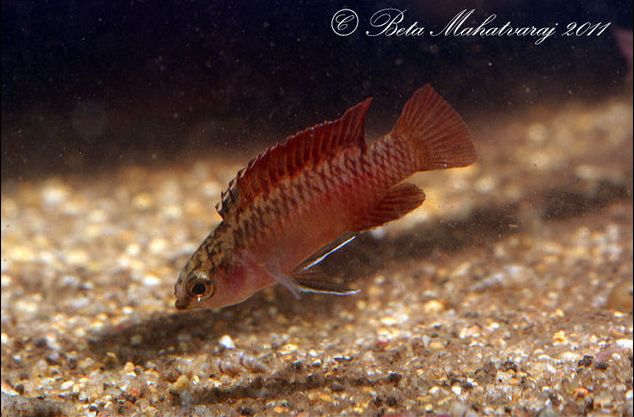
雄鱼颜色较浓,成熟后腹鳍、背鳍和臀鳍延长。雌鱼更小、颜色淡,身体短圆。
繁殖
繁殖可能类似其他同属鱼,但尚不是本种已确认的完整流程。近缘短期配对、在固体表面产卵;雄鱼显色加强并反复邀请雌鱼进入领域,求偶可持续数天,多雄时通常优势雄鱼占主要机会。
近缘产卵动作短暂,卵散布在叶片等固体表面下侧,随后雌鱼被驱离而雄鱼保留领域。为提高鱼苗数量,可将带卵介质移入原缸水,或移走成鱼以减少吃苗。
作为近缘参考,卵约两三天孵化,幼体可能再需约一周耗尽卵黄。开口需纤毛虫级食物,长大后才可吃微虫及丰年虾无节幼体,实际本种进程需观察。
补充说明
旧商品名包括 Jaintia Hills 和 Bangladesh。眼前后深纹相接、雄鱼上半身成对竖纹,以及樱桃红体侧和背侧绿光组成较有用的识别组合。
与 Dario urops 不同,本种没有明显尾柄黑斑和水平眼下纹;与火焰变色龙(Dario dario)相比,背鳍前部有黑斑,体纹也不贯穿全身上下。
图片
图片来自 SeriouslyFish,版权归各摄影者所有。
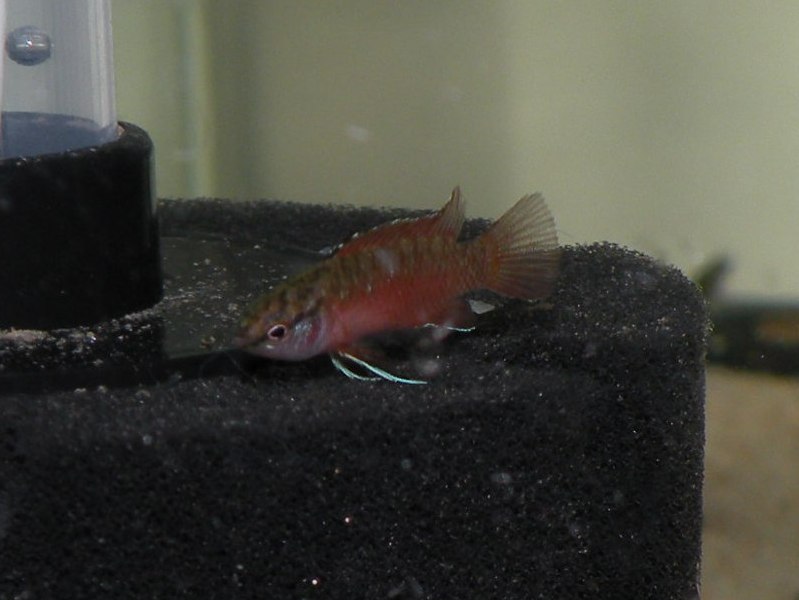
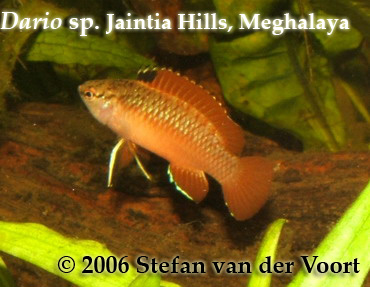
English
Overview
Male Dario kajal shows cherry-red flanks with a greenish upper sheen, paired bars on the upper body, and dark markings before and behind the eye that align almost straight. Its cautious feeding and strong male territoriality favor a well-covered species aquarium.
Distribution & habitat
Records involve India and Bangladesh. The Indian type site is Seinphoh stream near Jowai in Meghalaya's Jaintia Hills at about 1320 m elevation, within the Myntdu and Meghna drainage system.
The collection habitat was a small shallow pool with turbid, nearly stagnant or very slow water and no aquatic plants. Heavy seasonal rainfall can alter depth, flow, turbidity, and water chemistry, so one collection does not describe constant conditions.
Aquarium setup
Use soft substrate or fine gravel with extensive cover. Cryptocoryne, attached Microsorum, Anubias, and Taxiphyllum are suitable, with moss supplying potential spawning surfaces. Branches, floating plants, and leaves help divide the layout.
A pair or one male with several females can start in a 45 cm aquarium. More males require extra space and independent territories. Spread caves, boundaries, and spawning material around the tank. Favor the cooler suitable conditions: excessive warmth apparently reduces color and increases illness susceptibility rather than improving the fish's appearance.
Diet & feeding
The genus consumes small aquatic crustaceans, worms, insect larvae, and zooplankton. Offer minute live or frozen foods, including Artemia nauplii, small Daphnia, microworms, and banana worms. Verify that cautious feeders obtain enough.
Bloodworms and Tubifex are associated with obesity and health problems and are best excluded.
Behaviour & compatibility
Prefer a dedicated aquarium. This is not a shoaling fish. Use a pair or single-male group where room is limited; several males can fight intensely and need separate areas, cover, and ample space.
If companions are included, choose peaceful small upper-water fishes or suitable miniature loaches. Large, active, or aggressive feeders may suppress these deliberate fish over time.
Sexual dimorphism
Males are more colorful and develop elongated pelvic, dorsal, and anal fins. Females are smaller, duller, and shorter-bodied with a rounder profile.
Breeding
Reproduction is expected to resemble congeners but is not a confirmed complete procedure for this species. Relatives form temporary pairs and spawn on solid surfaces. Males intensify their colors and repeatedly invite females into territories over several days. A dominant male usually gains most opportunities when several are present.
In those relatives, brief spawning deposits eggs beneath leaves or other solid surfaces. The female is excluded while the male retains the area. Moving egg-bearing material into spawning-tank water or removing adults can reduce predation and improve fry survival.
As a comparative guide, eggs hatch after about two to three days and yolk absorption can take another week. Initial food must be infusoria-sized, with microworms and Artemia nauplii introduced as the young grow. Actual progress in this species requires observation.
Notes
Earlier labels include Jaintia Hills and Bangladesh. Aligned eye stripes, paired upper-body bars, cherry-red flanks, and a greenish dorsal sheen form a useful combination of identification features.
Unlike Dario urops, it lacks a conspicuous tail-peduncle blotch and horizontal suborbital stripe. Compared with Dario dario, it has a dark anterior dorsal spot and bars that do not extend across the full body depth.
来源
- https://www.seriouslyfish.com/species/dario-kajal(抓取于 2026-10-10)
dario-kajal · 文件: data/species/dario-kajal.md · 状态: 草稿