穆氏非洲攀鲈 · Ocellated Bushfish
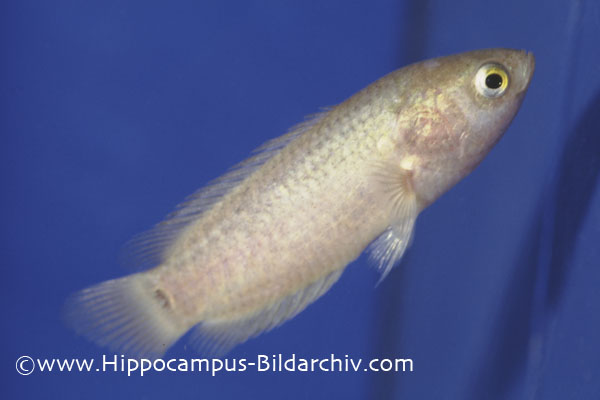
概要
| 字段 | 值 |
|---|---|
| 类别 | 鱼 |
| 学名 | Ctenopoma muriei |
| 别名 | 栉非洲攀鲈、穆氏非洲攀鱸、櫛非洲攀鱸 |
| 分类 | 攀鲈目 Anabantiformes › 攀鲈科 Anabantidae › Ctenopoma |
| 水体 | 淡水 |
| 成体体长 | 7.5 cm |
| 饲养难度 | 中等 |
| 最小水体 | 54 L |
| 最小缸长 | 60 cm |
| 特征 | 吃小鱼: 是;会跳缸: 是 |
| 外部数据 | seriouslyfish ctenopoma-muriei;fishbase 10043 |
| 原产地 | 埃及、苏丹、乍得、尼日尔、尼日利亚、喀麦隆、刚果民主共和国、乌干达、肯尼亚、布隆迪、坦桑尼亚、赞比亚 |
| 食性 | 杂食 |
| 领地性 | 是 |
水质参数
| 参数 | 耐受范围 | 最适范围 | 单位 |
|---|---|---|---|
| 水温 | 24–28 | — | °C |
| pH | 6–7.5 | — | — |
| 总硬度 | 5–20 | — | dGH |
概述
穆氏非洲攀鲈(Ctenopoma muriei)是本属较小型成员,在贸易中不常见。虽然体型不大,能入口的微小鱼仍有被吞食风险;遮蔽丰富的植物缸更能让它在白天安心活动。
分布与栖息地
分布记录主要沿非洲中部展开,从埃及、苏丹,经乍得、尼日尔、尼日利亚、喀麦隆和刚果民主共和国,到乌干达、肯尼亚、布隆迪、坦桑尼亚和赞比亚。
多生活于缓流或静水的池塘、湖泊、潟湖和沼泽,不少栖地溶氧低,常利用水边植被最密集的区域躲避捕食者。
饲养环境
缸长至少约 60 cm、容积约 54 L。密植水草并设置浮水遮蔽,另可加入圆滑石块或沉木根枝。遮挡充足时白天会更活跃。缸盖需贴合严密,避免逃出。
食性与喂食
相比许多同属鱼更偏杂食。喜欢红虫、丰年虾、切碎虾肉、蚯蚓等小型活饵或冷冻饵,多数个体也吃植物材料,可尝试焯软菠菜和去壳豌豆;干粮很少被接受。
习性与混养
会吞食口能容纳的鱼,但主要威胁最小型同伴。可考虑体型相配的非洲脂鲤、小型慈鲷和小型鲶鱼。
雄鱼间有一定领地意识,因成体较小,宽敞且有大量遮蔽时可维持同种群体。不能因它较小就省去草丛和分隔视线的布置。
雌雄区分
成熟雌鱼通常比雄鱼更大。
繁殖
几乎没有可靠的水族箱繁殖记录。依据近缘散卵种,有推测认为雌雄可能缠抱排卵,卵浮入水面植物,亲鱼不照护后代;这尚不是本种已充分确认的繁殖过程。
若尝试繁殖,可参考幼鱼群中自然配对、宽敞浮草缸及单独孵化的方向,但不要把约 48 小时孵化、最初用微小食物再转丰年虾等近缘种经验当作保证结果的固定流程。
补充说明
迷鳃的血管丰富褶皱组织能够帮助鱼利用空气中的氧,这是适应低氧水域的能力,不代表可以忽略缸内正常维护。
图片
图片来自 SeriouslyFish,版权归各摄影者所有。
English
Overview
Small for its genus and rarely traded, Ctenopoma muriei still poses a risk to fishes tiny enough to swallow. Dense vegetation makes it more confident and encourages activity during daylight.
Distribution & habitat
Records run broadly through central Africa, from Egypt and Sudan through Chad, Niger, Nigeria, Cameroon, and the Democratic Republic of the Congo to Uganda, Kenya, Burundi, Tanzania, and Zambia.
It inhabits slow or still pools, lakes, lagoons, and swamps, many with low oxygen levels. Thick marginal vegetation offers protection from predators.
Aquarium setup
Provide at least about 60 cm of tank length and 54 L. Dense planting and floating cover are useful, supplemented by smooth stones or branches. Better cover promotes daytime activity. Secure the lid against escape.
Diet & feeding
More omnivorous than many relatives, it enjoys small live or frozen bloodworms, Artemia, chopped shrimp, and earthworms. Most fish also take plant material; softened spinach and shelled peas are worth offering. Dry preparations are seldom accepted.
Behaviour & compatibility
Anything small enough to fit in its mouth may be eaten, although its size limits this risk to very small companions. Suitably sized African characins, dwarf cichlids, and small catfishes can be considered.
Males show some territoriality. A group is possible where space and ample cover allow individuals to separate. Small adult size is not a reason to omit planted retreats or visual barriers.
Sexual dimorphism
Mature females generally become larger than males.
Breeding
Reliable aquarium breeding records are almost absent. A strategy involving embraces, floating eggs, and no parental care has been inferred from related egg-scattering species, rather than firmly established for this fish.
A juvenile group forming pairs, a roomy planted spawning tank, and separate egg incubation are possible starting points for an attempt. Proposed timings around 48 hours and a progression from microscopic food to Artemia should be treated as related-species guidance rather than a verified procedure.
Notes
Vascular folds in the labyrinth organ permit use of atmospheric oxygen. This adaptation to oxygen-poor habitats does not remove the need for normal aquarium maintenance.
来源
- https://www.seriouslyfish.com/species/ctenopoma-muriei(抓取于 2026-10-10)
ctenopoma-muriei · 文件: data/species/ctenopoma-muriei.md · 状态: 草稿