Betta siamorientalis
概要
| 字段 | 值 |
|---|---|
| 类别 | 鱼 |
| 学名 | Betta siamorientalis |
| 分类 | 攀鲈目 Anabantiformes › 丝足鲈科 Osphronemidae › Betta |
| 水体 | 淡水 |
| 原产地 | 柬埔寨、泰国、越南 |
| 成体体长 | 3.3 cm |
| 饲养难度 | 中等 |
| 最小水体 | 41 L |
| 最小缸长 | 45 cm |
| 群居方式 | 成对 |
| 水流偏好 | 低 |
| 外部数据 | seriouslyfish betta-siamorientalis;fishbase 66987 |
| 繁殖方式 | 吐泡筑巢 |
| 特征 | 会跳缸: 是 |
水质参数
| 参数 | 耐受范围 | 最适范围 | 单位 |
|---|---|---|---|
| 水温 | 22–28 | — | °C |
| pH | 5.5–7.5 | — | — |
| 总硬度 | 1–12 | — | dGH |
概述
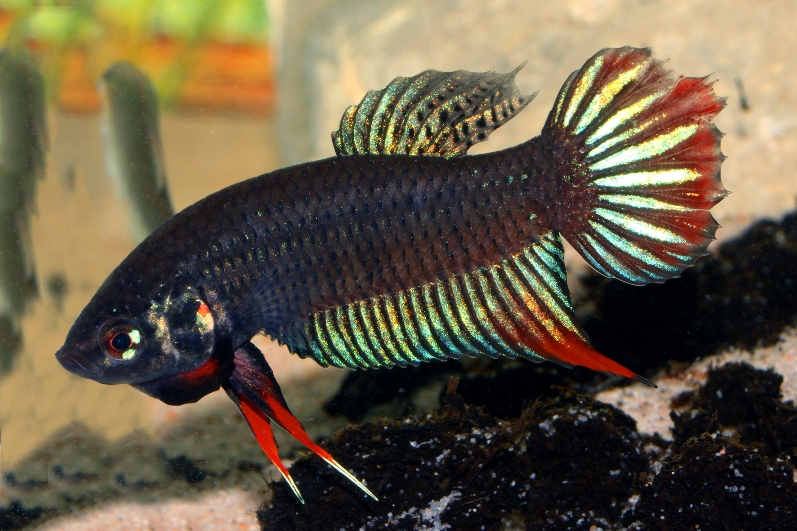
Betta siamorientalis 是泰国东部及邻近地区的小型泡巢斗鱼。它曾被视为 Betta imbellis 的黑色型,后被确认为独立物种。深褐至黑色的身体、黑鳃盖上两条通常偏红的纵纹,是常见识别线索。
分布与栖息地
已知分布包括泰国东部北柳、沙缴、巴真和春武里,以及柬埔寨西部班迭棉吉,越南也有地点尚不具体的记录。生活在静水或缓流水域,常利用沼泽、淹水田地、稻田及池塘沟渠的密植岸缘,并在植物间筑巢。
饲养环境
一对至少约 45 × 30 cm 底面积。密植、弱光及水面遮蔽很重要,可加入沉木根枝、陶罐或短管,形成多处独立藏身位。干叶提供额外掩护,也能培育仔鱼可利用的微生物;不必使用天然泥炭。
过滤轻柔即可,气动海绵适用。盖好缸,水不要加满,留出温暖湿润空气层供迷鳃呼吸,同时防止跳出。
食性与喂食
野外可能以昆虫及其他小型无脊椎动物为主。人工饲养通常可接受经过识别的干粮,仍宜轮换水蚤、丰年虾、红虫等小型活饵或冻饵。刚孵化蟋蟀或果蝇也可用,投喂前先让昆虫吃鱼粮或植物性食物。避免因频繁喂肉饵而过胖。
习性与混养
不适合普通热闹混养缸,单种饲养或极温和的伙伴更合适。较大、行动强势的鱼可能吓住它或抢走食物。遮蔽充足、视线被打断时,可能容纳多雄,但不能保证任意缸都兼容;繁殖宜单独成对安排。
雌雄区分
雄鱼颜色较鲜艳,鳍条也更长。临产雌鱼体色变淡,体侧出现深色条带。
繁殖
雄鱼在容器、宽叶下或水面细叶植物间筑泡巢,巢完成前通常不让雌鱼靠近。繁殖缸严密加盖,以维持仔鱼迷鳃发育所需的温暖湿润空气。
亲鱼在巢下拥抱产卵,雄鱼把卵放入巢,雌鱼也会拾回散落的卵。产后由雄鱼照顾巢,成鱼通常可留原缸。约 24–48 小时孵化,再留巢 3–4 天吸收卵黄;雄鱼捡回落仔,受到威胁时还可能转移整个巢。
自由游动后雄鱼逐渐停止看护,成鱼通常不吃后代。最初数天应提供草履虫等微小食物,随后转微虫和丰年虾无节幼体。每日 2–3 次少量多样投喂,配合规律小换水,避免丰年虾过量或突然大换水。
补充说明
鳃盖条纹在不同种群中也可能偏淡红、绿银、银色或不明显,不能只看红色就认成泰国斗鱼(Betta splendens)。尾鳍外侧的红色弯月带、细黑边及没有深色横带等特征应一起核对。
图片
图片来自 SeriouslyFish,版权归各摄影者所有。
English
Overview
Betta siamorientalis is a small bubble-nesting fish from eastern Thailand and neighboring areas. Formerly treated as a dark form of Betta imbellis, it was subsequently recognized as distinct. A dark brown or black body and two usually reddish bars on the black gill cover are useful clues.
Distribution & habitat
Records include Chachoengsao, Sa Kaeo, Prachin Buri, and Chon Buri in Thailand, Banteay Meanchey in western Cambodia, and an unspecified Vietnamese locality. It occupies still or slow water in marshes, flooded fields, rice paddies, and densely vegetated pond or channel margins, using plants for shelter and nesting.
Aquarium setup
A pair needs a footprint of about 45 × 30 cm. Dense planting, subdued light, and surface cover are valuable. Wood, roots, pots, and pipes provide separate retreats. Dried leaves add cover and support microorganisms useful to fry; natural peat is unnecessary.
Use gentle circulation, for example an air-driven sponge filter. A secure cover prevents jumping, while an unfilled space above the water retains humid air for breathing.
Diet & feeding
Small insects and other invertebrates are probable natural foods. Captive fish usually learn to accept dry preparations, supplemented regularly with small live or frozen Daphnia, brine shrimp, and bloodworms. Newly hatched crickets or fruit flies are options after being fed fish food or plant matter. Avoid excessive portions and obesity.
Behaviour & compatibility
A busy general community is unsuitable. Maintain it alone or with exceptionally peaceful companions; larger, vigorous fish can intimidate it and compete for food. Multiple males may coexist when cover breaks sightlines extensively, but this is conditional rather than guaranteed. Separate pairs are preferable for breeding.
Sexual dimorphism
Males are brighter and longer-finned. Females pale and develop dark flank bars near spawning.
Breeding
The male constructs a bubble nest in a container, beneath a broad leaf, or among fine surface plants, usually excluding the female until completion. A tight cover maintains the warm humid air required by developing fry.
Spawning embraces occur below the nest. The male installs eggs while the female helps recover fallen ones. He then assumes nest care; adults can usually remain. Eggs hatch after about 24–48 hours, and larvae stay another three to four days while absorbing yolk. The male retrieves falling young and may relocate a threatened nest.
Care declines after free swimming, and adults generally leave offspring uneaten. Begin with microscopic foods such as Paramecium, then introduce microworms and brine shrimp nauplii. Provide small varied meals two or three times daily and regular modest water changes.
Notes
Gill-cover bars vary between populations and may be pale red, greenish-silver, silver, or inconspicuous. Red bars alone do not establish Betta splendens identity. Check the red crescent and thin black tail margin together with the absence of dark transverse tail bars.
来源
- https://www.seriouslyfish.com/species/betta-siamorientalis(抓取于 2026-10-10)
betta-siamorientalis · 文件: data/species/betta-siamorientalis.md · 状态: 草稿