Acrochordonichthys septentrionalis · Mae Klong Chameleon Catfish
概要
| 字段 | 值 |
|---|---|
| 类别 | 鱼 |
| 学名 | Acrochordonichthys septentrionalis |
| 分类 | 鲶形目 Siluriformes › 粒鲶科 Akysidae › Acrochordonichthys |
| 水体 | 淡水 |
| 原产地 | 泰国西部美功河流域 |
| 成体体长 | 10 cm |
| 饲养难度 | 中等 |
| 最小水体 | 81 L |
| 最小缸长 | 90 cm |
| 水流偏好 | 高 |
| 特征 | 吃小鱼: 是 |
| 外部数据 | seriouslyfish acrochordonichthys-septentrionalis;fishbase 58359 |
水质参数
| 参数 | 耐受范围 | 最适范围 | 单位 |
|---|---|---|---|
| 水温 | 17.5–24 | — | °C |
| pH | 5–7 | — | — |
| 总硬度 | 0–10 | — | dGH |
概述
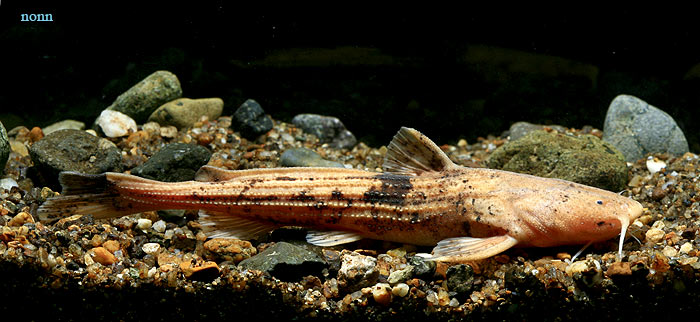
Acrochordonichthys septentrionalis 以近奶油色身体、少量小褐斑较易识别,但本属体色会变化。小鱼可能成为猎物,受惊分泌物也会危及同缸鱼,混养不能只考虑性情是否温和。
分布与栖息地
模式产地在泰国西部北碧府桂诺河,可能为美功河水系特有。马来西亚半岛的相关记录存在疑问,不宜据此扩展确定分布。近亲常在急流林溪的石木下躲藏,可作布景参考。
饲养环境
以成熟、稳定、洁净且高溶氧的水体为基础,大容量过滤配造流或增氧均可。底砂可用细砂、细砾或混合材料,再放水磨石、老沉木和树根,形成遮蔽;落叶与强健附生水草可选用。
每周换水 30–50%,不因鱼活动少就忽略缸体大小和水化学稳定性。
食性与喂食
可按本属伏击捕食习性投喂小型活饵或冷冻饵,如红虫、水蚯蚓与小蚯蚓,无需活鱼。因动作慢、不善抢食,可能要定点送到嘴前,避免混养伙伴先吃光。
习性与混养
不推荐一般混养。除吞食小鱼外,本属受压时能排出乳白分泌物,在水族箱内可迅速危及其他鱼。较大缸中若尝试搭配,应选足够大、不好斗且适应凉爽流水的种类,底栖伙伴也不宜强守地盘。
对体形大到无法吞下的同种一般不具攻击性,可条件式多尾饲养,但并非真正需要成群的鱼。
雌雄区分
雄鱼生殖乳突在腹鳍基部后方,顶端孔有皮瓣,肛门紧接其前;雌鱼肛门更后,乳突为较短管状、开口无肉质瓣。
繁殖
尚无水族箱繁殖记录。
补充说明
除了浅色斑纹,背鳍与脂鳍间距较短也是鉴别线索。体色变化可能与蜕皮有关;分泌物的化学性质尚未充分研究,不能把缺少机制解释当作没有风险。
图片
图片来自 SeriouslyFish,版权归各摄影者所有。
English
Overview
A mostly cream body with a few small brown spots helps identify Acrochordonichthys septentrionalis, though coloration is variable. Predation and the genus’s stress-related chemical discharge make compatibility more complicated than temperament alone.
Distribution & habitat
Described from the Khwae Noi in western Thailand’s Kanchanaburi Province, it may be confined to the Mae Klong drainage. Malaysian records are questionable. Shelter beneath rocks and wood in fast forest streams is documented for a relative and offers context for aquarium design.
Aquarium setup
Use a mature system with clean, stable, oxygen-rich water, achieved through substantial filtration and suitable circulation or aeration. Sand, fine gravel, worn stones, seasoned wood, and roots create a sheltered layout. Leaves and hardy attached plants are optional additions.
Replace 30–50% of the water weekly. Limited activity does not remove the need for adequate volume and chemical stability.
Diet & feeding
Feeding can follow the genus’s ambush-predator habits using small live or frozen bloodworms, Tubifex, and earthworms rather than live fish. Slow responses and weak competition may require targeted feeding directly in front of the fish.
Behaviour & compatibility
Ordinary community keeping is inadvisable. Besides eating small fishes, stressed members of the genus can release a milky secretion that rapidly endangers others in aquarium water. Larger installations offer the only reasonable setting for sufficiently large, peaceful, cool-water companions, including nonterritorial bottom dwellers.
Conspecifics too large to swallow are generally tolerated, so groups are possible without implying a true social requirement.
Sexual dimorphism
Males have a papilla behind the pelvic base with a covered tip opening and the anus immediately in front. Females have a more posterior anus and a short tubular papilla lacking the fleshy cover.
Breeding
Aquarium breeding is unrecorded.
Notes
A relatively short dorsal-to-adipose gap complements the pale pattern as an identification clue. Color variation may relate to skin shedding. The discharge is incompletely studied, but uncertainty about its chemistry does not remove the practical risk.
来源
ID:acrochordonichthys-septentrionalis · 文件: data/species/acrochordonichthys-septentrionalis.md · 状态: 草稿