Acrochordonichthys gyrinus · Falcate Chameleon Catfish
概要
| 字段 | 值 |
|---|---|
| 类别 | 鱼 |
| 学名 | Acrochordonichthys gyrinus |
| 分类 | 鲶形目 Siluriformes › 粒鲶科 Akysidae › Acrochordonichthys |
| 水体 | 淡水 |
| 原产地 | 泰国北部彭世洛府永河水系 |
| 成体体长 | 8 cm |
| 饲养难度 | 中等 |
| 最小水体 | 68 L |
| 最小缸长 | 75 cm |
| 水流偏好 | 高 |
| 特征 | 吃小鱼: 是 |
| 外部数据 | seriouslyfish acrochordonichthys-gyrinus;fishbase 61549 |
水质参数
| 参数 | 耐受范围 | 最适范围 | 单位 |
|---|---|---|---|
| 水温 | 17.5–24 | — | °C |
| pH | 5–7 | — | — |
| 总硬度 | 0–10 | — | dGH |
概述
Acrochordonichthys gyrinus 活动不多,却不能放进水质容易波动的小容器。它会吞食小鱼,而本属受惊后排出的乳白分泌物还可能危及其他鱼,通常不宜作为普通混养选择。
分布与栖息地
仅知来自泰国北部彭世洛府永河,该河属于湄南河上游水系。近亲多在清澈急流林溪的沉木或石下活动,但这只能作为理解本种环境需求的参考。
饲养环境
关键是清洁、高溶氧和稳定水质。可用大容量过滤、造流或气石实现,不必拘泥某一种设备;出水可形成定向水流。底部用砂、细砾和不同大小水磨石,老沉木与树根增加遮蔽,可配少量落叶及强健附生水草。
只在成熟缸饲养,每周换水 30–50%,避免小水体常见的快速波动。
食性与喂食
本属是伏击型捕食鱼,人工不必喂活鱼,可尝试红虫、水蚯蚓、小蚯蚓等活饵或冷冻饵。它们动作慢、抢食能力差,可能要把食物送到面前才会反应;混养时尤其要确认它实际吃到。
习性与混养
小型伙伴会被捕食,且受惊时分泌物能在封闭水体中迅速杀死其他鱼。若仍考虑混养,只宜在较大空间选足够大、温和、适应偏凉流水的鱼;其他底栖鱼还应不具强领地性。
它并不真正群居,但对大到无法吞下的同种不具明显攻击性,因此可有条件多尾饲养。
雌雄区分
雄鱼肛门紧接生殖乳突前方,乳突位于腹鳍基部后,顶端开口有皮瓣覆盖。雌鱼肛门更靠后,乳突较短,顶端开口没有肉质皮瓣。
繁殖
尚无人工繁殖记录,自然繁殖行为也未明确。
补充说明
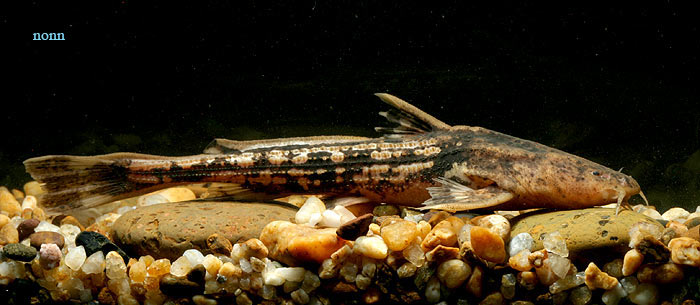
胸鳍后缘向内凹,是区分其近似类群的重要特征。体色在同一地点个体间也能变化,可能与蜕皮后颜色变浅有关,不能只按深浅认种。乳白分泌物被认为与防御有关,详细机制尚未明确。
图片
图片来自 SeriouslyFish,版权归各摄影者所有。
English
Overview
Low activity does not make Acrochordonichthys gyrinus suitable for an unstable tiny container. Small fish can be swallowed, and stress-related secretions known in the genus create a separate chemical risk to companions. It is a poor choice for a routine community.
Distribution & habitat
Known records are confined to the Yom in Phitsanulok, northern Thailand, within the upper Chao Phraya basin. Related species use clear, fast forest streams and shelter beneath wood or rocks; that account provides context rather than a detailed habitat survey of this species.
Aquarium setup
Prioritize clean, oxygen-rich, stable water. Substantial filtration, circulation, or aeration can provide it; no single equipment design is compulsory. A directional current is one option. Combine sand or fine gravel with worn stones, seasoned wood, and roots, adding optional leaves and hardy attached plants.
Introduce fish only into a mature system and change 30–50% weekly. Stability matters more than the fish’s limited activity might suggest.
Diet & feeding
The genus comprises ambush predators, but live fish are unnecessary in captivity. Offer bloodworms, Tubifex, small earthworms, or comparable live and frozen foods. These sedentary fish may need food placed directly in front of them, particularly when competitors would otherwise take it first.
Behaviour & compatibility
Small companions face predation, while stress-induced discharge can rapidly kill fish in confined water. Any attempted combination needs substantial space and sufficiently large, peaceful fishes suited to cooler flowing conditions. Bottom dwellers should also lack strong territorial tendencies.
It is not truly gregarious, but tolerates conspecifics too large to swallow, allowing carefully matched groups.
Sexual dimorphism
In males the anus lies just ahead of a papilla behind the pelvic-fin base, whose tip opening is covered by a skin flap. Females have a more posterior anus and a short papilla with an uncovered opening.
Breeding
Captive reproduction is unrecorded and natural breeding behavior remains poorly understood.
Notes
A concave trailing pectoral-fin edge is a useful identification feature. Color varies even within one locality, possibly because periodic skin shedding leaves fish paler. The milky discharge appears defensive, although its mechanism is incompletely understood.
来源
- https://www.seriouslyfish.com/species/acrochordonichthys-gyrinus(抓取于 2026-10-10)
acrochordonichthys-gyrinus · 文件: data/species/acrochordonichthys-gyrinus.md · 状态: 草稿